


Popular articles


The 8 Wonders of the World Aren’t What Most Travelers Think
 DestinationsThe 8 Wonders of the World Aren’t What Most Travelers Think
DestinationsThe 8 Wonders of the World Aren’t What Most Travelers Think
The 8 Wonders of the World Aren’t What Most Travelers Think
Article content

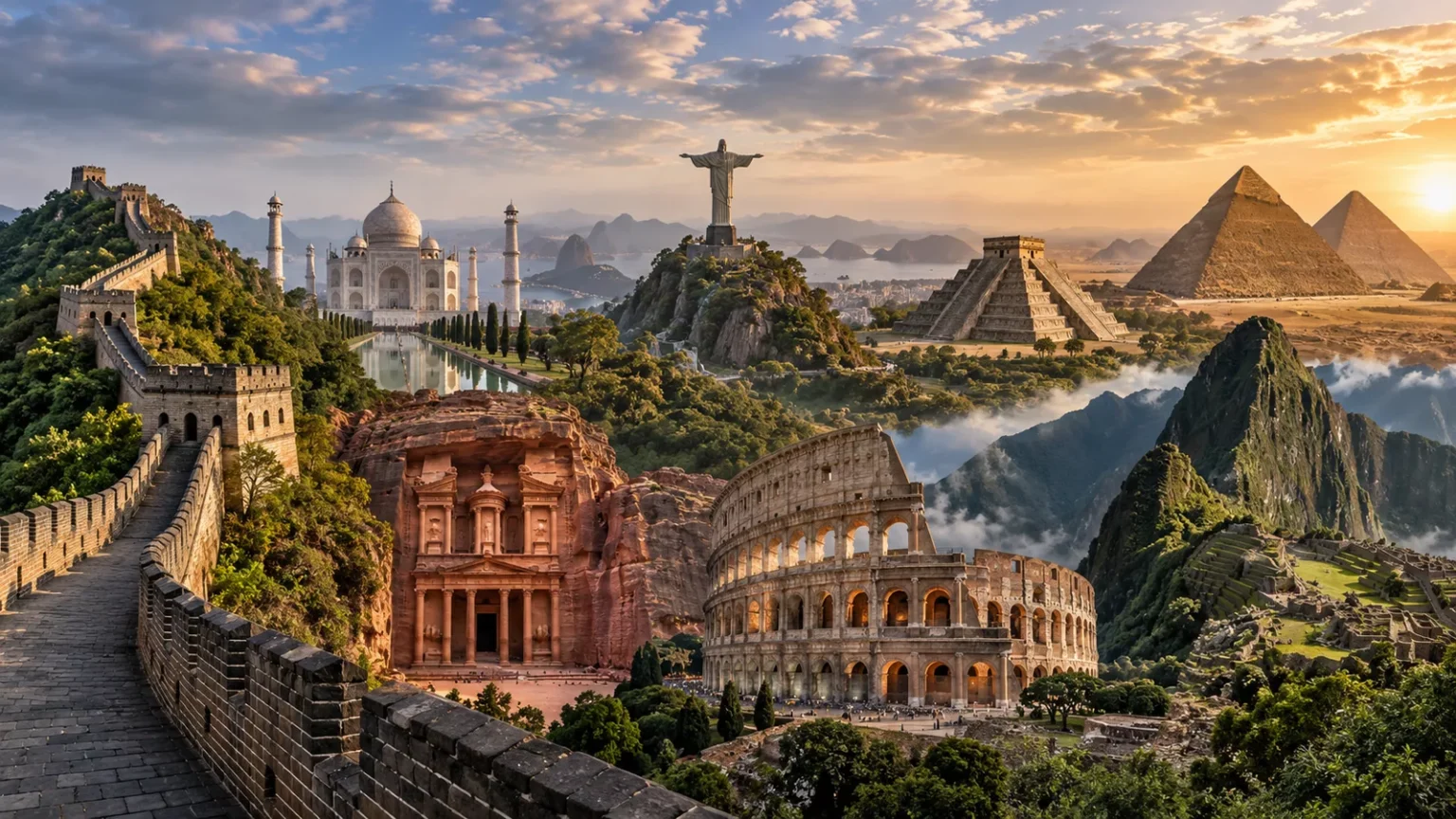
Search for the 8 wonders of the world and one problem appears almost immediately: there is no universally recognized official list containing exactly eight wonders. Instead, several famous lists have become tangled together over centuries. There are the Seven Wonders of the Ancient World, the New 7 Wonders of the World selected in a global campaign in 2007, and the Great Pyramid of Giza, which occupies an unusual place between the two.
That confusion actually makes the story far more interesting than a simple checklist. The Great Pyramid is the only surviving member of the ancient list, while the seven places selected in 2007 stretch from the mountains of Peru to the deserts of Jordan. Put the pyramid beside those New Seven Wonders and travelers get the eight extraordinary places commonly associated with the modern idea of the 8 wonders of the world.
But these monuments are surrounded by myths almost as famous as the structures themselves. The Great Wall cannot casually be spotted from the Moon with the naked eye. Machu Picchu was not simply a “lost city” waiting for a foreign explorer to discover it. Petra is far more than the Treasury facade seen in photographs, while Chichén Itzá was not built in a single period by one homogeneous society.
Understanding the eight wonders of the world therefore means looking beyond the postcard.
What Are the 8 Wonders of the World?
There is no single historical or international authority that recognizes an official list called the 8 wonders of the world. The most useful modern interpretation combines the seven winners of the 2007 New7Wonders campaign with the Great Pyramid of Giza, which received honorary status during that project because it is the sole surviving Wonder of the Ancient World. More than 100 million votes were cast in the campaign that selected the New Seven.
That gives travelers the following eight places.
| Wonder | Country | Approximate era | What makes it exceptional |
|---|---|---|---|
| Great Pyramid of Giza | Egypt | c. 26th century BC | Only surviving Wonder of the Ancient World |
| Great Wall of China | China | Built and rebuilt across many centuries | Vast network of defensive walls and fortifications |
| Petra | Jordan | Flourished especially from the late 1st century BC | Nabataean city carved and built into sandstone |
| Colosseum | Italy | 1st century AD | Monumental Roman amphitheater |
| Chichén Itzá | Mexico | Major development across several centuries | Major Maya and Maya-Toltec ceremonial center |
| Machu Picchu | Peru | 15th century | Inca complex high in the Andes |
| Taj Mahal | India | 17th century | Mughal mausoleum built for Mumtaz Mahal |
| Christ the Redeemer | Brazil | 20th century | Monumental Art Deco statue overlooking Rio de Janeiro |
The important distinction is that these eight were never elected together as one official group. Seven belong to the 2007 selection, while the Great Pyramid belongs to the ancient tradition and was separately honored by the New7Wonders project.
That distinction explains why searches for the name of 7 wonders of the world, the list of New Seven Wonders of the World and the eight wonders of the world can produce apparently conflicting answers.
Why Were There Seven Wonders in the First Place?
The idea of listing wonders is much older than modern tourism. Ancient Greek and Hellenistic writers described remarkable structures around the Mediterranean and Near East, eventually creating the tradition now known as the Seven Wonders of the Ancient World. These were not seven buildings selected from every civilization on Earth – they reflected the geographical world familiar to the writers who created and transmitted the lists.
The traditional list included the Great Pyramid of Giza, Hanging Gardens of Babylon, Statue of Zeus at Olympia, Temple of Artemis at Ephesus, Mausoleum at Halicarnassus, Colossus of Rhodes and Lighthouse of Alexandria. Wars, earthquakes, fires, dismantling and the passage of time eventually claimed six of them. Only the Great Pyramid survives substantially intact today.
Even the ancient list contains mysteries. The Hanging Gardens of Babylon are particularly controversial because their exact location and archaeological identification remain unresolved. That uncertainty is an important reminder that the famous seven were never a modern inventory supported by photographs, standardized judging rules and global archaeological evidence.
Why Does the Great Pyramid Turn Seven Wonders Into Eight?
The Great Pyramid creates the apparent eighth wonder because it belongs to a different list. When the New Seven Wonders were announced in Lisbon on July 7, 2007, the pyramid was not simply placed in competition with newer monuments. It was honored separately as the surviving member of the ancient seven.
The distinction makes historical sense. The Great Pyramid of Khufu predates every winner on the New Seven Wonders list by an enormous margin and remains the sole physical bridge to the original tradition. UNESCO identifies it as the only surviving Wonder of the Ancient World and notes its place within the wider pyramid fields extending from Giza to Dahshur.
So when someone asks for the 8 wonders of the world, the most useful answer is not to pretend that a formal eighth wonder exists. It is to explain that seven modern winners plus the surviving ancient wonder produce the group of eight landmarks people often expect to see.
1. Great Pyramid of Giza – The Wonder That Refused to Disappear
The Great Pyramid is different from every other place on this list because it actually belonged to the ancient Seven Wonders. Built for Pharaoh Khufu during Egypt’s Old Kingdom, it forms part of the extraordinary archaeological landscape at Giza. The wider UNESCO property also encompasses other pyramids, temples, settlements, the Great Sphinx and thousands of rock-cut tombs.
Its survival is astonishing when placed on a human timeline. Civilizations rose and disappeared while the pyramid remained on the Giza Plateau. For more than 3,800 years it was the tallest human-made structure on Earth, giving the monument a record that lasted far longer than the history of many modern states.
The biggest Great Pyramid myth
One persistent idea claims that extraterrestrials must have helped build the pyramids because ancient Egyptians supposedly lacked the necessary engineering abilities. There is no credible archaeological basis for that claim. Evidence associated with ancient Egyptian quarrying, labor organization, workers and construction practices places the pyramids firmly within Egyptian society and engineering.
The more interesting story is not that the builders possessed mysterious technology. It is that human beings more than four millennia ago could organize materials, labor, surveying and construction on such an extraordinary scale.
What travelers often miss at Giza
The pyramid is not an isolated triangle in the desert. The Giza landscape includes three principal pyramids, smaller pyramids, tombs, temples and the Great Sphinx, while the broader UNESCO property stretches far beyond the most familiar viewpoint.
Anyone fascinated by monumental architecture can extend that theme beyond Egypt. The palaces of Marrakech offer a very different look at how architecture can preserve political power, craftsmanship and cultural history across generations.
2. Great Wall of China – Not One Wall and Not Visible From the Moon
The Great Wall is better understood as a vast defensive system than as one uninterrupted wall. Different fortifications were constructed, connected, rebuilt and expanded by successive Chinese states and dynasties. UNESCO describes the complete system as extending for more than 20,000 kilometers, with walls, watchtowers, shelters, fortresses, passes and other defensive structures.
Some earlier fortifications were linked during the rule of Qin Shi Huang in the third century BC, but construction continued for many centuries. Much of the monumental masonry most travelers associate with the Great Wall today is connected with later periods, particularly the Ming dynasty.
Can you really see the Great Wall from the Moon?
This is probably the most famous myth attached to any of the eight wonders of the world. The idea sounds plausible because the wall is enormously long, but length is not the same thing as visibility. The structure is relatively narrow and often blends into the surrounding terrain, making the popular Moon claim misleading.
Its genuine scale needs no exaggeration. A defensive landscape stretching across thousands of kilometers and representing construction from different historical periods is remarkable without turning it into an object supposedly visible from deep space.
There is no single Great Wall experience
Travelers should also abandon the idea that visiting “the Great Wall” means visiting one specific attraction. Different sections offer dramatically different experiences, from restored stretches close to Beijing to rougher and more remote remains. Conditions, accessibility and conservation status vary accordingly.
That matters when planning a visit. Choosing a section should depend on mobility, available time, tolerance for crowds and whether the priority is convenient sightseeing, hiking or seeing less-restored fortifications.
3. Petra – The Famous Treasury Is Only the Beginning
Petra is often reduced to a single image: the Treasury appearing dramatically at the end of the narrow Siq. Yet the Treasury is only one monument within a huge archaeological landscape. Petra was a Nabataean caravan city positioned between the Red Sea and Dead Sea and connected trade routes linking Arabia, Egypt and the eastern Mediterranean.
Its importance was not based simply on beautiful rock-cut facades. The Nabataeans developed sophisticated systems of channels, cisterns, reservoirs, tunnels and diversion structures that helped manage scarce and seasonal water in an arid environment. That engineering supported a substantial settlement in a landscape that initially appears hostile to urban life.
Was Petra really a lost city?
Calling Petra a “lost city” makes a good adventure story but oversimplifies its history. The site did decline and became far less prominent than it had been during antiquity, but it was not erased from local knowledge until Europeans suddenly found it. Bedouin communities knew the landscape, and human connections with the area continued.
The more accurate story is one of changing political power, trade networks and settlement patterns. Petra moved from major commercial center to archaeological wonder, but its history did not simply stop and restart when outsiders became interested in it.
What makes Petra worth more than a day-trip photo
The Monastery, Royal Tombs, High Place of Sacrifice and numerous archaeological remains reveal a city much larger than the familiar Treasury photograph suggests. Petra is half-built and half-carved into rock, and the surrounding mountains, passages and gorges are integral to the experience.
Travelers should therefore allow enough time for walking rather than treating the Treasury as the finish line.
4. The Colosseum – Rome’s Arena Was More Complicated Than the Movies
The Colosseum became one of the New Seven Wonders because few surviving structures embody ancient Rome so immediately. Built in the first century AD, the amphitheater formed part of a city whose monuments, roads, temples and public spaces projected imperial power on an extraordinary scale. Today the Colosseum forms part of the UNESCO-listed historic center of Rome.
Its architecture was designed to move and organize huge numbers of spectators while providing carefully differentiated seating. Beneath the arena, the hypogeum developed into a network of corridors and operational spaces associated with the spectacles above.
Did every gladiator fight end in death?
Popular culture often presents gladiatorial combat as a simple death match in which almost every defeated fighter was killed. Reality was more complicated. Gladiators could represent substantial investments in training and maintenance, and contests did not automatically require the death of one participant.
The Colosseum also hosted more than gladiator fights. Ancient spectacles included animal hunts, executions and other public entertainments, turning the amphitheater into a carefully managed stage for both spectacle and political messaging.
Why the Colosseum is partly ruined
The building did not acquire its present appearance from one catastrophic event. Earthquakes, centuries of changing use and the removal or reuse of materials all contributed to its transformation. What survives is therefore both an ancient monument and evidence of what happened to Rome after antiquity.
A trip centered on Roman history can easily be combined with a broader Italian journey. LitiTravels’ guide to the best coastlines in Italy adds seven scenic destinations for travelers extending a stay beyond Rome.
5. Chichén Itzá – The Maya City Behind the Famous Pyramid
Chichén Itzá is frequently represented by one building, El Castillo, also known as the Temple of Kukulcán. The archaeological site is much larger. It contains the Great Ball Court, Temple of the Warriors, El Caracol observatory and numerous other structures reflecting centuries of cultural and architectural development.
UNESCO describes Chichén Itzá as one of the greatest Maya centers of the Yucatán Peninsula, with a history extending across almost a millennium. Its monuments show Maya traditions alongside influences associated with central Mexico, making the site especially valuable for understanding cultural change rather than imagining the Maya world as static.
The equinox serpent is real – but the story needs context
One of the most famous spectacles at El Castillo occurs around the equinoxes, when sunlight and shadow create triangular forms along the staircase balustrade, visually connecting with the carved serpent head at its base. It is often presented as proof of almost impossibly precise ancient astronomical knowledge.
Maya astronomy was indeed sophisticated, but modern interpretations of individual effects can become more absolute than the surviving evidence allows. The safest way to appreciate Chichén Itzá is to recognize that astronomy, religion, architecture, calendars and political authority were deeply connected without turning every visual effect into a modern astronomical claim.
There is more Maya history beyond Chichén Itzá
The Yucatán’s archaeological landscape extends far beyond its most famous site. Travelers interested in Maya history can also explore the LitiTravels guide to things to do in Costa Maya, which includes Chacchoben and other experiences connected with the region’s culture.
Chichén Itzá may be the name recognized around the world, but it should be the beginning of an interest in Maya civilization rather than the end of it.
6. Machu Picchu – It Was Never Simply a Lost Inca City
Machu Picchu sits more than 2,400 meters above sea level where the Andes approach the Amazon Basin. Built during the 15th century, the site contains roughly 200 structures arranged among terraces, plazas and steep mountain slopes. Its architecture and surrounding landscape are so closely integrated that UNESCO recognizes Machu Picchu for both cultural and natural values.
The site was abandoned during the period in which the Inca Empire collapsed following Spanish conquest. Its precise function remains the subject of research, and some questions about its ceremonial, political and astronomical roles are still unresolved.
Did Hiram Bingham discover Machu Picchu?
The familiar phrase “discovered in 1911” creates the wrong impression. Hiram Bingham helped bring Machu Picchu to widespread international attention, but local people already knew the site existed. Even UNESCO uses more careful wording, stating that the complex was “made known to the outside world” in 1911.
That distinction matters because words such as “discovered” can erase the knowledge of communities living near archaeological places. Machu Picchu was not an empty secret waiting for the first outsider to find it.
Why Machu Picchu feels different from the other wonders
Part of its power comes from the relationship between architecture and terrain. Terraces climb steep slopes, stone structures follow the mountain, and the surrounding sanctuary encompasses a biologically rich transition between the high Andes and upper Amazon basin.
The mountain is not simply a backdrop for the ruins. Landscape and architecture together are part of what makes Machu Picchu exceptional.
7. Taj Mahal – A Love Story With a Much Bigger History
The Taj Mahal is often described as the world’s greatest monument to love. That interpretation comes from its origin: Mughal emperor Shah Jahan commissioned the mausoleum in memory of his wife Mumtaz Mahal. Construction of the principal mausoleum began in the 1630s, while other elements of the complex were completed later.
But describing it only as a romantic gesture hides much of what makes the monument extraordinary. The Taj Mahal belongs to a carefully designed complex of gardens, gateways, subsidiary structures, a mosque and guest house. Its visual power comes from symmetry, proportion, calligraphy, marble, stone inlay and deliberate control of perspective.
Was a black Taj Mahal supposed to stand opposite it?
A persistent legend says Shah Jahan intended to build an identical black-marble mausoleum for himself across the Yamuna River. It is an irresistible story, especially when paired with the white Taj Mahal, but historians do not have convincing evidence that such a complete black counterpart was genuinely planned.
This is exactly the kind of myth that grows around famous monuments. A dramatic story can become so widely repeated that it begins to feel like established history even when the evidence remains weak.
Is the Taj Mahal perfectly symmetrical?
Almost – and the exception is fascinating. The overall complex relies heavily on bilateral symmetry, but Shah Jahan’s own cenotaph disrupts the symmetry inside the mausoleum because it was placed beside Mumtaz Mahal’s central cenotaph.
That tiny break in an overwhelmingly ordered composition is easy to miss. It also shows why seeing the Taj Mahal merely as a white dome means overlooking much of its architectural intelligence.
8. Christ the Redeemer – The Youngest Wonder on the List
Christ the Redeemer is dramatically younger than the other places commonly grouped among the 8 wonders of the world. Standing on Corcovado above Rio de Janeiro, the monument belongs to the 20th century rather than an ancient or medieval civilization. Its position within Rio’s mountain-and-sea landscape has helped turn the statue into one of the most recognizable silhouettes in the world.
The monument is also inseparable from its setting. Corcovado rises within the extraordinary landscape of Rio, and UNESCO documentation for the city’s World Heritage property specifically includes imagery of Christ the Redeemer within the surrounding Tijuca landscape.
Is Christ the Redeemer the world’s largest statue of Jesus?
No. That description is frequently repeated but is no longer accurate, and several later statues of Christ are taller under various measurements. What makes Rio’s monument exceptional is not a world height record.
Its cultural power comes from location and visibility. The outstretched figure above Rio has become inseparable from the visual identity of the city, which explains why physical dimensions alone do not capture its significance.
The viewpoint is part of the wonder
Unlike a monument experienced mainly from ground level, Christ the Redeemer works in two directions. Rio sees the statue from below, while visitors reaching Corcovado look outward across mountains, dense urban areas, Guanabara Bay and the Atlantic coastline.
That relationship between monument and landscape helps explain why an early 20th-century statue could stand beside structures that are hundreds or thousands of years older.
Ancient Seven vs New Seven vs the “Eight Wonders”
The easiest way to understand the confusion is to separate three different ideas. They overlap in popular culture, but historically they are not interchangeable.
| List | What it means | How many survive today? |
|---|---|---|
| Seven Wonders of the Ancient World | Classical list of extraordinary structures known in antiquity | 1 |
| New 7 Wonders of the World | Seven sites chosen through the New7Wonders global campaign and announced in 2007 | 7 |
| “8 Wonders of the World” | Informal modern grouping often interpreted as the New Seven plus the Great Pyramid | 8 places can be discussed, but this is not a separate official list |
You may also be interested in our article: 12 Best Restaurants in Glasgow Worth Building a Food Trip Around in 2026
The phrase 8 wonders of the world therefore works best as a gateway into the history of the lists rather than as the name of another formal competition. There is no need to invent an eighth official winner – the fascinating part is understanding why the number became eight in the first place.
Which of the Original Seven Wonders Can You Still Visit?
Only the Great Pyramid of Giza survives as a substantially standing monument from the traditional Seven Wonders of the Ancient World. The other six disappeared, although archaeological remains, locations and historical evidence associated with several of them can still be studied.
Their disappearance is one reason the modern wonders feel so significant. Travelers can still walk through Petra, stand below the Great Wall, enter the archaeological landscape of Chichén Itzá and see Machu Picchu among the Andean peaks. The ancient list reminds visitors that even the most monumental human creations are not guaranteed to survive forever.
It also changes the meaning of a bucket list. Visiting a wonder is not simply collecting a photograph of a famous landmark – it is encountering a place whose survival depends on conservation, responsible tourism and respect for the communities and landscapes around it.
Can You Visit All 8 Wonders of the World?
Yes, all eight places in this modern interpretation can be visited, although such a journey spans eight countries across five continents and requires significantly more planning than a conventional multi-country vacation. Entry rules, permits, weather, altitude and local transportation differ enormously between the destinations.
The Great Pyramid, Colosseum, Taj Mahal and Christ the Redeemer can fit relatively easily into city-based trips. Petra and the Great Wall require more deliberate day planning, while Machu Picchu involves regulated access and high-altitude travel. Chichén Itzá is straightforward to include in a Yucatán itinerary, but heat and visitor numbers make timing important.
Trying to complete all eight quickly would miss much of their value. These are places shaped by civilizations, religions, empires, trade networks and landscapes, so a slower itinerary provides far more context than treating them as eight boxes to tick.
Which Wonder of the World Is the Oldest?
The Great Pyramid of Giza is by far the oldest of the eight wonders discussed here. It was built in the third millennium BC, thousands of years before Christ the Redeemer and long before several civilizations responsible for the other monuments had reached their later forms.
At the opposite end of the timeline stands Christ the Redeemer, completed in the 20th century. The enormous chronological gap is part of what makes the informal eight-wonder grouping so interesting: it places ancient Egyptian royal architecture and modern reinforced-concrete monumentality within the same conversation.
There is no single architectural style, religion or civilization connecting these places. Their common feature is the extraordinary cultural importance later generations have attached to them.
The Biggest Myths About the 8 Wonders of the World
The world’s most famous landmarks attract simple stories because simple stories are easy to remember. Reality is usually more interesting.
Here are the myths worth leaving behind:
- There is an official list of eight wonders. There is no universally recognized standalone list of exactly eight. The common eight-place interpretation combines the New Seven with the Great Pyramid.
- The Great Wall is one continuous wall. It is a vast system of fortifications created and modified across different regions and periods.
- The Great Wall is easily visible from the Moon. Its enormous length does not make its relatively narrow structure an obvious naked-eye object from lunar distance.
- Petra is basically the Treasury. The Treasury is only one part of an extensive Nabataean archaeological city.
- Every Colosseum gladiator fight ended in death. Roman spectacles were more varied and their outcomes more complicated than the familiar movie formula.
- Machu Picchu was unknown until 1911. Local knowledge existed before the site gained major international attention.
- The Taj Mahal had a confirmed black twin planned across the river. The famous Black Taj Mahal story lacks convincing evidence for a complete planned counterpart.
- Christ the Redeemer is the world’s tallest Jesus statue. Taller statues now exist.
Stripping away those myths does not make the wonders less impressive. It does the opposite: their documented histories are richer than the simplified legends built around them.
Why These 8 Wonders of the World Still Matter in 2026
The fascination with the eight wonders of the world is not really about counting monuments. These places allow travelers to move between civilizations and see how radically different societies solved problems of engineering, water, defense, religion, commemoration and urban life.
They also expose the limits of the idea of a universal “best” list. The ancient wonders reflected a particular geographical worldview, while the 2007 campaign represented a modern public vote. Countless extraordinary cultural sites never appeared on either list, so wonder status should never be mistaken for a complete ranking of humanity’s greatest achievements.
What the famous lists do exceptionally well is create curiosity. Someone who begins with the Great Pyramid may end up exploring ancient Egypt far beyond Giza; Chichén Itzá can open the door to a much broader understanding of Maya history; Petra can lead to Nabataean trade and desert engineering; and the Colosseum can turn a photograph in Rome into a much deeper exploration of the ancient city.
That may be the most useful way to understand the 8 wonders of the world: not as the eight greatest places humanity has ever created, but as eight remarkable starting points for understanding the world that created them.
FAQ About the 8 Wonders of the World
What are the 8 wonders of the world?
There is no universally recognized official list of eight. A useful modern interpretation includes the Great Pyramid of Giza together with the New Seven Wonders: the Great Wall of China, Petra, Colosseum, Chichén Itzá, Machu Picchu, Taj Mahal and Christ the Redeemer.
Why are there 8 wonders of the world if the list is called the Seven Wonders?
The confusion comes from combining two lists. The 2007 New7Wonders campaign selected seven winners, while the Great Pyramid of Giza was separately honored as the only surviving member of the Seven Wonders of the Ancient World.
What are the 7 wonders of the world names?
The New Seven Wonders announced in 2007 are the Great Wall of China, Petra, Chichén Itzá, Christ the Redeemer, Colosseum, Machu Picchu and Taj Mahal. They were selected following a worldwide voting campaign.
Is the Great Pyramid one of the 7 wonders of the world?
Yes, but it belongs to the Seven Wonders of the Ancient World rather than the seven winners selected in 2007. It is the only ancient wonder that remains standing substantially intact today.
Is there an official eighth wonder of the world?
No. “Eighth wonder of the world” is an informal expression that has been applied to many extraordinary natural and human-made places. No single monument holds a universally recognized title as the official eighth wonder.
Which is the oldest wonder of the world?
The Great Pyramid of Giza is the oldest surviving wonder. It was constructed during ancient Egypt’s Old Kingdom in the third millennium BC and is the sole survivor of the traditional Ancient Seven.
Which of the New Seven Wonders is the youngest?
Christ the Redeemer in Rio de Janeiro is the youngest of the New Seven Wonders. It was completed in the 20th century, making it dramatically newer than sites such as Chichén Itzá, Petra and the Colosseum.
How many of the original Seven Wonders still exist?
Only one – the Great Pyramid of Giza. The Hanging Gardens of Babylon, Statue of Zeus at Olympia, Temple of Artemis at Ephesus, Mausoleum at Halicarnassus, Colossus of Rhodes and Lighthouse of Alexandria no longer survive as intact monuments.
Can you visit all the New Seven Wonders of the World?
Yes. All seven sites selected in 2007 remain visitor destinations, although access systems, opening conditions and conservation rules vary. Travelers should check official local information before visiting because ticketing and entry procedures can change.
Are the New Seven Wonders UNESCO World Heritage Sites?
The New7Wonders campaign and the UNESCO World Heritage List are separate systems. The monuments or wider cultural landscapes containing the seven selected wonders have UNESCO World Heritage recognition, but UNESCO did not conduct the 2007 New7Wonders vote.
cheapest time to go to disney world


Author of LitiTravels Portal


Articles by the author:
All articles by author


San Francisco is easier to navigate safely when you know how quickly conditions can change from one block to the next. Here is what visitors need to know in 2026 about neighborhoods, nighttime travel, transit, car break-ins and...
 September 18, 2026
 1
1

Glasgow is a city worth planning around food. This 2026 guide reveals where to eat from the city centre to the West End, what to order, how much to budget and how to turn the best restaurants in Glasgow into a food crawl that a...
September 17, 2026
4

Edinburgh is much easier to enjoy when you stop treating it as one long checklist. This 2026 guide picks the sights worth your time, shows which ones fit together and reveals where to go when the Royal Mile starts feeling too c...
September 17, 2026
4
Valladolid is easy to mistake for a quick stop on the way to Chichén Itzá. Stay a little longer and the picture changes: colorful streets, swimmable cenotes, Yucatecan food and major Maya sites all fit into a surprisingly simpl...
September 17, 2026
3
Subscribe to “lititravels” on Telegram for gaming intel.
No filler, no fuss—just your daily XP boost. Hop in and level up, squad!



Read also
Glasgow is a city worth planning around food. This 2026 guide reveals where to eat from the city centre to the West End, what to order, how much to budget and how to turn the best restaurants in Glasgow into a food crawl that a...
September 17, 2026
4
Valladolid is easy to mistake for a quick stop on the way to Chichén Itzá. Stay a little longer and the picture changes: colorful streets, swimmable cenotes, Yucatecan food and major Maya sites all fit into a surprisingly simpl...
September 17, 2026
3
Iceland is known for its natural beauty, and one of the best ways to experience it is by taking a trip from Reykjavik to the Golden Circle. This popular route takes you through some of Iceland’s most famous sites, from powerful...
 June 17, 2026
362
June 17, 2026
362

Broken Hill is one of those singular places out in the Aussie outback, oozing with history, ripe with artistic expression, and raw, rough appeal. Whether your interest is in mine museums, absorbing local culture, or wide-open s...
May 28, 2025
389

Travellers who are planning to visit a popular cruise port in the Western Caribbean have a lot of locations to add to their list of things to do in Costa Maya. From viewing ancient Mayan ruins to diving into the turquoise Carib...
May 24, 2025
437

Choosing the best country to go in Europe is a difficult task due to the large variety of its landscapes, the diversity of its climates, and its history. The European continent has more than 50 countries and it is not easy to m...
April 18, 2025
397

Auckland is a great spot to kick off your New Zealand trip. It’s packed with cool stuff to do, including buzzing city vibes and chilled-out nature spots. You’ll find beaches, parks, museums, and local markets – all in one...
March 30, 2025
359

Broken Bow, located in southeastern Oklahoma, is a hidden gem for anyone looking to escape into nature. Whether you’re seeking adventure, relaxation, or family fun, Broken Bow offers plenty of activities for every type of...
April 9, 2025
421

Feral Island is a captivating and untouched paradise, perfect for travelers who seek a getaway far from the typical tourist spots. With its remote location, breathtaking views, and abundance of wildlife, Feral Island offers an ...
March 25, 2025
655

Many adventurers wonder what to see in Madrid in 3 days when they travel across Europe. This city captures the essence of Spain and is the perfect destination to start your exploration of the country. Read this checklist for tr...
February 3, 2025
287

Cooperation
Looking to shine a spotlight on your project? LitiTravels has you covered! We offer article-based promotion, manage branded blogs on our platform, drive engagement through our social media channels, and create content that delivers real results. Get in touch today and let’s make your brand stand out!
Subscribe to the monthly news digest from LitiTravels
The main news and updates from the team about gadgets, sports, cars, health, and lifestyle.
