Home Cultural DiscoveriesWhat to Eat at a Korean Convenience Store When You Don’t Speak Korean
Cultural DiscoveriesWhat to Eat at a Korean Convenience Store When You Don’t Speak Korean
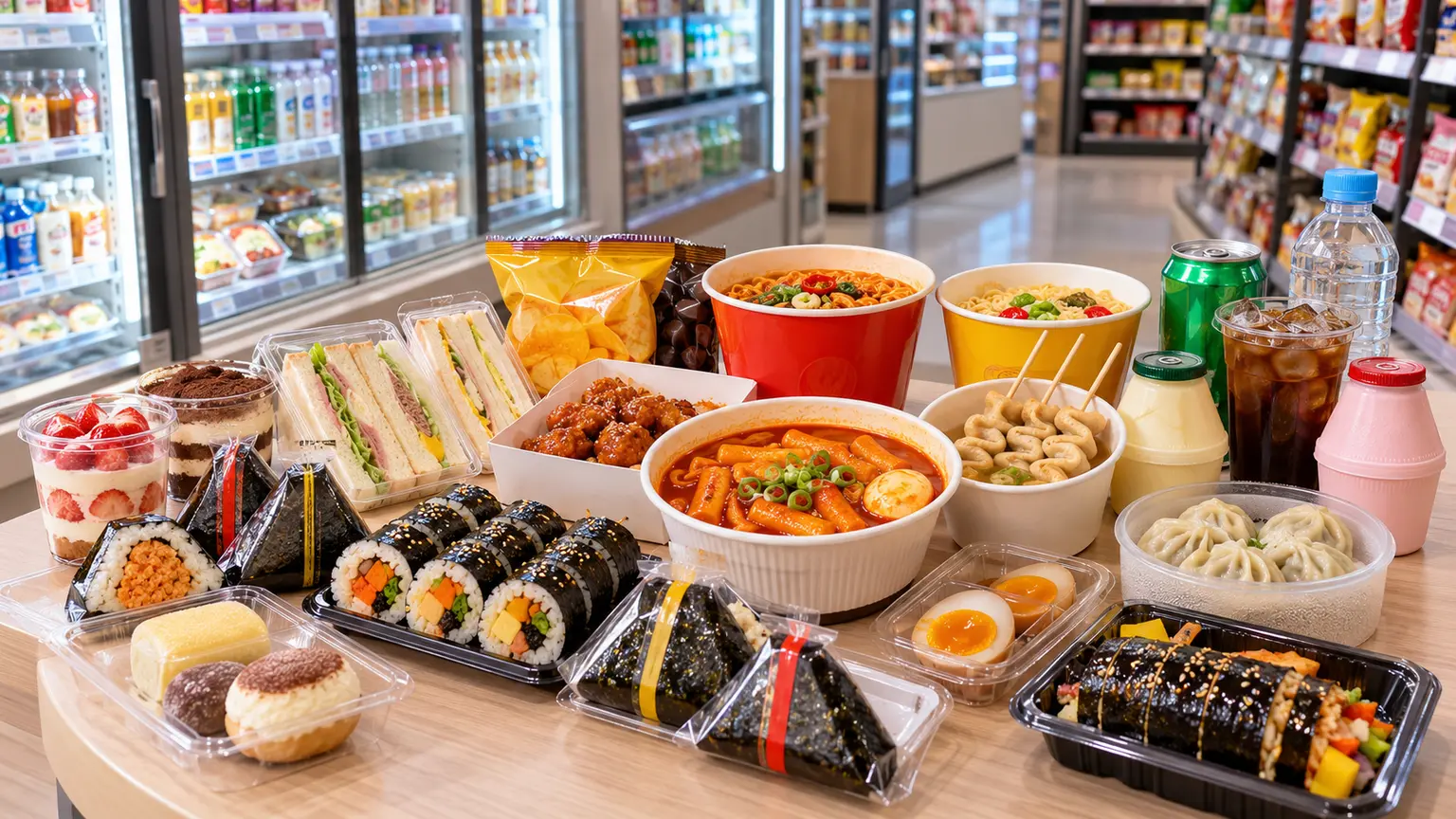
A Korean convenience store can solve breakfast, lunch, or a late-night dinner without a restaurant reservation, a Korean-language menu, or much money. Refrigerated shelves hold rice balls, sliced gimbap, sandwiches, and complete meals, while the aisles are filled with instant noodles, unusual snacks, coffee, and desserts. Many stores even provide microwaves and hot-water dispensers so customers can prepare food immediately after buying it.
The problem for first-time visitors is knowing what to choose. A triangle-shaped package might contain mild tuna mayonnaise or spicy pork. Two similar noodle cups can have completely different preparation instructions, and an appealing vegetable rice dish may contain fish sauce or meat broth.
Fortunately, you do not need to speak Korean to eat well at CU, GS25, 7-Eleven, or Emart24. Recognizing a handful of food names and packaging symbols is enough to make everyday shopping significantly easier.
This Korean convenience store food guide explains what to buy, how much to budget, how to read essential Korean labels, and how to prepare meals without making common mistakes. It also covers vegetarian and halal considerations, foreign-card payments, promotions, and what to do when a store has no eating area.
The best Korean convenience store foods for beginners are triangle gimbap, packaged gimbap rolls, dosirak lunch boxes, cup ramyeon, and simple breakfast snacks. They are widely available, relatively inexpensive, and usually easy to identify by their packaging.
For someone who has just arrived in South Korea, starting with familiar ingredients is more practical than choosing a product solely because it looks unusual. Tuna mayonnaise gimbap is a good first purchase, while a microwaveable lunch box provides a more substantial meal.
The following comparison covers common food categories and approximate 2026 planning prices. Actual prices, ingredients, and availability vary by chain, branch, package size, and promotion.
|
Food |
Korean name |
Typical price |
How to eat it |
|
Triangle gimbap |
삼각김밥 |
₩1,200–2,000 |
Unwrap; usually ready to eat |
|
Gimbap roll |
김밥 |
₩2,500–4,500 |
Usually ready to eat |
|
Lunch box |
도시락 |
₩4,000–7,500 |
Heat if directed |
|
Cup ramyeon |
컵라면 |
₩1,200–3,000 |
Add hot water as instructed |
|
Cup tteokbokki |
떡볶이 |
₩2,500–5,000 |
Follow package cooking directions |
|
Sandwich |
샌드위치 |
₩2,000–4,500 |
Usually ready to eat |
|
Ready-to-eat eggs |
구운계란 / 훈제란 |
₩1,500–3,000 |
Peel and eat |
|
Hot-bar snack |
핫바 |
₩1,500–3,000 |
Eat as sold or heat if directed |
|
Packaged rice |
즉석밥 |
₩1,500–2,500 |
Microwave according to label |
|
Banana-flavored milk |
바나나맛 우유 |
₩1,500–2,200 |
Drink chilled |
|
Filled cream bread |
크림빵 |
₩2,000–4,000 |
Ready to eat |
|
Packaged Korean snacks |
과자 |
₩1,200–3,500 |
Ready to eat |
These are indicative retail ranges rather than fixed nationwide prices. A chain-exclusive product, premium meal, airport branch, or larger portion can cost more.
For a first purchase, a triangle gimbap and a drink are the simplest combination. Choose a dosirak if a complete hot meal is more important than portability.
Korean convenience stores sell much more than chips and candy. Their ready-meal sections offer inexpensive versions of familiar Korean dishes, often designed to be prepared with minimal equipment.
The following foods are useful starting points because they represent different meal types rather than short-lived promotional products.
Samgak gimbap is a triangular rice snack wrapped in seaweed, usually containing a seasoned filling in the center. It is one of the most practical first purchases because it is inexpensive, compact, and available in numerous flavors.
A package normally shows the flavor in Korean, sometimes with a picture of the filling. Common choices include tuna mayonnaise, bulgogi, kimchi, and spicy meat variations.
Look for these names:
Tuna mayonnaise is often the least intimidating introduction for travelers unfamiliar with Korean heat levels. However, it contains fish and typically egg, so it is unsuitable for anyone avoiding those ingredients.
The packaging is designed to keep the seaweed separate from the rice until it is opened. Pull the numbered center strip first, then remove the two side sections as indicated. This releases the seaweed around the rice without tearing the entire package apart.
Price: Generally around ₩1,200–2,000, depending on size and filling.
For a quick snack between sightseeing stops, triangle gimbap is easier to carry than noodles or a full lunch box.
Packaged gimbap is a sliced rice-and-seaweed roll filled with vegetables, egg, meat, seafood, or other ingredients. It is a more substantial alternative to triangle gimbap and usually comes in a plastic tray.
Common fillings include tuna, beef bulgogi, ham, egg, pickled radish, and seasoned vegetables. The slices are already cut, making them easy to eat without additional preparation.
Not all gimbap is vegetarian, even when vegetables are visible. Traditional fillings often contain egg, fish cake, ham, or meat, and sauces may include seafood-derived ingredients.
Gimbap is generally sold refrigerated and intended for relatively prompt consumption. Check the use-by date and storage instructions before leaving the store.
Price: Approximately ₩2,500–4,500 for a typical packaged roll.
This is a useful choice for a train journey, hotel lunch, or day of sightseeing when carrying a hot meal would be inconvenient.
Dosirak is a Korean lunch box containing rice, a main dish, and several side dishes in a divided tray. It is one of the strongest options for travelers who want an inexpensive meal that resembles an everyday Korean plate.
Depending on the product, a dosirak might contain bulgogi, fried chicken, a pork cutlet, a hamburger-style patty, vegetables, kimchi, or seasoned noodles. Portions and side dishes vary substantially.
GS25 is known for its Hyejaroun lunch-box range, while CU offers its own branded and collaborative meal lines. These products change regularly, so choosing from the available selection is more reliable than searching for a specific viral release.
Most dosirak products require reheating, but the exact instructions printed on the package take priority over generic microwave advice. Some trays contain components that must be removed before heating.
Price: Commonly ₩4,000–7,500, with premium or oversized products costing more.
For travelers comparing Korean convenience store meals with restaurant prices, dosirak is often one of the best-value options. It also avoids the need to cook or purchase several separate dishes.
Cup ramyeon is Korean instant noodle soup or stir-fried noodles packaged in a cup or bowl. It is one of the most recognizable convenience store foods and is especially practical because many locations provide hot water.
Flavors range from mild beef or seafood-style broths to extremely spicy chicken noodles. Some products contain noodles that must be drained before adding sauce, while others are prepared as soup.
Popular styles include Shin Ramyun, kimchi ramyeon, jjajang-style noodles, and Buldak hot chicken noodles. Products marketed as hot chicken or fire noodles can be substantially spicier than an unfamiliar traveler expects.
A basic noodle meal is straightforward:
Some cups have separate packets that must be added after cooking or require water to be drained. Do not treat every product as an ordinary soup noodle.
Price: Approximately ₩1,200–3,000 for many standard cups.
For a more filling meal, combine noodles with a ready-to-eat egg or triangle gimbap. Check allergens and sodium content if dietary restrictions are important.
Convenience-store tteokbokki consists of chewy Korean rice cakes served with a seasoned sauce, often in a microwaveable cup or tray. It is a useful introduction to a well-known Korean street food without visiting a market stall.
The standard sauce is usually sweet, savory, and spicy. Some products add cheese, creamy sauce, noodles, or other ingredients.
Preparation varies. Certain versions require water and microwave heating, while others contain sauce packets or refrigerated components with different instructions.
Price: Approximately ₩2,500–5,000.
Tteokbokki is not automatically vegetarian. Fish cake, anchovy stock, seafood extracts, or meat-derived ingredients may appear in the sauce or accompanying toppings.
Travelers sensitive to chili heat should also check the packaging carefully. A cheese-flavored version can still be quite spicy.
Packaged sandwiches are convenient for travelers who want a familiar breakfast or a meal that does not require hot water or a microwave. Common varieties include egg salad, ham and cheese, chicken, and sweet fillings.
Korean convenience-store sandwiches often contain creamy dressings and may have softer bread than sandwiches sold in some other countries. Certain products emphasize large amounts of egg or cream.
Look for the following words:
Price: Approximately ₩2,000–4,500.
Sandwiches are particularly useful before an early train or on days when a sit-down breakfast would consume too much time. Keep refrigerated products properly chilled until they are eaten.
Ready-to-eat eggs and hot-bar snacks are useful additions when a rice ball or noodle cup feels too small. They are usually sold separately and require little preparation.
Brown-colored roasted or smoked eggs are a familiar Korean convenience-store food. Their darker appearance comes from preparation rather than an unusual egg variety, and they are commonly sold in small packs.
Hot-bar snacks are typically processed fish or meat products, often served on sticks. Some have spicy seasoning, cheese, or other fillings.
Price: Approximately ₩1,500–3,000 for many egg packs or individual hot-bar products.
Not every branch has a heated-food counter. Read the packaging to determine whether a snack is ready to eat or requires additional heating.
Banana-flavored milk is one of South Korea's most recognizable packaged drinks. It is sweet, creamy, and commonly sold in small bottles or cartons.
The distinctive round bottle associated with Binggrae Banana Flavored Milk is especially easy to recognize, although several manufacturers sell similar products. Other flavored milks and dairy drinks are also available.
Look for 바나나맛 우유, meaning banana-flavored milk.
Price: Often approximately ₩1,500–2,200, depending on product and size.
Banana milk works as a simple snack or breakfast drink but should not be confused with fresh banana smoothies. Most varieties contain dairy and added sugar.
Korean convenience stores are good places to explore packaged desserts, including cream-filled bread, flavored rice cakes, ice cream, and limited-edition collaborations. The selection can change quickly, even between branches of the same chain.
Common categories include cream bread, sweet rolls, mochi-style desserts, packaged yakgwa, and ice cream bars. Products connected with popular brands or entertainment releases may be temporary.
Some desserts are sold refrigerated and contain substantial amounts of milk or cream. Others are shelf-stable and easier to take on a day trip.
Price: Many packaged desserts fall around ₩1,500–4,000, although larger and specialty items can cost more.
For a first visit, a small cream-filled bread or traditional-style sweet is usually more manageable than purchasing several unfamiliar desserts at once.
Packaged snacks are among the easiest Korean convenience store foods to explore without speaking the language. Potato chips, seasoned seaweed, rice crackers, chocolate treats, and honey-flavored snacks generally require no preparation.
Popular flavor combinations can differ from those found elsewhere. Honey-butter seasonings, roasted seaweed, seafood-inspired flavors, and spicy sauces are particularly common categories.
Price: Approximately ₩1,200–3,500 for many standard packages.
For gifts or snacks to take home, choose sealed shelf-stable products and check destination customs rules. Meat-based seasonings or other restricted ingredients can affect international import eligibility.
The most important Korean convenience store labels identify the food, ingredients, use-by date, storage conditions, and heating instructions. Learning a few words is often more useful than memorizing dozens of product names.
Packaged foods in South Korea carry labeling information regulated by the Ministry of Food and Drug Safety. Ingredient declarations, allergen information, and storage instructions are particularly important for international travelers.
The following Korean terms are useful enough to save as a screenshot or offline note.
|
Korean label |
English meaning |
Why it matters |
|
삼각김밥 |
Triangle gimbap |
Identifies rice triangles |
|
도시락 |
Lunch box |
Identifies complete packaged meals |
|
컵라면 |
Cup ramyeon |
Identifies instant cup noodles |
|
원재료명 |
Ingredients |
Check the full ingredient list |
|
알레르기 |
Allergy |
Look for allergen information |
|
소비기한 |
Use-by date |
Check before buying fresh food |
|
유통기한 |
Older expiration/sales-date terminology |
May appear in older guidance |
|
냉장보관 |
Keep refrigerated |
Essential for chilled food |
|
냉동보관 |
Keep frozen |
Applies to frozen products |
|
실온보관 |
Store at room temperature |
Applies to shelf-stable products |
|
전자레인지 |
Microwave |
Look for heating instructions |
|
전자레인지용 |
Microwave-safe / for microwave use |
Check before heating the container |
|
조리방법 |
Cooking instructions |
Follow the printed preparation method |
|
뜨거운 물 |
Hot water |
Useful at noodle preparation stations |
|
분 / 초 |
Minutes / seconds |
Helps interpret heating time |
|
매운맛 |
Spicy flavor |
Indicates chili heat |
|
순한맛 |
Mild flavor |
Useful for spice-sensitive travelers |
|
포함 |
Contains / included |
Often appears with ingredient information |
|
칼로리 |
Calories |
Useful for nutrition information |
|
총 내용량 |
Total contents |
Identifies package quantity |
The most valuable checks are 소비기한, 냉장보관, 원재료명, and 전자레인지. They tell travelers whether the product is safe to purchase, how it should be stored, what it contains, and whether it can be heated.
Look for 소비기한, the use-by date, on the package, especially for gimbap, sandwiches, salads, eggs, and dosirak. Some fresh products specify a time as well as a calendar date.
A printed marking such as 2026.11.22 14:00 indicates November 22, 2026, at 2 p.m. This is an illustrative format, not a real product date.
Always check both the date and storage requirements. A refrigerated product should not be treated as shelf-stable simply because the package is sealed.
For a long train journey or flight, shelf-stable snacks may be more practical than refrigerated gimbap or sandwiches that cannot be kept cold.
Look for 매운맛, 매콤, or other references to chili heat, and use the packaging picture as a secondary clue. A red package is not a reliable guarantee of spiciness, while a creamy-looking noodle dish can still contain strong chili seasoning.
Common indicators include:
A product marked mild is generally a better starting point, but heat tolerance varies. Ingredients and preparation methods still matter more than package color.
You may also be interested in our article: 10 Best Restaurants in Paris That Feel Special Without Costing a Fortune
Travelers with low spice tolerance should start with tuna-mayo gimbap, plain rice, egg sandwiches, or other explicitly mild products.
Korean convenience stores often provide microwaves, hot-water dispensers, or specialized instant-noodle cookers. The safest method is to pay first and follow the instructions printed on the product and equipment.
Not every branch has every appliance. Smaller shops may have limited space or lack customer seating entirely.
Use the microwave only for food packaged in an approved microwave-safe container, and follow the product's wattage-specific heating instructions. Do not assume every plastic tray or noodle cup can be heated.
A safe routine is:
Korean food labels may give different heating times for 700 W and 1,000 W microwaves. Using the longer time intended for a lower-powered microwave can overheat food in a more powerful appliance.
Never microwave metal packaging, foil, or a sealed container unless the manufacturer explicitly provides an approved preparation method. Do not heat eggs in their shells or assume that every paper noodle cup is microwave-safe.
If the instructions cannot be understood, ask a staff member rather than guessing.
Use the hot-water dispenser when the noodle package specifies preparation with boiling or hot water. Fill only to the indicated line and wait the required time.
Most larger convenience stores have a hot-water station, but equipment and availability vary by branch.
Some stores also offer specialized ramyeon cookers that use a separate cooking container. These machines are designed for compatible products and may have preset cooking cycles.
Check whether the purchased noodles are intended for a cup, a separate cooker, or another method. A packet of noodles should not automatically be placed inside an ordinary microwave.
After cooking, keep the container level and avoid spilling hot broth near other customers.
Yes, when the branch has a designated eating counter or seating area. Some stores provide tables and stools, while others offer only shopping space.
Pay before sitting down, use the designated eating area, and clean up after finishing. Seating may be limited during busy periods.
Waste sorting is also important. Stores may provide separate containers for food waste, plastic, general trash, and recyclable materials. Follow the posted instructions rather than placing leftover soup directly into an ordinary recycling bin.
If seating is unavailable, take the food back to the hotel or another place where eating is permitted.
Most Korean convenience store purchases require little conversation. Choose a product, bring it to the register, pay, and use the preparation area if necessary.
However, a few short Korean phrases can help when asking about heating, bags, ingredients, or prices. Showing the Korean text on a phone is often easier than relying on pronunciation.
The following phrases cover common situations.
|
Korean phrase |
English meaning |
|
이거 데워 주세요. |
Please heat this for me. |
|
전자레인지 어디 있어요? |
Where is the microwave? |
|
뜨거운 물 어디 있어요? |
Where is the hot water? |
|
젓가락 주세요. |
Chopsticks, please. |
|
숟가락 주세요. |
A spoon, please. |
|
봉투 주세요. |
A bag, please. |
|
봉투 필요 없어요. |
No bag needed. |
|
카드 돼요? |
Can I pay by card? |
|
얼마예요? |
How much is it? |
|
이거 매워요? |
Is this spicy? |
|
고기 들어 있어요? |
Does this contain meat? |
|
돼지고기 들어 있어요? |
Does this contain pork? |
|
해산물 들어 있어요? |
Does this contain seafood? |
|
계산해 주세요. |
Please ring this up. |
For travelers with limited Korean, camera translation is especially useful on ingredient lists and heating instructions. However, automated translation may miss small print, unfamiliar ingredient names, or manufacturing warnings.
Before departure, the guide to useful travel apps for international trips can help identify translation and navigation tools worth installing.
Vegetarian Korean convenience store food is available, but it requires more careful label checking than simply avoiding visible pieces of meat. Korean packaged foods can contain anchovy broth, fish extracts, shrimp, eggs, or meat-based seasoning even when the main ingredient is rice or vegetables.
Products marketed as plant-based are increasingly available, although availability changes by retailer and branch.
Vegetarians can look for packaged salads, fruit, nuts, plain rice, selected bread products, and clearly labeled plant-based foods. Some gimbap and rice meals may also be suitable once their ingredients are verified.
Potential starting points include:
Vegetable gimbap should not automatically be considered vegetarian. It may contain egg, fish cake, or meat-based ingredients.
Similarly, kimchi and tteokbokki can contain fish sauce, anchovy extract, or seafood seasoning.
For strict vegetarian or vegan diets, the complete ingredient list matters more than the product name or front-of-package photograph.
Korean packaged-food regulations require allergen information for specified ingredients, including milk, eggs, wheat, soybeans, peanuts, shrimp, crab, certain fish, and several other animal and plant foods.
The allergen statement is commonly displayed separately near the ingredient list, often with contrasting formatting.
Useful Korean allergen terms include:
|
Korean |
English |
|
우유 |
Milk |
|
계란 / 달걀 |
Egg |
|
밀 |
Wheat |
|
대두 |
Soybean |
|
땅콩 |
Peanut |
|
새우 |
Shrimp |
|
게 |
Crab |
|
조개류 |
Shellfish |
|
돼지고기 |
Pork |
|
쇠고기 / 소고기 |
Beef |
|
닭고기 |
Chicken |
|
호두 |
Walnut |
|
오징어 |
Squid |
Cross-contact warnings can also appear when products are manufactured using shared equipment. A translation app may not always interpret those warnings correctly.
Travelers with severe food allergies should not rely solely on packaging pictures, product names, or a casual verbal reassurance. Use a professionally translated allergy card where appropriate, confirm the ingredient information, and choose alternatives if safety cannot be established.
Some packaged products may be halal-certified, but Korean convenience store food should not be assumed halal simply because it contains no obvious pork. Ingredients and processing methods vary widely.
Pork-based seasoning, animal extracts, gelatin, and other ingredients may be difficult to identify without reading the packaging.
Look for a credible halal certification on the specific product and check the complete ingredient list. The absence of pork from the product name is not sufficient confirmation.
Simple items such as sealed fruit, certain nuts, and some beverages can be easier to assess, although individual dietary requirements still apply.
A practical Korean convenience store meal often costs approximately ₩3,000–8,000 per person, depending on the combination of products. A small snack can cost less, while a full lunch box with a drink and dessert may exceed that range.
The most useful budgeting method is to choose a main item first, then add only what is needed to make the meal satisfying.
The examples below use indicative 2026 prices rather than guaranteed retailer offers.
|
Meal |
Example combination |
Estimated total |
|
Small breakfast |
Egg sandwich + bottled water |
₩3,000–5,500 |
|
Quick snack |
Triangle gimbap + water |
₩2,000–3,500 |
|
Light lunch |
Gimbap roll + drink |
₩3,500–6,500 |
|
Hot budget meal |
Cup ramyeon + triangle gimbap |
₩2,400–5,000 |
|
Full dinner |
Dosirak + drink |
₩5,000–9,000 |
|
Sweet break |
Cream bread + banana milk |
₩3,500–6,200 |
The best-value combination is not always the cheapest. A larger dosirak may provide a more balanced and filling meal than buying several sweet snacks at comparable cost.
For longer stays, convenience-store meals can help control everyday expenses, but they are not necessarily cheaper than every local restaurant or market stall.
Korean convenience stores frequently advertise 1+1 and 2+1 promotions, which offer additional qualifying products at no extra charge when the required quantity is purchased.
These signs are useful, but visitors should understand exactly what they mean.
A 2+1 offer on a ₩2,000 drink, for example, could provide three eligible drinks for ₩4,000 instead of ₩6,000.
However, qualifying items, flavors, sizes, promotion dates, and payment conditions can vary. Some deals require matching products, while others allow selected combinations.
Check the precise shelf label and the amount displayed at checkout. If the promotion does not apply, do not assume every similar-looking product qualifies.
For short-stay travelers, buying extra refrigerated products merely to obtain a promotional discount may not be worthwhile.
Most major Korean convenience stores accept ordinary credit and debit card payments, and cash in South Korean won remains a practical backup. International Visa and Mastercard cards commonly work, but acceptance is not guaranteed for every foreign-issued card or transaction.
Contactless payment may be supported, although individual terminals and mobile-wallet compatibility can differ.
A straightforward approach is to carry a working payment card along with a modest amount of local currency.
Yes, Tmoney cards can be used for purchases at participating convenience stores displaying the appropriate acceptance logo. Tmoney is also widely used for public transportation in South Korea.
Cards can be purchased and recharged at many major convenience-store branches, but top-up methods may differ from ordinary retail payment methods.
Foreign-issued credit cards are not universally accepted for recharging Tmoney. Travelers should carry cash for a potential top-up even when they can pay for snacks using a foreign bank card.
Tmoney is useful when combining public transportation with small everyday purchases, but it should not be the only available payment method.
Some stores support international mobile-wallet payments, but acceptance depends on the payment terminal, card issuer, and transaction system. A store accepting contactless cards does not guarantee that every foreign mobile wallet will work.
Apple Pay acceptance has expanded in South Korea, but it remains sensible to carry a physical card. Google Wallet compatibility can also depend on the card and terminal configuration.
If a payment fails, use a physical international card or cash instead of attempting repeated transactions.
Yes, some CU, GS25, 7-Eleven, and Emart24 branches sell prepaid physical SIM cards. Availability varies, so visitors should not assume every store carries the same plans or supports immediate activation.
Mobile data is particularly useful for translating packaging, checking maps, and navigating unfamiliar neighborhoods. Travelers deciding between a local SIM and digital mobile plan can use the eSIM vs physical SIM travel comparison before choosing a connectivity option.
For a short trip, arranging internet access before arrival can make the first convenience-store visit significantly easier.
CU, GS25, and 7-Eleven all sell the essential convenience-store foods, including rice balls, lunch boxes, noodles, sandwiches, and drinks. The best choice usually depends more on the individual branch's stock than on the chain name.
Each chain also develops private-label products and temporary collaborations, so selections can change within a relatively short period.
CU offers a broad selection of ready meals, snacks, rice products, and seasonal collaborations. Its convenience-food range includes different sizes of triangle gimbap, packaged rolls, and prepared dishes.
The chain regularly introduces promotional products and branded collaborations, although availability depends on location and launch period.
CU is a practical choice for travelers wanting to browse several familiar Korean meal categories in one place.
GS25 is particularly associated with prepared lunch boxes, including its Hyejaroun product range, and its Café25 coffee offering. The selection typically includes rice dishes, sandwiches, noodles, and desserts.
The range and quality of fresh food depend on the store's size and restocking schedule. A small station branch may carry a much smaller selection than a large residential or commercial location.
For travelers seeking a full meal, GS25 is worth checking for its available dosirak products.
7-Eleven Korea sells many of the same everyday food categories, including triangle gimbap, noodles, ready meals, drinks, and sweets. It also offers its own exclusive and collaboration products.
Availability and facilities vary, making it unhelpful to assume that every branch has a particular dessert, hot-food counter, or seating area.
For most short visits, choosing the nearest well-stocked convenience store is more useful than making an additional trip to a preferred brand.
Emart24 offers prepared foods, packaged snacks, beverages, and private-label products. It is a useful alternative when other chains are less conveniently located.
Its assortment can be particularly helpful for travelers who want shelf-stable snacks, drinks, or simple meal ingredients.
As with the other chains, store-specific stock should determine the choice. A larger, well-equipped branch is generally more useful for a hot meal than a smaller location with limited preparation facilities.
The best convenience-store meal depends on the time of day and whether the food can be heated. Cold sandwiches and gimbap are easiest for early departures, while lunch boxes and noodles work better when preparation facilities are available.
The following examples are designed to make a first visit easier.
A sandwich, ready-to-eat egg, or simple rice snack is a practical breakfast when local cafes are closed or time is limited. These products usually require no complicated cooking.
A straightforward combination is an egg sandwich with coffee or bottled water. Another option is triangle gimbap with a ready-to-eat egg.
Check refrigerated storage requirements if purchasing breakfast the previous night. Fresh products should not remain unrefrigerated in a hotel room until morning.
A dosirak or packaged gimbap roll is a useful lunch option because it provides a recognizable main dish without requiring restaurant service. The choice depends on whether hot food is available.
For a short lunch break, packaged gimbap is especially convenient. If the store has a microwave and seating, a complete lunch box is often more satisfying.
A reasonable lunch budget is ₩4,000–8,000 for many ordinary meal combinations.
Cup ramyeon or a microwaveable dosirak is practical when restaurants have closed or a traveler arrives at the hotel late. Many convenience stores operate around the clock, but not every branch is open 24 hours.
A noodle cup with an egg provides a quick meal, while a lunch box offers greater variety when still available.
Late-night fresh-food stock can be limited. Check use-by dates and do not assume a discount means the product is suitable for storage until the next day.
The most common mistakes involve misunderstood promotions, incorrect microwave use, unexpected ingredients, and refrigerated food kept at room temperature for too long. They are easy to avoid once the basic system is familiar.
Before checking out, pay attention to the following:
A few minutes spent checking the packaging can prevent most problems. The aim is not to turn a simple snack purchase into a complicated task, but to recognize the small details that matter.
Yes, Korean convenience store food is worth trying as part of the country's everyday food culture, particularly for inexpensive meals, quick breakfasts, and late-night snacks. However, it is not a complete replacement for restaurants, traditional markets, or freshly prepared street food.
Packaged dosirak and gimbap can provide good value, while instant noodles and snacks offer convenient introductions to familiar Korean flavors. They are also useful when traveling by train or staying in accommodation without cooking facilities.
The trade-offs include packaging waste, potentially high sodium levels, limited customization, and the quality differences between freshly prepared and reheated food.
For visitors interested in exploring more of Asia's casual dining traditions, Thai street foods worth trying provide a useful contrast between freshly cooked market dishes and packaged convenience-store meals.
During a South Korea trip, the strongest approach is to combine both experiences. Use convenience stores when speed, affordability, and flexibility matter, while leaving room in the itinerary for Korean barbecue, traditional soups, market snacks, and regional specialties.
Korean convenience store food is straightforward to buy once the basic labels and preparation methods are familiar. These answers cover common questions about language, prices, payments, food safety, and dietary requirements.
Triangle gimbap, packaged gimbap rolls, dosirak lunch boxes, and cup ramyeon are strong starting choices. They are widely available, inexpensive, and usually easy to identify.
Yes. Customers can select packaged food and pay without much conversation. Camera translation and a few Korean phrases help with ingredients, heating instructions, and dietary restrictions.
A simple snack may cost ₩1,200–3,000, while many complete meal combinations cost approximately ₩3,000–8,000. Prices vary by product, branch, and promotion.
A triangle gimbap or cup ramyeon is often among the cheapest practical meal options. Combining the two can provide a more filling meal for a few thousand won.
It generally means buying one qualifying product and receiving a second eligible product at no extra charge. Check the exact promotional label for participating items and conditions.
It usually means receiving three qualifying products for the price of two. Products, flavors, and sizes must meet the displayed promotion conditions.
Yes, many branches have microwaves for customer use. Only heat products approved for microwave preparation and follow the package instructions.
Hot water is commonly provided for purchased instant noodles at equipped branches. Facilities and policies can vary, so check with the staff before using the dispenser.
Some products display English names or descriptions, but many provide essential ingredient and heating information primarily in Korean. A translation app is useful for more detailed labels.
Some products are vegetarian, but ingredient checking is essential. Vegetable dishes can contain anchovy stock, fish sauce, eggs, or meat-derived seasonings.
Some products may be suitable or carry halal certification, but the food is not universally halal. Check the ingredients and certification of each specific product.
Foreign Visa and Mastercard cards are commonly accepted at major chains. However, individual transactions can fail, so carrying won cash or another payment method is advisable.
Yes, participating stores accept Tmoney cards for retail purchases. Check for the Tmoney logo and make sure the card has sufficient balance.
Many operate 24 hours, especially in cities, but opening hours vary. Some branches close overnight or follow different schedules depending on location.
Packaged snacks and non-messy ready-to-eat foods can be practical on many train journeys, subject to the operator's rules. Avoid strong odors, spills, and leaving waste behind.
A tuna-mayo triangle gimbap, a mild cup ramyeon, and banana-flavored milk provide an easy introduction. Travelers wanting a complete meal can start with a dosirak instead.






January in Dubai can mean comfortable all-day sightseeing and surprisingly cool swimming water. By April, the sea feels warmer, but midday heat can change your plans. Discover when to visit for beaches, desert adventures, famil...
 November 1, 2026
 0

Amsterdam's canals become an open-air light art exhibition from November 26 to January 17. Discover how to see the installations for free, when a paid walking map makes sense, which boat cruise to choose, and how to plan a comf...
October 31, 20261
A beautiful Parisian restaurant doesn't have to come with an expensive tasting menu. Discover ten places where a modest budget buys more than a meal - century-old interiors, a recreated Tokyo alley, former railway buildings, ge...
October 31, 20261
Just 35 minutes from Seattle, Bainbridge Island offers more than waterfront shops and ferry views. Explore 13 worthwhile stops, including free museums, quiet forest trails, gardens, and beaches, with practical itineraries for t...
October 30, 20260A beautiful Parisian restaurant doesn't have to come with an expensive tasting menu. Discover ten places where a modest budget buys more than a meal - century-old interiors, a recreated Tokyo alley, former railway buildings, ge...
October 31, 20261
The best Chicago foodie spots go far beyond deep-dish pizza. Find iconic sandwiches, neighborhood taquerias, Michelin-recognized restaurants and global food districts, with what to order, what meals cost and a practical food ro...
October 11, 202673
Haitian food goes far beyond fried pork and rice. These 18 dishes reveal the flavors worth knowing first, the combinations that belong together, what to order if you only get one meal, and how to build a Haitian food crawl with...
October 3, 2026125
Australian food is much more than Vegemite and barbecue. From bakery meat pies and barramundi to lamingtons, flat whites and Indigenous ingredients, these are the foods that reveal what Australia actually tastes like.
September 28, 202679
London has enough museums to fill an entire trip, and many of the biggest cost nothing to enter. This 2026 guide shows which museums deserve your limited time, what to see first and how to avoid spending a day wandering galleri...
September 24, 2026109
Thailand's best meals do not always come with reservations. They arrive sizzling from a wok, smoking over charcoal or packed into a paper tray. These 18 Thai street foods are the ones worth knowing before your first market visit.
September 23, 2026129
Karnak is overwhelming, Philae sits on an island and Abu Simbel was moved piece by piece. These nine Egyptian temples make far more sense once you know what to look for – and which ones actually fit the same trip.
September 21, 2026153
Puerto Rico is more than beaches and Old San Juan. These 21 fact-checked Puerto Rico facts explain the glowing water, rainforest, music, food, history and everyday details you can actually notice on a trip – plus the myths wort...
September 20, 202673
The historic Parisian quarter of Montmartre is associated with a strong affinity for art and cultural backgrounds. This is the area where famous artists such as Picasso and Monet used to reside and work. Here, you may find art ...
May 26, 2025537
Saint-Rémy-de-Provence is one of the oldest towns in France founded by the Celts more than 2,500 years ago and developed by both the Greeks and the Romans. Set at the base of the Alpilles Mountains and surrounded by vineyards a...
April 15, 2025600
Looking to shine a spotlight on your project? LitiTravels has you covered! We offer article-based promotion, manage branded blogs on our platform, drive engagement through our social media channels, and create content that delivers real results. Get in touch today and let’s make your brand stand out!
The best travel guides, trip planning tips and cultural discoveries from the LitiTravels team — once a month, straight to your inbox.