


Popular articles


15 Glasgow Foods Worth Trying on Your First Visit in 2026
 Tips & Guides15 Glasgow Foods Worth Trying on Your First Visit in 2026
Tips & Guides15 Glasgow Foods Worth Trying on Your First Visit in 2026
15 Glasgow Foods Worth Trying on Your First Visit in 2026
Article content

Glasgow food is not defined by one signature dish. The city’s eating culture stretches from hot morning rolls and old-school chippies to Scottish seafood, curry houses, neighbourhood bakeries and restaurants turning local produce into much more modern plates. That range is exactly what makes eating here more interesting than working through a checklist of stereotypical Scottish dishes.
First-time visitors should still try haggis, neeps and tatties, but stopping there misses much of the picture. A square sausage roll tells you more about an ordinary Glasgow morning, while a curry points to the city’s long South Asian food history. A fish supper, Scotch pie or slice of tablet can be as useful an introduction to Glasgow food as a formal dinner built around Scottish beef or seafood.
For a short visit, aim for four different experiences: one Scottish classic, one Glasgow breakfast, one curry and one neighbourhood meal away from the busiest tourist streets. That gives you a much better sense of how the city actually eats.
Glasgow Food at a Glance
The easiest way to understand Glasgow food is to separate genuinely Scottish dishes from foods that have become closely associated with everyday life in the city. Not everything below was invented in Glasgow, and it does not need to have been. Local food culture is often about what people repeatedly eat, adapt and make their own.
| Food or drink | What it is | Best time to try it | First-timer priority |
|---|---|---|---|
| Haggis, neeps and tatties | Savoury haggis with turnip and potato | Lunch or dinner | Essential |
| Square sausage roll | Lorne sausage in a morning roll | Breakfast | Essential |
| Tattie scone | Thin potato scone, often fried | Breakfast | High |
| Full Scottish breakfast | Eggs, sausage, bacon and Scottish additions | Breakfast or brunch | High |
| Chicken tikka masala | Creamy tomato-based curry | Dinner | High |
| Fish supper | Battered fish and chips | Lunch or dinner | High |
| Pizza crunch | Battered, deep-fried pizza | Late lunch or evening | For the curious |
| Scotch pie | Small double-crust meat pie | Snack or lunch | High |
| Cullen skink | Smoked haddock and potato soup | Lunch | High |
| Stovies | Potatoes, onions and meat | Lunch or dinner | Traditional pick |
| Cranachan | Cream, oats, raspberries, honey and whisky | Dessert | High |
| Tablet | Very sweet Scottish confection | Snack | High |
| Scottish seafood | Salmon, mussels, langoustines and more | Dinner | High |
| Irn-Bru | Scottish orange soft drink | Anytime | Fun first-timer pick |
| Whisky | Scotland’s best-known spirit | Evening | Optional |
You do not need to try all 15 foods in one weekend. Start with the dishes that fit naturally into your day rather than ordering traditional food simply because it appears on a must-eat list.
1. Start With Haggis, Neeps and Tatties
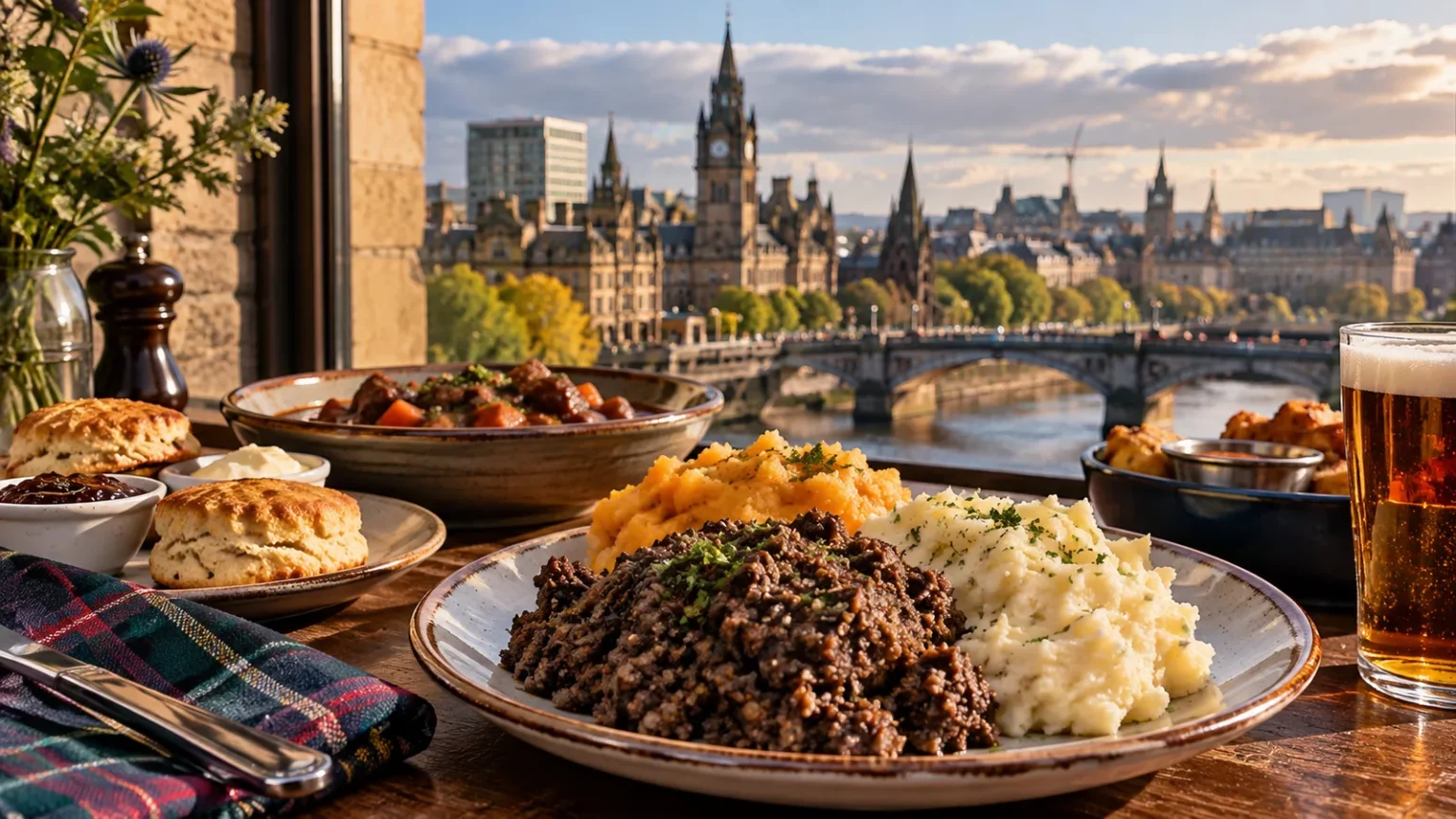
Haggis, neeps and tatties is still the clearest introduction to traditional Scottish food in Glasgow. Haggis is a savoury mixture traditionally made with sheep’s offal, oatmeal, onion and seasoning, while neeps are mashed turnip or swede and tatties are mashed potatoes.
The flavour is far less dramatic than the ingredient list makes it sound. Good haggis is peppery, savoury and rich, with the oatmeal giving it a crumbly texture rather than the heaviness many first-time visitors expect. The mild potato and slightly sweeter turnip balance it well.
For a first taste, order a normal plated portion rather than a novelty version. Haggis bonbons, burgers and other modern adaptations can be enjoyable later, but the traditional combination gives you a better reference point.
Vegetarian haggis is also widely available and is not simply an afterthought. Versions based on oats, pulses, vegetables, seeds and spices can preserve much of the texture and seasoning that define the dish.
If you only order one unmistakably Scottish meal in Glasgow, haggis, neeps and tatties is the logical place to begin.
2. Order a Morning Roll With Square Sausage
A morning roll with square sausage is one of the most useful foods for understanding everyday Glasgow rather than visitor-facing Scottish cuisine. Square sausage, also called Lorne sausage, is formed in a loaf and cut into flat rectangular slices before cooking.
The roll matters almost as much as the filling. Glasgow-style morning rolls are typically light inside with a crisp or well-fired exterior, and they are designed for simple hot fillings rather than elaborate brunch presentation.
Square sausage can be joined by bacon, egg, black pudding or a tattie scone. Brown sauce and tomato sauce are common additions, although there is no need to turn a first order into an oversized breakfast challenge.
You will find hot filled rolls in cafés, bakeries and takeaway counters across the city. That ubiquity is part of their appeal: this is Glasgow food you can eat quickly, inexpensively and without booking a table.
How to Order One Without Overthinking It
Start with a roll and square sausage if you want the simplest version. Add a tattie scone if you are hungry, then choose brown sauce or ketchup according to preference.
A few local terms help:
- Square means square or Lorne sausage.
- Tattie scone means potato scone.
- Roll and square means exactly what it sounds like – a roll filled with square sausage.
- Well-fired roll refers to a roll baked until the outside is particularly dark and crisp.
Once you know those terms, a Glasgow breakfast counter becomes considerably easier to navigate.
3. Add a Tattie Scone to Breakfast
A tattie scone is a thin Scottish potato scone normally made from potato, flour and fat. It is often cooked on a griddle and then reheated or fried before serving.
The texture sits somewhere between bread and a very thin potato cake. On a full Scottish breakfast, it absorbs egg yolk, sauce and other flavours. Inside a morning roll, it adds a soft potato layer without making the sandwich feel like a completely separate dish.
Tattie scones are common enough that visitors can easily overlook them beside bacon, sausages and eggs. That would be a mistake if the goal is to understand traditional Scottish breakfast food rather than simply eat a large fry-up.
For an efficient first morning in Glasgow, a square sausage and tattie scone roll covers two local staples in one order.
4. Try a Full Scottish Breakfast When You Have a Slow Morning
A full Scottish breakfast is the bigger alternative to a filled morning roll. Exact components vary, but the plate commonly includes eggs, bacon, sausage, black pudding, tattie scone, beans, mushrooms and tomato, with some versions adding haggis.
The main difference from a standard full English is not a rigid recipe but the Scottish additions. Square sausage, tattie scones and haggis immediately change the character of the plate.
This is not the best breakfast before a tightly scheduled morning of walking and museums. It is substantial, and enjoying it makes more sense when you can take your time rather than eat quickly and rush out.
Visitors combining Glasgow with England can compare the city’s breakfast habits with the practical food and pub notes in LitiTravels’ tips for traveling to London.
5. Eat Chicken Tikka Masala but Treat the Origin Story Carefully
Chicken tikka masala belongs in a Glasgow food guide because the city has a deep curry culture and a famous connection to the dish. One widely repeated story credits Glasgow restaurateur Ali Ahmed Aslam and Shish Mahal with developing the creamy, tomato-based curry in the 1970s after a customer wanted sauce with chicken tikka.
The story is famous, but the precise origin of chicken tikka masala is disputed. Other accounts place its development elsewhere in Britain or connect it more directly with earlier South Asian dishes. It is therefore better understood as part of the long exchange between South Asian cooking and British restaurant culture than as a recipe with an undisputed Glasgow birth certificate.
None of that makes curry less important to eating in the city. Glasgow has supported generations of Indian, Pakistani and other South Asian restaurants, and curry remains one of the meals worth deliberately including in a first visit.
Instead of automatically ordering the mildest familiar dish, read the house specialities and ask what the kitchen does particularly well. That usually produces a more interesting meal than approaching a Glasgow curry house as a historical exhibit.
6. Get a Proper Fish Supper
A fish supper in Scotland means battered fish served with chips. It is simple food, but the difference between an excellent version and one that has spent too long under a heat lamp is enormous.
The batter should still have texture, the fish should be moist rather than dry and the chips should arrive hot. Salt and vinegar are the classic finishing touches, although chippies offer plenty of additional sauces.
Fish suppers make particularly good sense on a cold or wet Glasgow evening because they deliver exactly the kind of hot, uncomplicated comfort food the weather can make appealing. Portions can be substantial, so check the size before adding multiple sides.
Traditional chippy culture is also a good reminder that Glasgow food does not have to be expensive or formal to be locally meaningful.
7. Try Pizza Crunch if You Want the Full Chippy Experience
Pizza crunch is essentially battered, deep-fried pizza. It is not refined, subtle or designed to represent the best Scottish produce. It is, however, closely associated with the kind of unapologetic chippy food that visitors often become curious about after hearing Glasgow food stories.
Expect something much heavier than an ordinary slice of pizza. The batter adds a crisp shell while frying changes the cheese and base into a dense, rich snack.
This is best treated as a shared experiment rather than the centrepiece of an entire food itinerary. Order one alongside other chippy food and split it if you are unsure.
And no, you do not need to eat a deep-fried chocolate bar simply to prove you visited Scotland. Choose local food because it interests you, not because it sounds extreme enough for a photograph.
8. Grab a Scotch Pie for a Quick Savoury Snack
A Scotch pie is a small, sturdy double-crust pie traditionally filled with seasoned minced meat. Its firm shell makes it easy to eat without turning lunch into a sit-down event.
Pies are an important part of Scottish bakery culture, and Glasgow offers them through bakeries, butchers, cafés and takeaway counters. Fillings now extend far beyond the most traditional versions, but a straightforward Scotch pie remains the best starting point.
The pie works particularly well on a sightseeing day when a restaurant lunch would interrupt the route. Pair it with soup or another bakery item if you need something more substantial.
A good Glasgow food itinerary should have room for this kind of ordinary snack. Not every local speciality needs a reservation, tasting menu or elaborate presentation.
9. Order Cullen Skink on a Cold Day
Cullen skink is a thick Scottish soup made with smoked haddock, potatoes and onions, usually finished with milk or cream. It originated in Cullen in northeast Scotland rather than Glasgow, but it appears widely enough on Scottish menus to be worth seeking out while visiting the city.
The smoked fish gives the soup depth without making it taste aggressively fishy. Potato provides body, while the dairy creates the comforting texture that makes the dish particularly well suited to autumn and winter.
Cullen skink works well as a starter, although a generous bowl with bread can easily function as lunch. If your trip falls during colder weather, it is one of the most satisfying traditional Scottish foods to order.
This is also a better example of Scotland’s connection to seafood than relying exclusively on fried fish.
10. Look for Stovies When You Want Old-School Comfort Food
Stovies are built around potatoes and onions, usually cooked slowly with meat or leftovers. Recipes vary considerably between families and regions, which is part of the point: this is practical home-style food rather than a precisely standardised restaurant dish.
The final result is soft, savoury and filling. Beef, lamb or corned beef can appear depending on the recipe, while meat-free versions are also possible.
Stovies are less internationally famous than haggis, which makes them a worthwhile order for visitors who have already covered Scotland’s obvious dishes. They also provide a useful glimpse of a food tradition based on making filling meals from accessible ingredients.
If you find them as a special rather than a permanent menu item, that is often a good opportunity to order them.
11. Leave Space for Scottish Seafood
Glasgow is not a fishing village, but the city’s restaurants have access to an exceptional range of Scottish seafood. Salmon, mussels, oysters, scallops, langoustines, lobster and smoked fish can all appear on menus.
This is one area where paying a little more can make sense. Fresh seafood allows you to experience Scottish produce without relying only on rich traditional dishes.
Finnieston is an especially useful area for this side of Glasgow food. The neighbourhood sits between the city centre and West End and has developed a strong concentration of restaurants, bars and nightlife, making it easy to build an entire evening around dinner.
Ask what is currently available rather than deciding on a specific species before arriving. Seasonality and supply matter more with seafood than checking a famous dish off a list.
12. Finish With Cranachan
Cranachan is one of Scotland’s classic desserts, traditionally combining whipped cream, toasted oats, raspberries, honey and whisky. The ingredients sound simple, but together they create a dessert with far more texture than a bowl of cream and fruit.
The oats add nuttiness and crunch, raspberries cut through the richness and whisky provides warmth without needing to dominate. Modern versions may alter the proportions or presentation considerably.
Cranachan is especially useful after a traditional Scottish meal because it keeps the regional theme going without ending with another heavy pastry.
If both cranachan and sticky toffee pudding are on the menu, choose cranachan when your priority is distinctly Scottish food. Save the pudding for another meal.
13. Buy Scottish Tablet for Later
Tablet is intensely sweet Scottish confectionery made from sugar, condensed milk and butter. It resembles fudge at first glance but has a firmer, grainier and more crystalline texture.
A small piece goes a long way. This is not a dessert that needs to be eaten in a large restaurant-sized portion to make an impression.
Tablet is useful for travelers because it is easy to buy from sweet shops, bakeries and gift shops and can be saved for a train journey or taken home. Artisan versions may add whisky, vanilla or other flavours, although plain tablet provides the clearest introduction.
If you like very sweet food, tablet is one of the easiest Scottish treats to become unexpectedly attached to.
14. Try Irn-Bru Once
Irn-Bru is Scotland’s unmistakably orange soft drink and one of the easiest local products to sample. Describing the flavour precisely is surprisingly difficult because its sweet, fruity character does not map neatly onto the usual cola, citrus or lemon-lime categories.
It is available almost everywhere, so there is no reason to build part of your itinerary around finding it. Buy a bottle or can when you want a soft drink and decide for yourself.
Irn-Bru also works as a useful cultural reference point. You will see it in supermarkets, cafés, takeaways and advertising throughout Scotland.
Trying it once requires almost no time or planning, making it an easy addition to a Glasgow food trip.
15. Have a Whisky Only if You Actually Want One
Whisky is inseparable from Scottish food and drink culture, but nobody needs to force down a dram to complete a Glasgow visit. If you already enjoy spirits, Glasgow provides plenty of opportunities to explore different Scottish regions and styles in whisky bars and tasting rooms.
The useful first step is to tell the bartender what you already like. Someone who prefers lighter, fruitier drinks may be directed toward a completely different whisky than a visitor looking for heavy peat and smoke.
Whisky can also accompany Scottish cheese or finish a meal rather than becoming an activity on its own. That approach often feels less intimidating for first-time drinkers.
Non-drinkers lose nothing by skipping it. Glasgow food culture has more than enough depth without alcohol.
Where to Eat in Glasgow: 5 Areas That Make Food Planning Easier
Glasgow’s neighbourhoods are more useful for food planning than a giant ranking of individual restaurants. Venues change, menus evolve and the “best” place depends heavily on whether you want curry, seafood, breakfast or a casual evening.
| Area | Best for | Good time to go |
|---|---|---|
| Merchant City | Scottish classics, dinner, cocktails, central dining | Lunch or evening |
| Finnieston | Modern restaurants, seafood, bars | Evening |
| West End | Cafés, curry, brunch and international food | All day |
| Southside | Independent cafés and neighbourhood dining | Brunch or dinner |
| East End and Barras | Markets, casual food and local atmosphere | Daytime/weekends |
You may also be interested in our article: Is San Francisco Safe in 2026? 9 Things Tourists Should Know Before Going
Each district gives you a different version of Glasgow food. The smartest approach is to match meals with sightseeing rather than crossing the city solely because a social-media list declared one restaurant essential.
Merchant City for Scottish Food Without Leaving the Centre
Merchant City is one of the simplest places for first-time visitors to start. It sits close to central attractions and combines historic streets with cafés, pubs, restaurants and bars.
This is a useful area for haggis, Scottish meat and fish dishes, a proper dinner or a more polished version of regional food. Current city tourism listings include restaurants specialising in Scottish cooking alongside pizza, Persian food, curries and contemporary seasonal menus.
Because the area is central, prices and atmosphere vary significantly. Check a menu before sitting down rather than assuming every handsome historic dining room serves traditional Glasgow food.
Merchant City is particularly convenient when you want dinner without adding another transport journey at the end of a sightseeing day.
Finnieston for a Food-Focused Evening
Finnieston is the strongest choice when dinner itself is one of the evening’s main activities. The neighbourhood is known for restaurants, bars, seafood and nightlife, with Argyle Street providing an easy spine for exploring.
It is also practical geographically. Finnieston sits between central Glasgow and the West End, so it combines naturally with Kelvingrove, the Riverside Museum or an afternoon around the university.
Modern Scottish cooking is especially visible here. Instead of only recreating old recipes, restaurants use Scottish fish, shellfish, meat and vegetables in contemporary dishes.
If you have money for one more ambitious Glasgow food experience, Finnieston is a sensible place to spend it.
West End for Breakfast, Curry and Café Hopping
The West End has enough variety to fill an entire food day. Byres Road, Great Western Road, Kelvinbridge and the lanes around the university mix cafés, bakeries, pubs and restaurants serving cuisines from around the world.
It works particularly well for breakfast and lunch because you can combine food with Kelvingrove Park, the university and nearby museums. In the evening, the area shifts naturally toward pubs, restaurants and Ashton Lane.
The West End is also closely connected with Glasgow’s curry history. Shish Mahal, which is associated with the disputed chicken tikka masala origin story, is part of that wider tradition rather than the only reason to eat Indian food here.
Visitors building Scotland into a longer trip can use LitiTravels’ Europe itinerary for three weeks to connect Glasgow with Edinburgh and other European stops.
Southside for a More Neighbourhood-Led Meal
Glasgow’s Southside is useful once you want to move beyond the areas most visitors automatically explore. Shawlands, Strathbungo and surrounding streets have built strong café, brunch and independent restaurant scenes.
The appeal is not one must-eat Scottish dish. It is the chance to have a meal in a part of the city where everyday neighbourhood life is more visible.
This makes the Southside better suited to a second or third day than a six-hour Glasgow stopover. Give yourself time to walk rather than arriving for one restaurant and immediately taking transport back to the centre.
Brunch or an early evening meal fits particularly well here.
The Barras and East End for a Different Side of Glasgow Food
The East End and Barras offer a very different atmosphere from Finnieston or the West End. Market culture, older Glasgow institutions and newer independent food businesses overlap here.
The Barras works best when you treat food as part of a broader daytime visit rather than expecting a conventional restaurant district. Check current market days and opening hours before making the journey, because individual traders may not operate every day.
Nearby attractions make it possible to combine the area with sightseeing rather than dedicating half a day entirely to eating.
This is also where a Glasgow food trip starts to feel less like a restaurant guide and more like an exploration of the city itself.
What Should a First-Time Visitor Order in Glasgow?
For a first trip, prioritise variety rather than attempting every traditional Scottish dish in 48 hours. Four or five strategically different meals will tell you more than repeatedly ordering haggis in different forms.
A practical first-timer food plan looks like this:
- Breakfast: Order a morning roll with square sausage and tattie scone.
- Lunch: Try a Scotch pie, Cullen skink or another Scottish café dish.
- Dinner: Have haggis, neeps and tatties or a modern Scottish meal.
- Second dinner: Choose a Glasgow curry.
- Casual meal: Get a fish supper from a chippy.
- Dessert or snack: Try cranachan or tablet.
- Drink: Sample Irn-Bru or a whisky, depending on preference.
That combination covers working-day Glasgow food, national Scottish dishes, the city’s multicultural side and its takeaway culture without turning every meal into a challenge.
A One-Day Glasgow Food Route
It is possible to get a useful introduction to Glasgow food in one day if meals are grouped logically. The aim should be variety, not maximum quantity.
Start with a square sausage and tattie scone roll in or near the city centre. Spend the morning sightseeing, then move toward Merchant City for lunch or a Scottish snack. This avoids eating a full breakfast and immediately sitting down for another large meal.
In the afternoon, explore the West End and stop for coffee or something sweet. Finish in Finnieston for seafood, modern Scottish cooking or a relaxed dinner, then have a dram only if whisky genuinely interests you.
One strong meal in each part of the day beats six rushed “must-eat” stops.
A Two-Day Glasgow Food Plan
Two days allows Glasgow food to become part of the trip rather than a separate tasting marathon. It also creates room for neighborhoods beyond the central tourist area.
| Day | Breakfast | Lunch | Afternoon | Dinner |
|---|---|---|---|---|
| Day 1 | Square sausage roll | Merchant City Scottish lunch | Tablet or coffee | Finnieston dinner |
| Day 2 | Full Scottish breakfast | West End café or bakery | Barras or Southside | Glasgow curry |
The order can easily be reversed depending on accommodation and sightseeing plans. Keep the curry and larger Scottish dinner on separate evenings, because both can be substantial.
How Much Should You Spend on Food in Glasgow?
Glasgow food can work at very different budgets. A bakery breakfast, pie or takeaway meal keeps costs down, while seafood restaurants and modern Scottish dining can turn dinner into one of the more expensive parts of a trip.
Do not judge value only by portion size. A cheaper daytime meal leaves room in the budget for one better dinner built around Scottish ingredients.
The easiest money-saving strategy is to avoid making all three meals restaurant meals. Start with a filled roll, use a bakery or café for lunch and spend more on dinner.
Another useful rule is to check menus before committing in the busiest central areas. The most visible restaurant is not automatically the best place to spend your food budget.
Is Glasgow Good for Vegetarians and Vegans?
Yes. Vegetarians and vegans do not have to survive on side dishes while everyone else explores Glasgow food. The city has dedicated plant-based venues as well as mainstream restaurants offering vegetarian versions of Scottish dishes and international cuisines with naturally meat-free choices.
Vegetarian haggis is particularly worth trying. It preserves the peppery, oat-heavy character of traditional haggis while replacing the meat ingredients with combinations of pulses, vegetables, seeds and grains.
Indian and other South Asian restaurants also expand the range considerably. Vegetarian travelers can therefore experience both Scottish-inspired and international sides of the city’s food scene without relying on salads.
Always check whether soups, sauces and pies contain meat stock if that matters to your diet, especially when ordering older traditional recipes.
What Food Is Glasgow Actually Famous For?
Glasgow is famous less for a single legally defined regional speciality than for a combination of Scottish comfort food, breakfast culture, chippies, curry and an increasingly broad restaurant scene. That makes the question more interesting than simply naming haggis.
Haggis belongs to Scotland generally. Square sausage and morning rolls are found beyond Glasgow but are deeply embedded in everyday food culture in the west of Scotland. Chicken tikka masala has a famous Glasgow origin claim, although the history is contested.
The result is a city where identity comes from how different food traditions live beside one another. A traditional pub, Pakistani-Scottish curry house, seafood restaurant and breakfast roll counter can all tell a legitimate part of the Glasgow food story.
That is why the strongest Glasgow food guide needs more than a list of Scottish national dishes.
When Is the Best Time for a Glasgow Food Trip?
Glasgow food works year-round because the city’s best-known dishes are not dependent on a short tourist season. Autumn and winter are particularly well suited to haggis, soups, pies, curries and other warming dishes, while longer spring and summer evenings make neighborhood dining and bar hopping easier.
October is an especially natural month for this type of city break. Cooler weather suits traditional Scottish comfort food, but walking between neighborhoods is still an important part of the experience.
Travelers planning a wider autumn holiday can compare Glasgow with LitiTravels’ guide to the best places to visit in October in Europe.
Regardless of month, check restaurant hours around public holidays and book popular dinner spots if there is one place you particularly want to try.
8 Glasgow Food Mistakes First-Time Visitors Can Avoid
The biggest food mistakes in Glasgow usually come from trying too hard to follow a tourist checklist. Local eating becomes more rewarding once every meal does not have to prove that you are in Scotland.
Avoid these common errors:
- Ordering haggis at every meal. Try it once traditionally, then explore other Glasgow food.
- Ignoring breakfast rolls. They reveal more about everyday local eating than many expensive tasting menus.
- Treating chicken tikka masala’s Glasgow origin as proven fact. The connection is real, but the history remains disputed.
- Eating only in the city centre. Finnieston, the West End and Southside add much more variety.
- Assuming traditional means meat-heavy. Vegetarian Scottish options are increasingly easy to find.
- Forcing yourself to try novelty fried food. Pizza crunch is optional, not a cultural obligation.
- Booking every meal. Leave room for bakeries, cafés and places you notice while walking.
- Choosing restaurants only from viral lists. Location, menu and what you actually enjoy matter more.
A good Glasgow food trip should feel like exploring a city, not completing an eating challenge.
Glasgow Food Is Best When You Mix the Old With the New
The best introduction to Glasgow food begins with familiar Scottish classics but should not end there. Haggis, tattie scones, square sausage, Scotch pies and Cullen skink explain one side of the city’s food identity. Curry, seafood, café culture and modern neighbourhood restaurants explain another.
That mix is what makes Glasgow particularly useful for food-focused travellers. You can start a morning with a hot roll that costs little and finish the day with Scottish seafood or a carefully cooked dinner without either meal feeling less representative of the city.
For a first visit, do not chase the longest list of famous foods. Eat across different neighbourhoods, try one or two genuinely traditional dishes, make room for Glasgow’s South Asian influence and leave at least one meal unplanned.
That approach produces something much better than a collection of food photos. It gives you a sense of how Glasgow actually tastes.
FAQ
What food is Glasgow famous for?
Glasgow is associated with square sausage rolls, Scottish breakfast food, fish suppers, curry and a broad modern restaurant scene. Traditional Scottish dishes such as haggis, Scotch pies and tattie scones are also widely available.
What should I eat on my first trip to Glasgow?
Start with haggis, neeps and tatties, a square sausage morning roll, a tattie scone, a fish supper and a Glasgow curry. Add cranachan or tablet for something sweet.
Is chicken tikka masala from Glasgow?
Glasgow has one of the most famous claims to the origin of chicken tikka masala, linked to Shish Mahal and restaurateur Ali Ahmed Aslam. The exact origin remains disputed, so it should not be presented as a proven fact.
What is a square sausage in Glasgow?
Square sausage, also called Lorne sausage, is a Scottish sausage formed in a loaf and cut into square or rectangular slices. It is commonly eaten in a morning roll.
What is a Glasgow morning roll?
A Glasgow morning roll is a crisp, light bread roll commonly filled with hot breakfast ingredients such as square sausage, bacon, egg, black pudding or tattie scone.
What is the best area in Glasgow for food?
There is no single best area for every traveler. Finnieston is strong for modern restaurants and seafood, Merchant City for central dining and Scottish dishes, while the West End offers cafés, curry and a broad international mix.
Where should foodies stay in Glasgow?
The city centre, Merchant City, Finnieston and West End are all convenient for food-focused trips. The best choice depends on whether you prioritize central sightseeing, restaurants, nightlife or a more neighborhood-oriented stay.
Is Glasgow expensive for eating out?
Glasgow covers a wide price range. Filled rolls, bakery food, cafés and chippies can keep meals inexpensive, while seafood, tasting menus and more ambitious restaurants cost considerably more.
What is the difference between haggis and black pudding?
Haggis traditionally combines sheep’s offal with oatmeal, onion and seasoning. Black pudding is a blood sausage generally made with blood, fat and cereal. They have different textures, flavours and cooking traditions.
What are neeps and tatties?
Neeps are mashed turnip or swede, while tatties are potatoes. They are traditionally served with haggis.
What is a tattie scone?
A tattie scone is a thin Scottish potato scone made primarily from potato and flour. It is often fried or heated and served with breakfast or inside a morning roll.
What Scottish dessert should I try in Glasgow?
Cranachan is one of the best traditional choices. It combines cream, toasted oats, raspberries, honey and whisky. Scottish tablet is another classic option if you prefer something much sweeter.
Is Glasgow good for vegetarian food?
Yes. Glasgow has dedicated vegetarian and vegan restaurants as well as meat-free dishes across cafés, curry houses and contemporary restaurants. Vegetarian haggis is also widely available.
Is Glasgow good for a food weekend?
Yes. Two days is enough to combine traditional Scottish food, a Glasgow breakfast, curry, neighbourhood cafés and one more ambitious dinner without making every hour revolve around eating.
places to visit in the Dominican Republic


Author of LitiTravels Portal


Articles by the author:
All articles by author


St. Thomas can give you a calm family beach, a reef a few kicks from shore or an almost-empty Caribbean cove – but rarely in the same place. These nine beaches make it easier to choose the right stretch of sand for the day you ...
 September 18, 2026
 4
4

Search for the 8 wonders of the world and the answer quickly becomes complicated. There is no universally recognized list of eight – but there is a fascinating reason travelers keep finding one. Here are the places, myths and s...
September 18, 2026
6

San Francisco is easier to navigate safely when you know how quickly conditions can change from one block to the next. Here is what visitors need to know in 2026 about neighborhoods, nighttime travel, transit, car break-ins and...
September 18, 2026
4
Glasgow is a city worth planning around food. This 2026 guide reveals where to eat from the city centre to the West End, what to order, how much to budget and how to turn the best restaurants in Glasgow into a food crawl that a...
September 17, 2026
6
Subscribe to “lititravels” on Telegram for gaming intel.
No filler, no fuss—just your daily XP boost. Hop in and level up, squad!



Read also
San Francisco is easier to navigate safely when you know how quickly conditions can change from one block to the next. Here is what visitors need to know in 2026 about neighborhoods, nighttime travel, transit, car break-ins and...
September 18, 2026
4

Edinburgh is much easier to enjoy when you stop treating it as one long checklist. This 2026 guide picks the sights worth your time, shows which ones fit together and reveals where to go when the Royal Mile starts feeling too c...
September 17, 2026
6

Looking for the right beach hotel in Greece? Here’s an honest review of Alboro Seaside Suites. When travelers imagine Greece, they often picture whitewashed buildings, crowded beaches, and busy promenades. But there are still p...
 September 21, 2025
465
September 21, 2025
465

The Cabot Trail in Nova Scotia is one of Canada’s most scenic road trips, blending stunning coastal views, thrilling outdoor adventures, and rich cultural experiences. Here are five highlights that make this journey unforgettab...
April 2, 2025
371

Autumn in Europe is just a vibe. Starting with the cool days of October, the thinner crowds make it a totally perfect time to get outdoors and explore. You can catch vibrant colors of fall, food, and festivals, sans chaos from ...
April 5, 2025
423

Barcelona is not only a city with magnificent architecture and a fine sand coastline but also a leisure destination for travelers searching for free places to visit in Barcelona. If you wish to know more about the area’s cultur...
March 20, 2025
852

London is among the number one tourist destinations, and it hosts more than 10 million visitors per year. In order to ensure that you have the best travel experience ever, we have provided easy travel tips London to understand ...
February 13, 2025
322

Paris is an awesome city, but finding affordable hotels in Paris can be tricky. There are tons of options, and prices can skyrocket fast. Want to save some cash and still enjoy the vibe? Check out this article. You’ll lea...
February 3, 2025
523

Kutná Hora is a town in the Czech Republic, an hour away from Prague. It’s filled with stunning ossuary, St. Barbara’s Church, and exquisite medieval charm. So, if you happen to wonder where you should go and how to...
January 21, 2025
306

Cooperation
Looking to shine a spotlight on your project? LitiTravels has you covered! We offer article-based promotion, manage branded blogs on our platform, drive engagement through our social media channels, and create content that delivers real results. Get in touch today and let’s make your brand stand out!
Subscribe to the monthly news digest from LitiTravels
The main news and updates from the team about gadgets, sports, cars, health, and lifestyle.
