


Popular articles


15 Swiss Foods You Should Actually Try on a Trip to Switzerland
 Tips & Guides15 Swiss Foods You Should Actually Try on a Trip to Switzerland
Tips & Guides15 Swiss Foods You Should Actually Try on a Trip to Switzerland
15 Swiss Foods You Should Actually Try on a Trip to Switzerland
Article content

Swiss food is often reduced to three things: cheese, chocolate and potatoes. All three matter, but that shorthand misses what makes eating in Switzerland interesting. The food changes noticeably between Zurich, Bern, Fribourg, Valais, Graubünden and Ticino, reflecting German, French, Italian and Alpine influences within a relatively small country. Switzerland’s own federal information service describes the national cuisine as strongly regional, shaped by neighboring culinary traditions as well as local farming and climate.
That means the best Swiss food experience is not about ordering fondue every night. Try Zürcher Geschnetzeltes in Zurich, raclette in Valais, capuns in Graubünden and polenta or risotto once the trip reaches Ticino. Save room for rösti, Älplermagronen and a proper slice of Zuger Kirschtorte along the way. For a first trip, 8–10 carefully chosen Swiss dishes will reveal far more about the country than repeatedly ordering the same internationally famous classics.
What food is Switzerland famous for?
Switzerland is most famous for cheese fondue, raclette, rösti, chocolate, Älplermagronen and Zürcher Geschnetzeltes, but its traditional food is highly regional. Swiss Tourism lists polenta in Ticino, Bündnerfleisch in Graubünden and sliced veal in Zurich among examples of how strongly local food traditions differ around the country.
The table below gives a quick starting point before diving into each Swiss food in detail.
| Swiss food | What it is | Best region to try it | Best time to order |
|---|---|---|---|
| Cheese fondue | Melted cheese with bread | Fribourg, Vaud, Alps | Dinner, especially colder months |
| Raclette | Melted cheese with potatoes and pickles | Valais | Lunch or dinner |
| Rösti | Crisp fried grated potatoes | Bern, Zurich, German-speaking Switzerland | Breakfast, lunch or dinner |
| Älplermagronen | Macaroni, potatoes, cheese, cream and onions | Central Switzerland, Alps | Lunch after hiking or skiing |
| Zürcher Geschnetzeltes | Veal in creamy mushroom-white wine sauce | Zurich | Lunch or dinner |
| Berner Platte | Mixed meats, potatoes, beans and sauerkraut | Bern | Hearty lunch or dinner |
| Capuns | Chard leaves filled with dough and often meat | Graubünden | Lunch or dinner |
| Bündnerfleisch | Air-dried beef | Graubünden | Starter or snack |
| Polenta | Slow-cooked cornmeal | Ticino | Lunch or dinner |
| Ticino risotto | Creamy risotto, often with local ingredients | Ticino | Lunch or dinner |
| St. Gallen bratwurst | Mild regional sausage | St. Gallen | Casual lunch or snack |
| Birchermüesli | Oats, apple, nuts and dairy | Nationwide, especially Zurich | Breakfast |
| Swiss chocolate | Chocolate shaped by major Swiss innovations | Nationwide | Anytime |
| Zuger Kirschtorte | Kirsch-flavored layered cake | Zug | Coffee and dessert |
| Brisolée | Chestnuts with wine and regional accompaniments | Valais | Autumn |
The useful rule is simple: order the famous national dishes once, then switch to the specialty of the region you are actually visiting.
1. Cheese fondue is the Swiss food everyone expects – and it is still worth trying
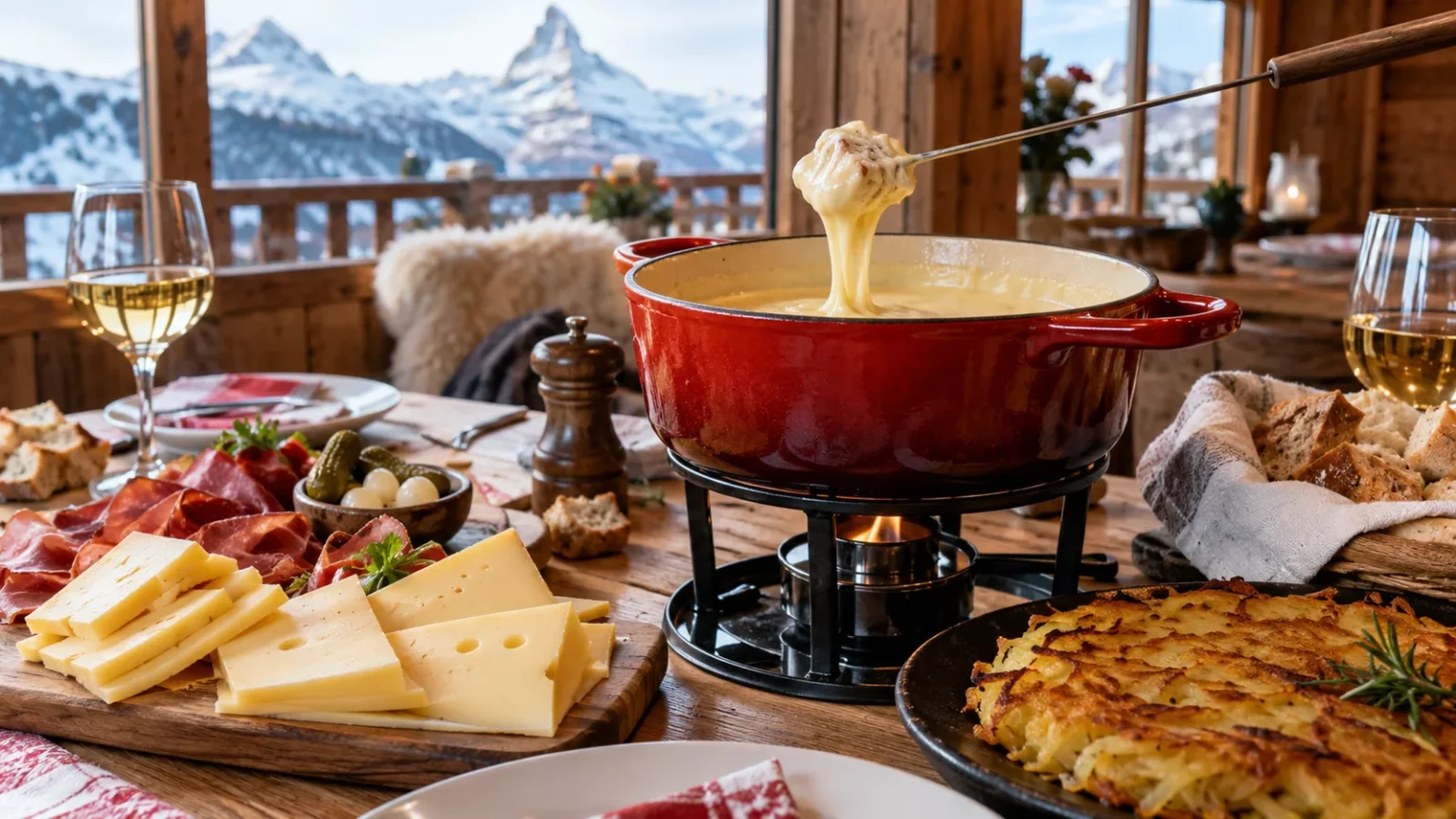
Cheese fondue is worth ordering at least once, but it is best treated as a full meal rather than a novelty snack. Bread is dipped into melted cheese kept warm in a ceramic pot called a caquelon. Common cheese combinations include Gruyère and Vacherin Fribourgeois, while recipes vary considerably by canton and restaurant. Swiss federal information identifies fondue as one of the country’s major national dishes.
One particularly useful version to know is fondue moitié-moitié, associated with Fribourg. It combines Gruyère AOP and Vacherin Fribourgeois AOP in roughly equal proportions. Switzerland Tourism describes this as one of the country’s best-known fondue styles.
Fondue is rich enough that ordering several additional mains is rarely necessary. A simple salad or cured-meat starter followed by one shared fondue can make more sense than trying to treat it as a side dish. Restaurants may also price fondue per person and require a minimum of two diners, so read the menu wording before ordering.
Where should you eat fondue in Switzerland?
Fribourg and Gruyères are particularly logical places for fondue, although it is easy to find throughout Switzerland. Alpine villages and traditional restaurants in French-speaking Switzerland also make natural settings for it.
Zurich, Geneva, Lucerne and Interlaken all have plenty of fondue restaurants, but location matters less than avoiding a place whose entire appeal is a photograph of a cheese pot beside a tourist landmark. Check whether the menu identifies the cheese blend and look for restaurants serving several regional dishes rather than only the most obvious visitor favorites.
2. Raclette is not the same thing as fondue
Raclette is melted cheese scraped onto potatoes and usually served with pickled onions and gherkins. Unlike fondue, diners do not dip bread into a communal pot. Traditional raclette is strongly associated with Valais, where Switzerland Tourism describes it as the region’s characteristic cheese dish.
The name refers both to the cheese and the dish. In traditional preparation, the cut surface of a half-wheel is heated and the softened layer is scraped directly onto the plate. Potatoes remain the essential partner, while pickled vegetables cut through the richness.
This is one Swiss food where location genuinely improves the experience. If the itinerary passes through Valais, save raclette for there. Sion, Brig and mountain areas around Zermatt give the dish a regional context that a generic city restaurant cannot quite reproduce.
Fondue or raclette – which should you order?
Choose fondue if you want a long communal meal built around bread and melted cheese; choose raclette if you want individual portions of melted cheese over potatoes. Both can be heavy, so ordering them on consecutive nights is rarely necessary.
Fondue is more interactive and often better for a group. Raclette gives more contrast between cheese, potatoes and pickles and can be easier to portion. Trying one early in the trip and the other several days later makes both feel more distinctive.
3. Rösti is the Swiss dish that fits almost any meal
Rösti is a crisp potato cake made from grated potatoes and fried until golden. It began as a regional food but is now common throughout Switzerland, often served beside meat, eggs or creamy sauces. Switzerland Tourism describes rösti as a flat potato specialty cooked in butter or fat until crisp.
This is one of the easiest Swiss foods to order without building an entire meal around it. A plain rösti can work as a side dish, while versions topped with cheese, bacon or a fried egg become a full meal. Regional variations appear across German-speaking Switzerland.
Rösti is also useful for travelers who want traditional Swiss food without committing to another cheese-heavy dinner. The potatoes still make it filling, but the dish adapts well to different toppings and accompaniments.
4. Älplermagronen is Switzerland’s answer to mountain comfort food
Älplermagronen combines macaroni, potatoes, cheese and cream, usually with fried onions and applesauce. It comes from Central Switzerland and Alpine food traditions, where inexpensive, energy-dense ingredients made practical sense. Switzerland Tourism identifies it as a Central Swiss specialty that has since become popular around the country.
The applesauce can surprise first-time visitors, but it is not a decorative extra. The sweetness and acidity balance the rich pasta, potatoes and cheese. Versions may also include bacon or other additions.
This Swiss dish makes the most sense after an active day. Order Älplermagronen after hiking, skiing or a cold mountain excursion rather than squeezing it between several heavy meals in a city food crawl. It is filling enough to carry the rest of the afternoon.
5. Zürcher Geschnetzeltes is the traditional Swiss food to order in Zurich
Zürcher Geschnetzeltes is thinly sliced veal served in a creamy white-wine and mushroom sauce, traditionally with rösti. It is one of Zurich’s defining dishes and one of the easiest ways to move beyond generic cheese-based Swiss food.
A traditional version centers on tender veal and a sauce that should be rich without drowning the meat. Some preparations historically include veal kidney, although many modern menus serve the dish without it. If that matters, ask before ordering.
Zurich’s Old Town is an obvious place to look, but restaurants a few streets away from the busiest sightseeing corridors can provide better value. Lunch is particularly useful because many Swiss restaurants offer a cheaper daily menu than their evening à la carte selection. Switzerland Tourism notes that lunch menus are generally the most economical sit-down option.
For travelers building a longer route through the country, LitiTravels’ three-week Europe itinerary already includes Switzerland and can help place food stops inside a wider European trip.
6. Berner Platte is one of the heaviest traditional Swiss dishes
Berner Platte is a large Bernese platter built around several meats, potatoes, beans and sauerkraut. Switzerland Tourism connects the dish with a celebration held after the Bernese victory at Neuenegg on March 5, 1798, when households contributed preserved foods to a communal feast.
Modern versions can include ham, bacon, sausages, pork and other meats, making it one of the least subtle meals in this guide. That is not criticism – the dish is designed to be hearty.
Order it when the appetite matches the portion. A cold or rainy day in Bern is far better timing than a quick midday meal before several hours of walking. Sharing may be possible depending on the restaurant.
7. Capuns are one of the best Swiss foods most visitors have never heard of
Capuns are a Graubünden specialty made by wrapping a dough-based filling, often containing meat, in chard leaves. The exact recipe changes from village to village and even family to family. Switzerland Tourism notes that this once-simple farmers’ dish now exists in numerous regional variations.
Capuns are a good example of why a Swiss food trip should not stop at fondue. They belong much more specifically to Graubünden and are therefore harder to find in the same context elsewhere.
Look for them in Chur, the Engadin and traditional restaurants across Graubünden. They may arrive in a creamy sauce and can be surprisingly filling despite appearing smaller than a plate of rösti or pasta.
8. Bündnerfleisch is the easy Graubünden specialty to try without a full meal
Bündnerfleisch is air-dried beef from Graubünden, usually cut into very thin slices. It works as an appetizer, part of a regional platter or a convenient snack rather than a heavy main course. The federal Swiss food overview identifies cured meats among the country’s long-standing culinary traditions and Graubünden as one of the regions with particularly distinct specialties.
This is a smart food to buy from a butcher, deli or supermarket when restaurant meals are starting to dominate the travel budget. Add bread, cheese and fruit and it becomes an easy picnic lunch for a train or hiking day.
The same approach works well throughout Europe: mixing destination restaurants with markets, bakeries and regional products gives a better sense of local food than relying only on formal meals.
9. Ticino polenta shows how different Swiss food becomes south of the Alps
Polenta is one of Ticino’s defining traditional dishes and reflects the canton’s Italian-speaking food culture. Switzerland Tourism describes slow-cooked polenta as a centuries-old staple in the region, traditionally prepared over fire and served with ingredients such as Alpine cheese, sausage or braised meat.
The most atmospheric place to order it is often a grotto, a rustic type of Ticino restaurant associated with regional dishes and local wine. The menu may feel more northern Italian than the cheese-and-potato stereotype many travelers associate with Swiss food.
This regional contrast is exactly why Ticino deserves its own food stop. Traveling from Zurich to Lugano changes more than the language on signs – the food on the plate changes with it.
10. Risotto in Ticino belongs on the Swiss food list too
Risotto is part of traditional food in Italian-speaking Switzerland, often appearing with mushrooms, local wine or regional sausages. Switzerland Tourism specifically lists risotto alla Ticinese among the specialties of Ticino.
It is tempting to dismiss risotto as simply Italian food eaten across the border, but Ticino’s cuisine developed in constant exchange with northern Italy while retaining its own regional products and customs. The same pattern appears throughout Switzerland: national borders do not erase neighboring culinary influences.
Choose either polenta or risotto for a first substantial Ticino meal, then try the other later. Ordering both alongside another heavy main defeats the practical advantage of exploring the region slowly.
Food-focused travelers continuing south into Italy can pair this part of Switzerland with LitiTravels’ guide to the Barolo wine region, where regional food and wine again make more sense together than as isolated attractions.
11. St. Gallen bratwurst has one unusual rule
St. Gallen bratwurst is a mild, finely seasoned sausage traditionally eaten without mustard. Switzerland Tourism specifically notes the no-mustard custom when describing this eastern Swiss specialty.
The reason to try it is not complexity. This is straightforward street and casual food that works between sightseeing stops. Order it from a butcher, market stall or simple food counter rather than assuming every Swiss specialty requires a formal restaurant.
Eating it without mustard is part of the local tradition, although nobody needs to turn lunch into an etiquette test. Try the sausage plain first and decide afterward.
12. Birchermüesli is the Swiss breakfast that traveled around the world
Birchermüesli combines oats with apple and other ingredients such as nuts and dairy and was developed around 1900 by Swiss doctor Maximilian Oskar Bircher-Benner. Switzerland Tourism includes it among the country’s best-known national foods.
Modern versions vary enormously. Hotel breakfasts may be creamier and sweeter than the original health-focused preparation, while cafés add berries, yogurt, seeds and other toppings.
It is one of the easiest traditional Swiss foods to try without spending much. A bakery, café or hotel breakfast is enough – there is little reason to search for an expensive “authentic muesli experience.”
13. Swiss chocolate is worth buying beyond the airport brands
Swiss chocolate deserves its reputation because Swiss producers played a major role in developing milk chocolate and the conching process that produces a smoother texture. Switzerland’s federal information portal credits Daniel Peter with combining milk and chocolate in 1875 and Rodolphe Lindt with developing conching in 1879.
Large brands are easy to find, but a food trip becomes more interesting when chocolate is treated like cheese: compare several producers instead of buying one souvenir box. Independent chocolatiers in Zurich, Bern, Lausanne, Geneva and other cities offer pralines and bars that are easier to taste in small quantities.
Supermarkets are also useful. A grocery-store chocolate shelf shows brands and price points that residents actually buy and costs far less than a tourist gift shop.
14. Zuger Kirschtorte is the dessert to remember in Zug
Zuger Kirschtorte is a layered cake flavored with Kirsch, the cherry spirit closely associated with Zug. Switzerland Tourism describes the cake as a combination of almond meringue, sponge, buttercream and Kirsch and traces its creation to Zug pastry chef Heinrich Höhn in 1921.
Because alcohol is integral to the flavor, this is not simply another cream cake. A small slice with coffee is usually enough, especially after a full meal.
Zug is the obvious place to try it, although bakeries elsewhere in Switzerland may sell versions. If the itinerary already passes between Zurich and Lucerne, adding a cake stop in Zug can fit without creating an entirely separate food excursion.
15. Brisolée is the Swiss food to look for in autumn
Brisolée is a Valais autumn tradition centered on roasted chestnuts, commonly accompanied by local wine, cheese, fruit and cured meats. Switzerland Tourism identifies it specifically as a seasonal Valais specialty.
This is one reason October can be a particularly interesting month for Swiss food. Cheese dishes make sense as temperatures cool, while chestnuts and other seasonal ingredients begin appearing on menus.
Travelers visiting Valais outside autumn should not chase brisolée simply because it appears on a must-eat list. Eat seasonally and switch to raclette, dried meat or another regional specialty instead.
Where should you eat Swiss food? Match the dish to the region
The best place to eat Swiss food depends on the dish rather than the fame of the city. Zurich is ideal for Zürcher Geschnetzeltes, Valais for raclette, Fribourg for fondue, Graubünden for capuns and Ticino for polenta. This regional approach produces a much stronger food trip than ordering every Swiss classic in central Zurich.
| Region | What to order first | Good secondary choices |
|---|---|---|
| Zurich | Zürcher Geschnetzeltes | Rösti, Birchermüesli, chocolate |
| Bern | Berner Platte | Rösti, regional cheese |
| Fribourg / Gruyères | Fondue moitié-moitié | Gruyère cheese |
| Valais | Raclette | Dried meat, brisolée, cholera |
| Central Switzerland | Älplermagronen | Sbrinz, Luzerner Chügelipastete |
| Graubünden | Capuns | Bündnerfleisch, nut tart |
| Ticino | Polenta | Risotto, local sausages |
| St. Gallen | St. Gallen bratwurst | Appenzeller cheese nearby |
| Zug | Zuger Kirschtorte | Kirsch |
| Geneva / Lausanne | Fondue and western Swiss dishes | Chocolate, lake-region specialties |
The map changes with the menu. Do not save all traditional Swiss food for one night in Zurich if the trip already crosses several cantons.
Where to find Swiss food in Zurich
Zurich’s Old Town is the easiest area for traditional Swiss food, but better value often appears outside the most photographed streets. Niederdorf and the wider Altstadt have many restaurants serving rösti, fondue and Zürcher Geschnetzeltes. Moving toward residential districts can reduce the concentration of tourism-oriented menus.
Lunch is particularly useful for value. A Tagesmenü or menu of the day can cost less than ordering à la carte in the evening. Switzerland Tourism currently gives CHF 20–50 as a broad range for an à la carte main course, while specifically pointing to lunch menus, snack bars and department-store restaurants as cheaper alternatives.
For Zürcher Geschnetzeltes, look for traditional Swiss restaurants rather than a place where the menu jumps from fondue to burgers, pizza and five unrelated cuisines.
Where to eat traditional Swiss food in Bern
Bern is a good city for rösti, Berner Platte and hearty German-speaking Swiss food. Restaurants around the Old Town are convenient, but the highest-traffic streets are not automatically the best place to judge local cuisine.
Berner Platte is substantial enough to deserve a dedicated meal. If it appears beside half a dozen other meat-heavy dishes, ask about portion size before adding starters. Rösti offers a lighter entry point and can be ordered with different toppings.
Markets, bakeries and food counters are also useful in Bern. A trip based entirely on restaurant dinners quickly becomes expensive and unnecessarily heavy.
Where to eat Swiss food in Fribourg and Gruyères
Fribourg and Gruyères are the most logical stops for a cheese-focused Swiss food day. Fondue moitié-moitié combines Vacherin Fribourgeois AOP and Gruyère AOP, linking the dish directly with the region.
Gruyères can be busy with day visitors, so eating at the busiest moment may mean paying for location as much as food. An early or late lunch can make the experience calmer.
There is no need to combine cheese tasting, fondue and another heavy cheese dinner in the same day. One strong fondue meal plus smaller tastings gives more contrast.
Where to eat in Valais
Valais is the region to prioritize for raclette, dried beef and seasonal brisolée. Its food works naturally with mountain travel, vineyards and colder evenings. Raclette is especially tied to the region and remains one of the strongest examples of a Swiss dish that is more rewarding in its home canton.
Sion makes a practical urban base, while mountain destinations such as Zermatt offer many traditional menus at higher tourist-area prices. A village restaurant outside the most expensive resort centers may provide better value if transport fits the itinerary.
In autumn, watch for chestnut-focused menus and brisolée rather than insisting on the exact same dishes visitors order in winter.
Where to eat in Ticino
In Ticino, look for a grotto and order polenta, risotto or regional sausage rather than another plate of fondue. The food culture becomes visibly more Italian-influenced, and this change is part of the value of traveling south through Switzerland.
Lugano and Locarno have broad restaurant scenes, but a traditional grotto outside the busiest central streets can provide the clearest regional experience. Menus often feature polenta with meat, mushrooms or cheese alongside local Merlot.
This is one of the best regions for breaking the assumption that Swiss food is uniformly Alpine and dairy-heavy.
How much does Swiss food cost in 2026?
Eating out in Switzerland is expensive, but lunch menus and casual food can reduce the cost substantially. Switzerland Tourism currently says an à la carte main course typically costs around CHF 20–50, while the menu of the day is usually the cheaper restaurant option.
Exact prices vary sharply between a mountain resort, central Zurich and a smaller town, so rigid daily budgets age quickly. It is more useful to plan meals by category.
| Meal type | Value strategy |
|---|---|
| Breakfast | Bakery, hotel breakfast or supermarket |
| Casual lunch | Sandwich, sausage, bakery dish or supermarket meal |
| Sit-down lunch | Choose the daily menu |
| Traditional dinner | Spend more on one regional specialty |
| Snacks | Cheese, chocolate, bread or cured meat from shops |
| Mountain meal | Expect a premium for location and transport access |
You may also be interested in our article: 15 Glasgow Foods Worth Trying on Your First Visit in 2026
A strong food budget usually mixes one restaurant meal with simpler food rather than trying to save money at every sitting. Spend where the dish is genuinely regional and simplify meals that are only filling a gap between attractions.
7 ways to eat Swiss food without overspending
The easiest way to spend less on Swiss food is to stop treating every meal as a restaurant event. Bakeries, supermarkets, markets and daily lunch menus are part of the local food landscape and can make the trip more varied rather than less interesting.
Use these strategies:
- Order the Tagesmenü at lunch. Daily restaurant menus are generally cheaper than evening à la carte meals.
- Buy cheese and cured meat from a supermarket or market. Turn them into a picnic with bread and fruit.
- Save fondue and raclette for one good restaurant each. Repeating expensive cheese dinners adds little after the first few.
- Use bakeries for breakfast. There is little reason to pay restaurant prices every morning.
- Eat regional specialties where they originate. A meal in the right canton provides more value than ordering a tourist version elsewhere.
- Carry a reusable water bottle. Swiss tap water is safe to drink.
- Do not assume the city center is the only place for traditional food. A short walk away from the main attraction can change both the menu and price.
The point is not to make Switzerland cheap. It is to spend deliberately on food experiences that would actually be difficult to recreate somewhere else.
Travelers who like building trips around casual local eating can also compare the Swiss approach with LitiTravels’ guide to street food in Spain, where regional differences matter just as much as famous national dishes.
Swiss restaurant etiquette is easier than it looks
Service is included in Swiss restaurant prices, so tipping is optional rather than mandatory. Switzerland Tourism says rounding up the bill is common, while roughly 5–10% can be left for good service if desired.
Lunch is generally served around noon to 2 p.m., while dinner commonly starts around 6 p.m. and continues into the evening. Many urban restaurants offer continuous hot food, but smaller traditional restaurants may keep more limited kitchen hours.
Reservations are sensible for popular restaurants, weekends and well-known fondue places. Switzerland Tourism specifically recommends booking in cities and at weekends, particularly for groups.
Tap water is safe to drink, although restaurant policies around serving it can differ. If drinking water throughout the day, refilling a bottle before leaving the hotel or public fountain areas can reduce unnecessary purchases.
What should vegetarians eat in Switzerland?
Vegetarian travelers can eat well in Switzerland, particularly with fondue, raclette, rösti, Älplermagronen, polenta and many modern city menus. Switzerland Tourism notes that vegetarian and vegan choices are widely available in cities.
The main thing to check is hidden meat. Rösti toppings, Älplermagronen and regional soups can include bacon, while capuns traditionally often contain meat. Ask rather than assuming a potato- or cheese-based dish is vegetarian.
Ticino can be especially useful because polenta, risotto and Italian-influenced menus broaden the choices beyond cheese dishes.
What Swiss food should you buy as a souvenir?
Chocolate, hard cheese and packaged regional specialties travel better than anything that depends on refrigeration or immediate serving. Swiss chocolate is the obvious choice, but regional biscuits, nut tart and selected cheese can create a more distinctive food souvenir.
Zuger Kirschtorte contains Kirsch and is delicate, making it less convenient for a long flight than packaged chocolate. Bündner Nusstorte from Graubünden is sturdier and easier to transport. Hard cheeses may travel well for shorter journeys, but customs rules at the destination country still matter.
Avoid filling luggage with products that are readily available at home unless the Swiss version or producer is genuinely different.
What should you order if you have only three meals in Switzerland?
With only three chances to eat traditional Swiss food, choose one cheese dish, one regional main and one lighter local specialty. Trying fondue, raclette and Älplermagronen in 24 hours proves very little except that Swiss dairy products are filling.
A balanced three-meal plan looks like this:
- First meal – Fondue or raclette. Pick one iconic cheese experience.
- Second meal – A regional dish. Choose Zürcher Geschnetzeltes in Zurich, capuns in Graubünden or polenta in Ticino.
- Third meal – Rösti or a regional lunch plate. Finish with something simpler, then add Swiss chocolate or cake separately.
This creates more range while still covering the food most travelers expect to try.
The biggest mistake is thinking there is one Swiss cuisine
Swiss food is better understood as a collection of regional cuisines than as one fixed national menu. Switzerland’s federal information portal explicitly links this diversity to the country’s neighboring cultures, linguistic regions, agriculture and climate.
German-speaking Switzerland brings dishes such as rösti, sausages and Zürcher Geschnetzeltes. Western Switzerland is closely associated with cheese dishes including fondue, while Valais has its own strong raclette tradition. Graubünden adds capuns and air-dried meat. Ticino shifts toward polenta, risotto and northern Italian influences.
That regional structure is the most useful thing to remember before a trip. Instead of asking “Where can I try Swiss food?”, ask “What should I eat in this canton?” The answer becomes much more interesting.
8 Swiss food mistakes to avoid
Most Swiss food mistakes come from ordering according to stereotypes instead of location, season and appetite. The famous dishes are worth trying, but they make more sense when they are spaced across the trip.
Avoid these common mistakes:
- Eating fondue every night. One good fondue is enough to understand the experience.
- Confusing raclette with fondue. They use melted cheese differently and create very different meals.
- Ignoring regional specialties. Capuns in Graubünden or polenta in Ticino may be more meaningful than another generic cheese dish.
- Ordering several heavy Swiss dishes at one sitting. Many traditional foods were designed for cold weather and physical work.
- Skipping lunch menus. They are one of the easiest ways to reduce restaurant costs.
- Assuming a potato dish is automatically vegetarian. Bacon and meat accompaniments are common.
- Leaving a mandatory 20% tip. Service is already included, and tipping is optional.
- Buying all food souvenirs at the airport. Supermarkets, bakeries and specialist shops usually give a broader picture of what is actually eaten locally.
A food trip does not need dozens of dishes. It needs enough contrast that each meal still feels connected to the place where it is eaten.
What Swiss food is worth planning a trip around?
Fondue, raclette, Zürcher Geschnetzeltes, capuns and Ticino polenta are the Swiss foods most worth matching deliberately to a region. Rösti, chocolate and Birchermüesli can be tried almost anywhere, while dishes such as Zuger Kirschtorte and Berner Platte make sense when the route already passes through their home cities.
The best Swiss food itinerary therefore follows the journey itself. Eat Zürcher Geschnetzeltes in Zurich, shift to fondue around Fribourg, try raclette once the route reaches Valais and let the menu become Italian-influenced in Ticino. That progression explains Swiss cuisine more effectively than any single restaurant can.
Switzerland may be small, but its food map is not. The best meal is often the dish that belongs exactly where you happen to be standing.
FAQ about Swiss food
What is the most famous Swiss food?
Cheese fondue, raclette, rösti and Swiss chocolate are among the most internationally famous Swiss foods. Älplermagronen and Zürcher Geschnetzeltes are also widely eaten inside Switzerland.
What is Switzerland’s national dish?
Switzerland does not have just one universally accepted national dish. Fondue, raclette, rösti and Birchermüesli are commonly described among its national foods, while Swiss cuisine itself remains strongly regional.
What should you eat in Switzerland besides fondue?
Try rösti, Älplermagronen, Zürcher Geschnetzeltes, capuns, Bündnerfleisch, Ticino polenta, risotto, Berner Platte and regional sausages. The best choice depends on which canton you are visiting.
Is Swiss food mostly cheese?
No. Cheese is important, but traditional Swiss food also includes potatoes, pasta, sausages, cured meats, veal, cornmeal, breads, cakes, chestnuts and regionally influenced dishes.
What food should you try in Zurich?
Zürcher Geschnetzeltes with rösti is the most distinctive traditional Zurich meal. Birchermüesli also has strong connections with Zurich, while Swiss chocolate is easy to sample throughout the city.
What food should you try in Ticino?
Polenta and risotto are two essential Ticino dishes. Traditional grotti also serve regional sausages, braised meats, cheese and local wine.
Is food expensive in Switzerland?
Yes, restaurant meals can be expensive. Switzerland Tourism currently gives roughly CHF 20–50 for an à la carte main course and recommends lunch menus, snack bars and department-store restaurants for lower-cost meals.
Do you tip in Swiss restaurants?
Tipping is optional because service is included. Rounding up is common, while an additional 5–10% can be used for good service if desired.
Can vegetarians eat traditional Swiss food?
Yes. Fondue, raclette, many rösti preparations, Älplermagronen and polenta can all be vegetarian, although recipes should be checked because bacon or other meat may be added.
When is the best time to try traditional Swiss food?
Swiss food is available year-round, but autumn and winter suit the richest cheese and mountain dishes especially well. Valais brisolée is specifically an autumn tradition, while fondue and raclette are particularly associated with colder-season eating.
Egyptian temples


Author of LitiTravels Portal


Articles by the author:
All articles by author


Maui hiking can mean bamboo forest, volcanic crater, cloud-covered ridge or wild lava coast – sometimes on the same trip. These 10 Maui hikes show which trail fits your fitness, schedule and weather before you commit to the drive.
 September 20, 2026
 6
6
Nashville food starts with fiery hot chicken, but stopping there means missing half the city. From meat-and-three lunches and biscuits to barbecue, banana pudding and Goo Goo Clusters, here is what to eat and how to order it.
September 20, 2026
5

Puerto Rico is more than beaches and Old San Juan. These 21 fact-checked Puerto Rico facts explain the glowing water, rainforest, music, food, history and everyday details you can actually notice on a trip – plus the myths wort...
September 20, 2026
6

The Dominican Republic is much bigger than a resort strip. These 13 places show where to go for beaches, history, whales, waterfalls and mountains – plus how long each stop actually deserves on a first trip.
September 19, 2026
8
Subscribe to “lititravels” on Telegram for gaming intel.
No filler, no fuss—just your daily XP boost. Hop in and level up, squad!



Read also
Glasgow food is much bigger than haggis. The city mixes old-school Scottish comfort dishes, legendary breakfast rolls, chippy culture, South Asian flavours and ambitious modern cooking. Start with these 15 foods and the neighbo...
September 19, 2026
11

San Francisco is easier to navigate safely when you know how quickly conditions can change from one block to the next. Here is what visitors need to know in 2026 about neighborhoods, nighttime travel, transit, car break-ins and...
September 18, 2026
13

Edinburgh is much easier to enjoy when you stop treating it as one long checklist. This 2026 guide picks the sights worth your time, shows which ones fit together and reveals where to go when the Royal Mile starts feeling too c...
September 17, 2026
11

Looking for the right beach hotel in Greece? Here’s an honest review of Alboro Seaside Suites. When travelers imagine Greece, they often picture whitewashed buildings, crowded beaches, and busy promenades. But there are still p...
 September 21, 2025
472
September 21, 2025
472

The Cabot Trail in Nova Scotia is one of Canada’s most scenic road trips, blending stunning coastal views, thrilling outdoor adventures, and rich cultural experiences. Here are five highlights that make this journey unforgettab...
April 2, 2025
382

Autumn in Europe is just a vibe. Starting with the cool days of October, the thinner crowds make it a totally perfect time to get outdoors and explore. You can catch vibrant colors of fall, food, and festivals, sans chaos from ...
April 5, 2025
430

Barcelona is not only a city with magnificent architecture and a fine sand coastline but also a leisure destination for travelers searching for free places to visit in Barcelona. If you wish to know more about the area’s cultur...
March 20, 2025
855

London is among the number one tourist destinations, and it hosts more than 10 million visitors per year. In order to ensure that you have the best travel experience ever, we have provided easy travel tips London to understand ...
February 13, 2025
329

Paris is an awesome city, but finding affordable hotels in Paris can be tricky. There are tons of options, and prices can skyrocket fast. Want to save some cash and still enjoy the vibe? Check out this article. You’ll lea...
February 3, 2025
528

Kutná Hora is a town in the Czech Republic, an hour away from Prague. It’s filled with stunning ossuary, St. Barbara’s Church, and exquisite medieval charm. So, if you happen to wonder where you should go and how to...
January 21, 2025
311

Cooperation
Looking to shine a spotlight on your project? LitiTravels has you covered! We offer article-based promotion, manage branded blogs on our platform, drive engagement through our social media channels, and create content that delivers real results. Get in touch today and let’s make your brand stand out!
Subscribe to the monthly news digest from LitiTravels
The main news and updates from the team about gadgets, sports, cars, health, and lifestyle.
