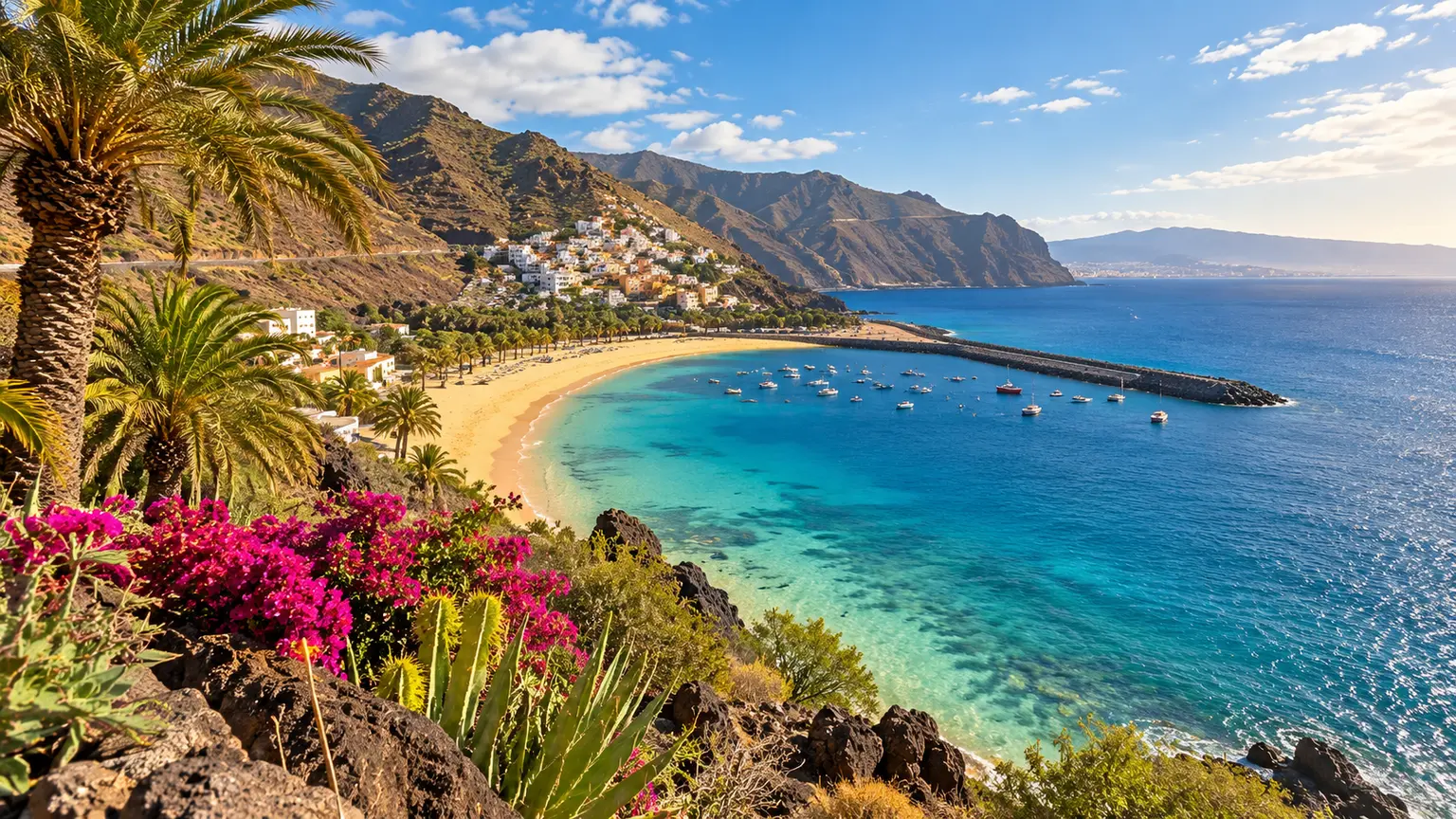
Home DestinationsCanary Islands in November: Which Island Is Best for Warm Weather, Beaches, and Hiking?
DestinationsCanary Islands in November: Which Island Is Best for Warm Weather, Beaches, and Hiking?
The Canary Islands in November offer something increasingly difficult to find in Europe: beach-friendly afternoons, swimmable Atlantic water, and mountain trails that are usually more comfortable than during the summer heat. Coastal daytime temperatures commonly reach 73–77°F (23–25°C), while the ocean generally stays around 70–73°F (21–23°C).
But choosing the right island matters more than the temperature forecast might suggest.
Southern Tenerife can be sunny while the island's northern mountains sit beneath clouds. Gran Canaria combines sheltered resort beaches with surprisingly green highlands. Lanzarote offers dry volcanic landscapes, while Fuerteventura has some of the archipelago's finest sandy beaches but can feel cooler when the wind picks up.
The western islands are different again. La Palma and La Gomera appeal to hikers who would happily trade a perfectly sunny beach day for forests, dramatic ridgelines, and quieter villages.
For most first-time visitors, southern Gran Canaria and southern Tenerife are the strongest all-around choices. Fuerteventura is particularly attractive for long beaches, Lanzarote for dry weather and volcanic scenery, and La Palma or La Gomera for hiking-focused vacations.
This guide compares all seven main Canary Islands, explains the November weather by region, and helps travelers choose where to stay, whether the sea is warm enough for swimming, and how to organize a three-, five-, or seven-day trip.
The best Canary Island in November depends on whether the priority is reliable sunshine, sandy beaches, hiking, family resorts, or exploring quieter landscapes. No single island is objectively best for every traveler.
The comparison below focuses on how each destination performs as a complete vacation experience rather than ranking islands solely by their average temperature.
|
Island |
Best for |
November weather |
Main advantage |
Main trade-off |
|
Gran Canaria |
Best overall balance |
Warm, especially in the south |
Beaches, mountains, villages, and resort variety |
Northern and inland areas can be cooler and cloudier |
|
Tenerife |
First-time trips and varied activities |
Warm, driest in the south |
Beaches, Mount Teide, forests, and excellent facilities |
Longer distances and busy resort areas |
|
Lanzarote |
Dry weather and volcanic landscapes |
Generally sunny with limited rainfall |
Unique scenery, compact sightseeing routes |
Exposed beaches can be windy |
|
Fuerteventura |
Sandy beaches and coastal walks |
Warm, dry, potentially breezy |
Long stretches of sand and open coast |
Fewer major cultural attractions |
|
La Palma |
Serious hiking and nature |
Mild coast, wetter mountains and eastern areas |
Dramatic trails, forests, volcanic scenery |
Less predictable beach weather |
|
La Gomera |
Forest hiking and quiet villages |
Mild coast, misty central highlands |
Garajonay National Park and uncrowded trails |
Limited resort infrastructure |
|
El Hierro |
Solitude, diving, and nature |
Mild but locally variable |
Wild scenery and a slower pace |
Limited transport and conventional sandy beaches |
For a vacation combining beach afternoons with short mountain excursions, Gran Canaria is particularly practical. Travelers who want a major volcano, larger resorts, and more extensive sightseeing options may prefer Tenerife.
A useful distinction is that the best island for sunshine is not automatically the best island for comfortable swimming. Rainfall, coastal exposure, wind, and wave conditions all influence how enjoyable a beach actually feels.
November is generally warm on the Canary Islands' coasts, but the month marks a transition toward wetter winter conditions. Low-lying eastern islands and sheltered southern resort areas typically have better chances of dry weather than northern slopes and some western islands.
Spain's State Meteorological Agency, AEMET, publishes long-term climate normals for representative weather stations. Its 1981–2010 reference series provides a useful basis for comparing November conditions, although it cannot predict the weather on a particular vacation.
Average daytime highs at the main coastal weather stations range from approximately 73–77°F (23–25°C). Nights are cooler, commonly falling into the low-to-mid 60s Fahrenheit.
The following figures are from representative AEMET airport stations. They describe those locations, not every beach, village, or mountain on each island.
|
Island and weather station |
Average daytime high |
Average nighttime low |
Average November rain |
|
Tenerife South Airport |
76.6°F / 24.8°C |
64.8°F / 18.2°C |
26 mm |
|
Gran Canaria Airport |
75.6°F / 24.2°C |
64.6°F / 18.1°C |
22 mm |
|
Lanzarote Airport |
75.6°F / 24.2°C |
63.0°F / 17.2°C |
15 mm |
|
Fuerteventura Airport |
75.2°F / 24.0°C |
63.9°F / 17.7°C |
13 mm |
|
La Palma Airport |
74.3°F / 23.5°C |
64.9°F / 18.3°C |
70 mm |
The differences in daytime temperature are relatively small. Rainfall varies much more, making it a more useful consideration for travelers hoping to spend most of the vacation outdoors.
These are long-term historical averages, not a November 2026 forecast. Some trips will be warmer, cooler, wetter, or sunnier than the figures suggest.
Yes, southern resort areas on mountainous islands often have warmer, drier, and sunnier conditions than northern slopes. This difference is particularly noticeable on Tenerife and Gran Canaria.
Moist Atlantic air can rise over the mountains, creating clouds and rainfall on windward slopes. The sheltered south or southwest may remain sunny at the same time.
On Tenerife, this creates a meaningful choice between the beach-oriented south and the greener north. Costa Adeje and Los Cristianos generally suit November sun seekers better than Puerto de la Cruz, although the latter has its own attractions.
Gran Canaria has a similar contrast. Maspalomas and Puerto Rico are more practical for a beach-focused holiday than assuming Las Palmas de Gran Canaria will always have the same weather.
Check forecasts for the specific resort, not merely for Tenerife or Gran Canaria as a whole. A single island-wide forecast can conceal substantial local differences.
Rain is possible throughout November, but the eastern islands and sheltered southern coastal regions usually experience fewer wet days than the wetter western and northern areas.
At Fuerteventura Airport, the long-term November average is approximately 13 mm of rain across 2.2 days with at least 1 mm of precipitation. Lanzarote Airport averages around 15 mm over three such days.
La Palma Airport records about 70 mm across nearly seven days on the same historical basis.
That does not mean La Palma experiences continuous rain, nor does it guarantee dry conditions on Fuerteventura. A brief but intense Atlantic weather system can affect several islands, and local conditions can change rapidly.
Travelers whose vacation depends almost entirely on sunbathing should favor a sheltered coastal base and retain some flexibility for unsettled days.
The sunnier coastal stations typically record approximately six to seven hours of actual sunshine per day on a long-term monthly average.
That is different from total daylight, which lasts roughly 10½–11 hours during November. Around the middle of the month, sunset occurs shortly after 6:00 p.m. local time.
An early start makes a difference for sightseeing. A mountain drive that begins late in the afternoon can easily become a return journey in darkness.
November also offers more comfortable temperatures for walking than the hottest summer months, making it an attractive period for combining outdoor activities with resort stays.
Tenerife is one of the best choices in November for travelers who want beaches, mountain scenery, varied attractions, and well-developed tourist facilities. Its southern coast offers relatively dependable warmth, while Mount Teide and the northern landscapes provide substantial alternatives to sunbathing.
The island is particularly appealing for a first trip lasting a week or longer.
Costa Adeje, Los Cristianos, and Playa de las Américas are the strongest options for a sunny resort base. They sit in southern Tenerife, where the climate is generally drier than in the north.
Costa Adeje is especially suitable for travelers seeking comfortable hotels, promenades, restaurants, and organized excursions. Los Cristianos combines beaches with a functioning town atmosphere and ferry connections to other islands.
Playa de las Américas is more oriented toward entertainment and resort life. These areas are close enough to explore together, but their atmospheres differ.
Puerto de la Cruz, on the north coast, is greener and often more appealing to travelers interested in gardens, traditional streets, and the surrounding landscapes. It is less dependable for uninterrupted November sunshine.
Southern Tenerife provides the strongest selection for a conventional November beach holiday. Playa de las Vistas, Playa del Duque, and Playa Fañabé are particularly convenient because they are surrounded by resort facilities and services.
Playa de las Vistas has a broad sandy area and a protected bay, making it popular with families. Playa del Duque offers a more polished resort setting, while Playa Fañabé is convenient for restaurants and beachside walks.
Conditions can still vary daily. A sheltered-looking beach does not guarantee safe swimming during strong Atlantic swell, so always check local flags and lifeguard instructions.
Yes. November is generally an excellent month for many Tenerife hikes because the lower elevations are cooler than during summer. The main complication is that mountain temperatures and trail conditions can differ dramatically from those on the coast.
Teide National Park is the obvious highlight. Its volcanic landscape, viewpoints, and shorter marked walking routes make it worth visiting even for travelers who do not intend to reach the summit.
Mount Teide rises above 12,000 feet (3,700 meters), where temperatures can be close to freezing even when southern beaches are warm.
Certain regulated trails require advance authorization. The Telesforo Bravo summit trail and several other upper-mountain routes are managed through Tenerife ON, with reservation availability generally opening up to 56 days ahead.
A cable car ticket does not automatically include permission to hike to the summit.
Other excellent hiking areas include Anaga Rural Park in northeastern Tenerife and the dramatic landscapes around Masca. Some popular routes, particularly the Masca Gorge descent, operate with reservations and access restrictions.
Tenerife is therefore the best choice for travelers who want to mix beach days with very different landscapes, provided they are willing to plan mountain visits properly.
Best for: First-time visitors, couples, families, volcanic scenery, and mixed beach-and-hiking vacations.
Consider another island if: Long sandy beaches or a compact, low-driving itinerary are the overriding priorities.
Gran Canaria is arguably the best all-around Canary Island in November because it combines sunny southern beaches, substantial resort infrastructure, attractive villages, and mountain hiking within one destination.
It is particularly practical for travelers who want several beach days but do not want every day to revolve around a swimming pool or hotel.
The south and southwest offer the strongest options for a sun-focused vacation.
Maspalomas is a versatile base with beaches, dunes, restaurants, hotels, and access to transportation. Adjacent Meloneras offers a more polished resort atmosphere, with a seafront promenade and upscale accommodation.
Puerto Rico is particularly useful for sheltered beaches and a resort-oriented stay. Nearby Amadores Beach is popular for its protected setting, while Puerto de Mogán combines a small harbor, restaurants, and a scenic village atmosphere.
Las Palmas de Gran Canaria, the island's capital, provides a very different experience. It has urban beaches, shopping, history, and restaurants, but the northeast coast can be cloudier than the southern resorts in November.
For a first-time beach trip, Maspalomas, Meloneras, Puerto Rico, or Amadores are more dependable choices.
Maspalomas Beach and Playa del Inglés offer long stretches of sand and plenty of space for walking. They are excellent for beach time, although parts of the coast may be exposed to waves.
Amadores is a useful option when calmer-looking water and easy resort access matter. Puerto de Mogán is another attractive possibility for combining a smaller beach with restaurants and a harbor.
Las Canteras Beach in Las Palmas is also worth considering, especially for travelers staying in the capital. Parts are protected by an offshore reef, although swimming conditions vary along its length and with the tides.
For travelers with children, a lifeguarded beach with manageable entry conditions is more important than choosing the island's most famous shoreline.
Yes. Gran Canaria's interior contains pine forests, volcanic formations, deep valleys, and mountain villages that feel very different from the southern coast.
Roque Nublo is one of the island's most recognizable natural landmarks. The volcanic rock formation stands high above the surrounding mountains and can be reached by a designated hiking route.
Advance reservations are required for regulated access to the main Roque Nublo trail during controlled visiting hours. The local authorities introduced this system to manage visitor numbers, and parking near the main trailhead is restricted.
Travelers should plan parking, shuttle transportation, and access arrangements before heading into the mountains.
Other rewarding areas include Tejeda, Cruz de Tejeda, the surrounding viewpoints, and hiking routes through the island's central highlands.
Temperatures at altitude can be much lower than in Maspalomas, particularly during cloudy or windy weather. Proper walking shoes and warm layers are important.
Best for: Couples, families, first-time visitors, relaxed beach holidays, and travelers who want accessible hiking.
Consider another island if: Remote landscapes, solitude, or a mainly wilderness-focused itinerary matter more than resort facilities.
Lanzarote is one of the strongest Canary Islands in November for travelers who want relatively dry weather, dramatic volcanic scenery, and an island that is manageable for a short road trip.
Its landscape is unusually distinctive. Dark lava fields, low volcanic cones, white villages, and vineyards planted into volcanic soil create a striking contrast with the blue Atlantic.
Playa Blanca is an excellent southern base for a relaxed beach holiday. It provides restaurants, hotels, a waterfront promenade, and convenient access to beaches on the island's southern coast.
Puerto del Carmen offers more nightlife, a large range of restaurants, and straightforward airport access. It works particularly well for travelers who prefer a lively vacation area.
Costa Teguise is popular for watersports and resort accommodation, although its more exposed position can feel breezy.
For November beach priorities, Playa Blanca is usually the most practical starting point, particularly for travelers who prefer spending time outdoors without lengthy transfers.
Playa Dorada and Playa Flamingo are convenient choices around Playa Blanca. Both have well-established visitor facilities and are easier to include in a relaxed resort schedule.
The Papagayo beaches are among Lanzarote's most beautiful natural coastal areas, with pale sand and dramatic coves. Access is less straightforward than to ordinary resort beaches, and facilities are more limited.
The protected area may have controlled vehicle access or associated charges, so visitors should check current arrangements.
Famara Beach, on the northwest coast, offers spectacular scenery beneath towering cliffs. However, it is more closely associated with surfing and exposed Atlantic conditions than calm, casual swimming.
A beautiful beach is not necessarily a safe swimming beach.
Timanfaya National Park is one of the island's essential attractions. Its volcanic landscapes can be explored through regulated visitor experiences, including the established sightseeing route.
Visitors cannot freely wander across protected volcanic terrain wherever they choose. Designated walking routes and guided access arrangements apply.
Other worthwhile stops include the volcanic vineyards of La Geria, Jameos del Agua, Cueva de los Verdes, and the architecture associated with César Manrique.
A rental car makes sightseeing considerably easier, although organized tours and public transportation can cover selected attractions.
Best for: Couples, photographers, short road trips, dry-weather seekers, and travelers interested in volcanic landscapes.
Consider another island if: Extensive green forests, high mountain hiking, or very long sandy beaches are essential.
Fuerteventura is one of the best Canary Islands in November for travelers whose main priorities are sandy beaches, wide coastal landscapes, and a relaxed seaside vacation.
The island has exceptionally long beaches compared with much of the archipelago. However, wind and ocean exposure are important considerations when choosing the exact location.
Corralejo, in the north, offers restaurants, beaches, dunes, and connections to nearby Lobos Island and Lanzarote. It suits travelers who want more than a quiet resort.
Caleta de Fuste is conveniently positioned near the airport and has a relatively sheltered beach area. It can be practical for shorter family vacations.
Costa Calma and the Jandía peninsula are good choices for travelers focusing on southern beaches and expansive coastal scenery.
Morro Jable combines a beach holiday with restaurants and access to parts of Jandía.
The best base depends on whether the preference is for the northern dunes and excursions or the long beaches of the south.
The Corralejo dunes and surrounding beaches are among the island's main highlights. Large areas of sand and turquoise water create an impressive landscape, although exposed beaches can experience stronger winds and waves.
Sotavento Beach, on the southeastern coast, is famous for its broad sandy shoreline and watersports. Its appearance and water conditions change with tides and weather.
El Cotillo, in the northwest, offers several different coastal environments. La Concha Beach is particularly appealing because its natural reef can provide more sheltered conditions than exposed surf beaches.
Caleta de Fuste is another practical choice for families seeking a relatively protected beach environment with nearby facilities.
For swimming, choose the beach based on daily conditions rather than assuming every Fuerteventura beach is equally calm.
Not necessarily. November generally has less persistent trade-wind intensity than peak summer, but exposed parts of Fuerteventura can still be breezy.
Wind can make an otherwise warm 75°F (24°C) afternoon feel noticeably cooler, particularly after swimming.
It can also influence sand movement, surf conditions, and how comfortable a long beach visit feels.
Travelers who dislike wind should favor sheltered bays and avoid booking solely because a beach looks spectacular in photographs.
Yes, although its hiking experiences differ from the greener, mountainous western islands.
Volcanic walks around Corralejo, coastal paths, and inland viewpoints provide opportunities for exploration. Lobos Island is also popular for walking, subject to its protected-area access procedures and ferry conditions.
Fuerteventura's open landscapes can be rewarding, but shade and freshwater access are limited in many areas. Sun protection and adequate drinking water remain essential even in November.
Best for: Beach lovers, couples, watersports, coastal scenery, and relaxed resort vacations.
Consider another island if: Dense forests, varied mountain hikes, or extensive urban sightseeing are higher priorities.
La Palma is one of the strongest choices for dedicated hikers, particularly those attracted to steep volcanic landscapes, forests, ridgelines, and less resort-oriented surroundings.
It is not the best island for travelers expecting a guaranteed week of sunny beach weather. Its landscapes are rewarding partly because sections of the island receive more moisture.
Caldera de Taburiente National Park is a major highlight, with deep valleys, steep slopes, and trails through dramatic volcanic terrain.
The island also offers routes around Roque de los Muchachos, volcanic landscapes in the south, and extensive walking opportunities through forests and mountain villages.
The Ruta de los Volcanes is a particularly appealing choice for experienced hikers interested in volcanic scenery. It involves exposed terrain and substantial elevation changes, so the full route should not be treated as an easy afternoon walk.
Some routes are affected by access restrictions, weather-related closures, or changes in volcanic areas. The latest official trail status should always be checked before setting out.
Los Llanos de Aridane and the island's western side are useful bases for travelers hoping to balance nature excursions with relatively favorable coastal weather.
Puerto Naos and Tazacorte offer coastal alternatives, although visitors should confirm current access conditions, accommodation availability, and local restrictions before booking.
Santa Cruz de La Palma provides a charming historical setting and convenient access to the eastern side of the island, but this area can be wetter.
La Palma is particularly well suited to travelers willing to change plans according to mountain forecasts.
Best for: Experienced hikers, nature photographers, scenic drives, and travelers who prefer quieter destinations.
Consider another island if: Resort beaches, nightlife, or highly predictable dry weather are the main reasons for traveling.
La Gomera is an excellent November choice for hiking, especially for travelers who enjoy forests, traditional villages, deep ravines, and a quieter atmosphere.
The island offers a different experience from Tenerife or Gran Canaria. Its identity revolves around dramatic terrain and natural landscapes rather than large resort developments.
Garajonay National Park is the island's main natural attraction. Its ancient laurel forests thrive in the humid conditions of the central highlands, creating moss-covered trees, dense vegetation, and atmospheric walking routes.
November can be particularly appealing because cooler temperatures make long hikes more comfortable. However, rain, mist, and slippery paths are common considerations in the forest.
Trails around El Cedro and other designated areas offer varying levels of difficulty. Choose routes based on current access conditions and actual fitness rather than selecting a trail solely from photographs.
The contrast between the central forest and the drier lower elevations makes La Gomera especially interesting for landscape enthusiasts.
Valle Gran Rey is a popular base for visitors seeking a combination of coastal scenery, restaurants, and access to nature.
San Sebastián de La Gomera is useful for ferry arrivals and travelers who want straightforward transportation connections.
Hermigua and Agulo offer quieter environments that suit nature-focused visitors, although getting around can require more planning.
La Gomera is best enjoyed without an overly ambitious schedule. Mountain roads are winding, and apparently short distances can take longer than expected.
Best for: Hiking-focused trips, quiet villages, laurel forests, and travelers avoiding large resort areas.
Consider another island if: Extensive sandy beaches and a wide selection of conventional beach hotels are essential.
El Hierro is particularly rewarding for travelers seeking solitude, volcanic landscapes, diving, and a slower pace of exploration. It is the least conventional choice for a first-time Canary Islands beach vacation.
The island has relatively limited large-scale tourist infrastructure and fewer sandy beaches than Tenerife, Gran Canaria, or Fuerteventura.
El Hierro offers volcanic coastal landscapes, viewpoints, forests, small settlements, and natural swimming areas.
La Restinga is particularly associated with diving. Conditions vary with weather and sea state, and diving excursions should be booked with qualified local operators.
Natural swimming pools provide another distinctive coastal experience, although they are not automatically safe during strong surf.
Hiking routes pass through different landscapes and elevations, often with relatively few other visitors. Transportation and access require more planning than on the larger islands.
El Hierro is best for independent travelers who value nature over resort facilities and are comfortable organizing transport and accommodation in advance.
It is less practical for a short first-time trip centered on sunbathing or for travelers who expect frequent public transportation between attractions.
The appeal lies in its remoteness rather than in offering more conventional holiday activities.
Southern Tenerife is among the strongest choices for warm November afternoons, with a long-term average daytime high of approximately 76.6°F (24.8°C) at Tenerife South Airport.
Lanzarote, Gran Canaria, and Fuerteventura are very close, generally averaging around 75–76°F (24°C) at their representative coastal stations.
The difference between islands is usually smaller than the difference between exposed and sheltered locations on the same island.
A sunny beach at Costa Adeje may feel substantially warmer than a windy shoreline on Fuerteventura, even when both record similar air temperatures.
Warmth should therefore be considered alongside wind, cloud cover, sun exposure, and the availability of protected beaches.
Fuerteventura and Lanzarote are particularly dry on long-term November averages. Their airport stations record approximately 13 mm and 15 mm of rain, respectively.
Southern Tenerife is another strong choice for relatively dry holiday weather.
However, rainfall averages do not predict individual storms. A few hours of heavy rain can account for a significant part of a month's total.
For travelers whose plans depend on hiking or outdoor sightseeing, checking local forecasts and retaining flexibility is more useful than treating an island's climate ranking as a guarantee.
Yes. Swimming in the Canary Islands in November is realistic at many beaches, with Atlantic water temperatures generally around 70–73°F (21–23°C).
The sea retains warmth from the preceding months, so November water can feel more comfortable than it does during late winter or early spring.
Whether swimming feels pleasant depends on individual cold tolerance, wind, cloud cover, and sea conditions.
Sea temperatures are relatively similar across the archipelago, although western islands can have slightly warmer average water in some datasets.
Typical November coastal values fall in approximately these ranges:
These are indicative monthly conditions, not measurements for a particular beach on a particular day.
You may also be interested in our article: Vienna Christmas Markets 2026: Which Ones Are Actually Worth Visiting?
The differences are generally too small to justify choosing an entire island solely because its sea temperature is slightly higher.
Many are suitable for swimming when conditions permit, but the Atlantic can generate powerful waves, rip currents, and shore breaks.
November falls within a period when Atlantic swell can become more substantial, especially on exposed north- and west-facing beaches.
A beach that was calm the previous day may have dangerous conditions after a change in wind or swell direction.
The safest approach is to choose lifeguarded beaches, follow warning flags, and avoid entering the water when local authorities advise against swimming.
Never treat warm weather or a sheltered-looking cove as proof that the sea is safe.
November is one of the more comfortable periods for hiking across much of the archipelago, provided routes remain open and weather conditions are suitable.
Lower temperatures reduce the discomfort of hiking in direct sun, although higher elevations may be cold, wet, or windy.
The best island depends on the landscape and difficulty level the traveler wants.
|
Island |
Hiking highlight |
Best experience |
Important consideration |
|
Tenerife |
Teide National Park |
Volcanic scenery and high-altitude trails |
Permits and mountain weather |
|
Tenerife |
Anaga Rural Park |
Forests, ridges, and coastal views |
Mist, rain, and steep paths |
|
Gran Canaria |
Roque Nublo and Tejeda |
Mountain viewpoints and pine forests |
Controlled trail access |
|
Lanzarote |
Volcanic landscapes and coastal routes |
Dry terrain and unusual geology |
National park restrictions |
|
Fuerteventura |
Coastal and volcanic trails |
Open scenery and ocean views |
Wind, exposure, limited shade |
|
La Palma |
Caldera de Taburiente |
Dramatic mountain trekking |
Long routes and variable weather |
|
La Gomera |
Garajonay National Park |
Ancient laurel forests |
Slippery trails and mist |
|
El Hierro |
Volcanic and forest paths |
Quiet nature exploration |
Limited transport and services |
For experienced hikers, La Palma and La Gomera are particularly rewarding. Tenerife offers the greatest variety, while Gran Canaria is often easier to combine with a family-oriented beach vacation.
Some regulated routes require permits or reservations, but there is no universal permit requirement for hiking throughout the Canary Islands.
On Tenerife, selected routes around Mount Teide require advance authorization through Tenerife ON. This includes the regulated Telesforo Bravo summit route and several upper-volcano trails.
On Gran Canaria, the main regulated approach to Roque Nublo requires advance reservations during controlled access periods. Nearby parking and shuttle arrangements also affect the visit.
Protected volcanic landscapes on Lanzarote have their own rules, with some areas accessible only through designated visits or approved guided routes.
Check the exact trail, not just the national park name. One route may be freely accessible while another nearby requires prior authorization.
Pack for the elevation and forecast of the particular trail rather than the weather at the coastal hotel.
A comfortable outfit for a low-elevation walk may be completely unsuitable for Teide National Park or an exposed mountain ridge.
Useful equipment includes:
The requirements become more demanding on regulated high-mountain routes, where authorities may require specific safety equipment.
Travelers packing for a short hiking vacation can also compare the best travel backpacks for different trip lengths, particularly when choosing between an airline personal item and a separate daypack.
For longer mountain routes, a comfortable hiking-specific backpack is more useful than a travel bag designed only for airport transfers.
The best accommodation location in November depends on the kind of weather and activities expected. A well-chosen southern coastal resort can make a bigger difference than selecting the theoretically warmest island.
The strongest bases for different travel styles are:
|
Travel priority |
Recommended area |
Why it works |
|
First-time beach holiday |
Costa Adeje, Tenerife |
Warm southern coast and varied facilities |
|
Family resort vacation |
Maspalomas, Gran Canaria |
Beaches, hotels, restaurants, and excursions |
|
Sheltered beach time |
Amadores, Gran Canaria |
Protected bay and convenient facilities |
|
Relaxed couples' trip |
Playa Blanca, Lanzarote |
Promenade, beaches, and volcanic excursions |
|
Long sandy beaches |
Morro Jable, Fuerteventura |
Access to Jandía's extensive coastline |
|
Restaurants and excursions |
Corralejo, Fuerteventura |
Northern beaches, town atmosphere, and ferry options |
|
Hiking-focused Tenerife stay |
Puerto de la Cruz or a suitable rural base |
Convenient for northern landscapes |
|
Serious nature vacation |
Western La Palma |
Access to varied landscapes and coastal conditions |
|
Quiet hiking retreat |
Valle Gran Rey, La Gomera |
Nature, coastal scenery, and village atmosphere |
Location matters even within a resort area. An apartment high above the waterfront may involve a steep walk that is inconvenient for families or travelers without a car.
Before booking, check the property's exact position, access to supermarkets and restaurants, public transportation, and whether the nearest beach is suitable for swimming.
A heated pool can be valuable for travelers who want to swim every day, particularly families with young children or anyone who finds 70–73°F (21–23°C) ocean water too cool.
Do not assume that every hotel advertising a swimming pool heats it throughout November.
Confirm whether heating is available, which pools are heated, and whether the service is included in the room rate. The advertised heated pool may not maintain the same temperature every day.
For a hotel-based vacation, this detail can matter more than a difference of one degree in the island's average air temperature.
Early November is generally somewhat warmer, while late November brings a slightly greater chance of cooler weather and unsettled conditions. Both periods can be suitable for beach holidays and hiking.
The month should be treated as a gradual seasonal transition rather than a sudden change from summer to winter.
Early November benefits from residual warmth after October, especially in coastal areas.
Sea temperatures are still relatively mild, and the weather can be particularly appealing for combining swimming with outdoor sightseeing.
Travelers primarily interested in beach time may prefer the first half of the month, although individual conditions remain unpredictable.
Late November remains mild compared with much of Europe, but nights are cooler and the probability of Atlantic weather systems increases.
The period can still provide pleasant beach afternoons, especially in southern Tenerife, southern Gran Canaria, Lanzarote, and Fuerteventura.
For hiking, the cooler temperatures can be an advantage, provided wind, rain, and trail closures are considered.
November is not necessarily a quiet low season. The Canary Islands attract travelers seeking warm weather when many European destinations become cold and wet.
Popular southern resorts can experience substantial demand from international visitors, especially around school holidays and other travel periods.
Hotel prices do not automatically fall simply because the Northern Hemisphere summer has ended.
Travelers comparing October and November conditions can also explore where to find warm weather in Europe in October. The comparison helps distinguish destinations that retain late-season Mediterranean warmth from the Canary Islands' more persistent subtropical climate.
For three days, choose one island and remain in a convenient base. Island hopping introduces airport or ferry transfers that can consume too much of a short vacation.
Gran Canaria and Lanzarote are particularly practical for a compact trip, while southern Tenerife works well for travelers who want to combine a resort stay with one major excursion.
A short Gran Canaria itinerary should focus on the south while reserving one day for the mountains.
This plan offers a useful introduction without trying to cover the entire island.
A three-day Lanzarote visit can combine southern beaches with volcanic sightseeing.
For both islands, leaving one afternoon flexible helps accommodate unexpected wind or rain.
Five days provide enough time for a satisfying mix of beaches, sightseeing, and hiking on one island. There is little need to change accommodation unless the itinerary covers widely separated areas.
Tenerife is especially suitable because its southern resorts and mountain scenery offer distinct experiences.
A balanced Tenerife itinerary might look like this:
This itinerary avoids treating every day as a major expedition.
Driving between southern resorts and northern mountains requires planning, so travelers should check journey times and start longer excursions early.
Seven days are ideal for exploring one main island properly or combining two nearby islands when the transfer is worthwhile.
The better choice depends on travel priorities. A beach-focused vacation may benefit from staying in one resort for the entire week, while an active itinerary can justify a second base.
A one-island Gran Canaria itinerary offers strong variety without changing hotels.
This option works particularly well for travelers who prefer not to spend a large portion of the vacation transferring between islands.
A week combining Tenerife and La Gomera provides greater contrast between resort beaches and forest hiking.
Spend approximately four days on Tenerife and three on La Gomera, allowing for ferry schedules and ground transportation.
Tenerife supplies beaches, larger towns, and the volcanic scenery of Mount Teide. La Gomera adds Garajonay's ancient forests, ravines, and quieter villages.
Ferries connect Los Cristianos on Tenerife with San Sebastián de La Gomera, but actual schedules and sea conditions should be checked before confirming accommodation.
Avoid treating La Gomera as a guaranteed quick day trip for substantial hiking. A longer stay allows more flexibility with weather and mountain roads.
Island hopping can be worthwhile when the trip lasts at least a week and the islands offer genuinely different experiences. For shorter vacations, choosing one island normally produces a more relaxed itinerary.
The archipelago has both inter-island flights and ferry connections, but journey times depend on the particular route.
Tenerife and La Gomera are a natural combination because of the ferry route from Los Cristianos. Lanzarote and Fuerteventura are another practical pairing, with ferries connecting Playa Blanca and Corralejo.
Travelers visiting multiple islands should also account for car-rental conditions. Rental vehicles cannot automatically be taken onto inter-island ferries without the operator's permission.
Booking separate rental cars may be simpler than assuming one vehicle can be used throughout the trip.
La Graciosa is an attractive excursion or short stay for travelers already visiting Lanzarote. The small inhabited island lies north of Lanzarote and is reached by ferry from Órzola.
Its quiet beaches, limited road infrastructure, and volcanic scenery offer a different experience from the larger resort islands.
However, ferry conditions can be affected by wind and sea swell. November visitors should check forecasts and crossing schedules.
La Graciosa is best treated as an optional addition rather than a necessary part of a first-time Canary Islands itinerary.
A rental car is useful for exploring the mountains, smaller villages, and remote beaches, but it is not essential for every November trip.
Travelers staying mainly in southern resorts can often manage with buses, airport transfers, walking, and occasional organized excursions.
The value of a rental car increases considerably for hiking-focused itineraries.
Tenerife and Gran Canaria are among the more practical choices for travelers without a rental car because they have substantial public bus networks, tourist services, and organized excursions.
Lanzarote also offers useful bus connections between major towns and resorts, although some volcanic attractions are easier to visit by tour or car.
Fuerteventura's long distances and dispersed beaches can make independent exploration more time-consuming without a vehicle.
La Palma, La Gomera, and El Hierro generally require more careful transportation planning, especially when starting hikes in remote areas.
A car-free beach vacation is therefore much easier to organize than a car-free itinerary involving several mountain trailheads.
Driving is generally straightforward on main roads, but mountain routes can be steep, narrow, and winding. This is particularly relevant in La Gomera, La Palma, and the interior of Gran Canaria.
Rain, low clouds, and fog can reduce visibility in higher areas.
Allow more time than a direct map distance suggests, and avoid rushing along unfamiliar mountain roads after sunset.
For day trips, offline maps and saved parking locations are useful. The guide to travel apps for navigation, planning, and offline access covers practical tools for handling unfamiliar transportation and unreliable mobile connectivity.
A November Canary Islands vacation can suit different budgets, but accommodation, flights, car rental, and resort location create substantial variation.
The islands are not automatically inexpensive in November. Winter-sun demand can keep popular hotels busy, and prices change significantly with booking dates and room type.
A useful budget separates fixed travel costs from spending that can be controlled during the trip.
The following example is a planning scenario for one adult sharing accommodation and some transportation costs with another traveler. It is not a live price quote or a market-wide average.
|
Expense |
Illustrative seven-day budget |
|
Shared accommodation |
€350 |
|
Food and groceries |
€210 |
|
Share of rental car, fuel, and parking |
€130 |
|
Activities and admission |
€100 |
|
Local extras |
€60 |
|
Contingency reserve |
€100 |
|
Illustrative total |
€950 |
International flights are excluded because departure cities, baggage allowances, and travel dates create large price differences.
The contingency reserve is money set aside for unexpected expenses, not necessarily money that will be spent.
For a traveler staying in a resort without renting a car, transportation expenses may be lower. Someone choosing a premium hotel, multiple guided excursions, or frequent restaurant meals may spend considerably more.
The biggest savings often come from accommodation choices and avoiding unnecessary transportation costs rather than cutting every small daily expense.
A few decisions have a meaningful effect:
It is often better to book a convenient base near the activities that matter most than choose a cheaper property requiring long daily transfers.
Packing for the Canary Islands in November requires both light beach clothing and layers for cooler evenings or high-altitude excursions. A suitcase containing only swimsuits and sandals is insufficient for a trip that includes mountain hiking.
For a standard beach-and-sightseeing vacation, the following items are useful:
Travelers going to Teide National Park or exposed mountain routes may need substantially warmer clothing and specific safety equipment.
Do not pack for the coastal temperature alone if the itinerary includes mountain elevations.
Sun protection remains important in November because UV exposure can still be substantial, especially at altitude.
Most disappointing November trips result from choosing a location that does not match the intended vacation style, rather than from the month itself.
The main mistakes worth avoiding include:
The best preparation is to prioritize the vacation's main purpose, choose a suitable base, and leave some flexibility for the weather.
For most travelers, the choice comes down to four islands.
La Palma and La Gomera are stronger choices for committed hikers, while El Hierro is best for travelers seeking quieter, less conventional island experiences.
November offers unusually good opportunities to combine outdoor exploration with mild coastal weather. The key is not finding an island that promises perfect sunshine every day. It is selecting a destination where the available beaches, trails, and activities still make the vacation worthwhile when conditions change.
Yes. November is a good month for mild coastal weather, beach visits, hiking, and sightseeing. Daytime temperatures often reach 73–77°F (23–25°C), although rain and wind vary by island and location.
Gran Canaria is a strong overall choice for beaches and hiking, while Tenerife offers the greatest variety of attractions. Lanzarote is particularly suitable for dry weather, and Fuerteventura excels for long sandy beaches.
Southern Tenerife has one of the highest long-term coastal November daytime averages, approximately 76.6°F (24.8°C). Lanzarote, Gran Canaria, and Fuerteventura are only slightly cooler at representative weather stations.
Fuerteventura and Lanzarote generally have low average rainfall, while southern Tenerife and southern Gran Canaria offer sheltered resort climates. The best choice also depends on wind, cloud cover, and the planned activities.
Yes. Many November afternoons are warm enough for sunbathing, particularly in sheltered southern resorts. Cloudy or windy days are possible, so conditions are not guaranteed.
Yes. Sea temperatures are typically around 70–73°F (21–23°C). Many travelers find this suitable for swimming, although others may prefer a heated pool.
Tenerife is excellent for varied sightseeing and volcanic scenery, while Gran Canaria is especially convenient for combining southern beach resorts with mountain excursions. Both are strong first-time options.
Lanzarote is generally more suitable for volcanic sightseeing and compact road trips. Fuerteventura is the better choice for travelers prioritizing extensive sandy beaches and coastal relaxation.
No. Southern Tenerife typically has daytime highs around 77°F (25°C), which is comfortable for many outdoor activities. Nights and higher elevations are considerably cooler.
It can be. November is generally less consistently windy than peak summer, but exposed beaches may still experience strong breezes. Sheltered bays can be more comfortable for sunbathing and swimming.
Yes, rain is possible, especially in northern and mountain areas. The southern and southwestern resort regions are generally drier and sunnier.
Yes. Mild temperatures make November suitable for many trails, but mountain weather, closures, and permits require preparation. La Palma, La Gomera, Tenerife, and Gran Canaria are particularly rewarding.
Yes, when weather, trail conditions, and the relevant permissions allow. Certain routes require advance authorization, and summit conditions can be very cold even when southern Tenerife is warm.
Yes, particularly for hiking, volcanic landscapes, and nature photography. It is less suitable for travelers who require consistently dry beach weather.
Yes. La Gomera is excellent for forest hiking and quiet villages. Expect cooler, mistier conditions around Garajonay National Park than on the coast.
The sea is generally warmer in November because it retains heat from summer and early fall. March falls closer to the end of the cooler ocean-temperature period.
They can be, particularly in popular southern resorts. Winter-sun demand means November is not automatically a low-price season. Accommodation location and transportation choices have a major effect on total cost.
Not for every trip. Resort-focused travelers can use buses, transfers, and tours. A rental car is more useful for mountain trails, smaller villages, and remote beaches.
Five to seven days are ideal for exploring one main island with a combination of beaches and sightseeing. Three days work for a short break, while longer trips can accommodate two islands.
October is generally warmer, with slightly warmer sea temperatures. November remains excellent for beach trips and hiking, but it brings cooler evenings, shorter days, and a somewhat greater chance of rain.
Pack swimsuits, light clothing, comfortable shoes, sun protection, and a warm layer for evenings. Add waterproof clothing and proper hiking equipment when visiting mountains.
Yes. Southern Gran Canaria and Tenerife are particularly convenient because of their beaches, family-friendly accommodation, and tourist infrastructure. Confirm pool heating and choose swimming locations based on daily conditions.






Pack a small paper activity folder for a family trip: coloring stories, mazes, counting games and a simple travel journal, with free printable examples.
 October 27, 2026
 0
Vienna's Christmas markets begin opening November 6, 2026, but not every market deserves equal time. Compare palace settings, traditional craft stalls, family activities, quieter neighborhoods, and costs, then plan a route that...
October 27, 20261
Bluetooth headphones usually work perfectly well on a plane, including after airplane mode is switched on. The less obvious problem is connecting them to seatback entertainment. Here is what works, what may not, and what to pac...
October 17, 2026100
Four letters on a boarding pass can change the airport routine. This guide explains the SSSS boarding pass meaning, what secondary screening may involve, whether TSA PreCheck helps, how early to arrive and what to do if SSSS fo...
October 16, 202652Vienna's Christmas markets begin opening November 6, 2026, but not every market deserves equal time. Compare palace settings, traditional craft stalls, family activities, quieter neighborhoods, and costs, then plan a route that...
October 27, 20261
Athens does not have to be an expensive sightseeing city. Many of its best views, ancient landmarks, neighborhoods and local experiences are completely free. Here are 25 things to do in Athens for free or very little, plus a wa...
October 10, 202664
Budapest can swallow a weekend if every famous sight becomes a separate mission. These 25 things to do combine thermal baths, Danube views, grand architecture, food and neighbourhoods into a route that leaves time to enjoy the ...
October 10, 202691
Bali is still worth visiting, but it is no longer the only answer for an Indonesian island escape. These Bali alternatives offer quieter beaches, volcanic landscapes, diving, surf, local culture and adventures that can feel far...
October 9, 202678
Jamaica’s famous rainforest bobsled runs for 3,280 feet through Mystic Mountain above Ocho Rios – but the ride is only one part of the visit. Here is how to choose tickets, avoid timing mistakes and decide whether it belongs in...
October 7, 202669
Jamaica does not have to mean expensive waterfall tours, private drivers and resort excursions. Many of the island’s best experiences cost little or nothing, from long beach walks and mountain views to local markets, street foo...
October 7, 202664
Steaming outdoor pools, snowy Alpine peaks, historic bathhouses and geothermal lagoons make winter one of the best times for a European spa trip. These are the best thermal baths in Europe, with practical advice on cost, atmosp...
October 6, 202688
Many of the best things to do in Prague cost nothing. This practical guide combines famous landmarks with free viewpoints, historic streets, parks and neighborhoods, plus a walkable itinerary that keeps unnecessary ticket spend...
October 6, 202669
Where is hot in Europe in October when summer has already disappeared farther north? These 12 destinations still offer warm days, swimmable seas, outdoor dining, and enough sunshine for a convincing late-season escape.
October 5, 2026121
Ontario camping ranges from easy lakeside weekends to remote canoe routes where the next campsite is hours away. These 15 places show where to camp in Ontario, what each park does best, when to go and what to know before booking.
October 5, 202676
Looking to shine a spotlight on your project? LitiTravels has you covered! We offer article-based promotion, manage branded blogs on our platform, drive engagement through our social media channels, and create content that delivers real results. Get in touch today and let’s make your brand stand out!
The best travel guides, trip planning tips and cultural discoveries from the LitiTravels team — once a month, straight to your inbox.