Home DestinationsVienna Christmas Markets 2026: Which Ones Are Actually Worth Visiting?
DestinationsVienna Christmas Markets 2026: Which Ones Are Actually Worth Visiting?
Vienna's Christmas markets begin opening on November 6, 2026, with the market at Schönbrunn Palace among the first to welcome visitors. The famous Christmas market at Rathausplatz opens November 13, while several other major markets follow later in the month. By November 20, the city's principal festive squares, palace courtyards, and neighborhood markets are scheduled to be operating.
The difficult part is not finding a Christmas market in Vienna. It is choosing between nearly identical-looking listings that promise mulled wine, handmade ornaments, and festive lights. A crowded square outside City Hall offers a very different experience from the narrow streets of Spittelberg or the craft-focused stalls at Karlsplatz.
For first-time visitors, Rathausplatz, Schönbrunn Palace, and Spittelberg are three of the strongest choices, while Karlsplatz deserves priority for handmade gifts and families interested in creative activities. Travelers looking for quieter surroundings should consider Freyung, the University of Vienna Campus, or Türkenschanzpark instead of spending every evening at the largest markets.
This guide compares Vienna Christmas markets in 2026 by opening dates, atmosphere, transportation, admission, and value. It also covers what to do before November 20, which markets remain open after Christmas, where to stay, and how to visit several without wasting time crossing the city.
Vienna Christmas markets start opening on November 6, 2026, but most major markets begin operating between November 13 and November 20. Opening dates vary considerably, so visiting in early November requires more careful planning than arriving during the traditional Advent period.
Schönbrunn Palace opens on November 6. The Vienna Tourist Board also lists November 6 for Stephansplatz, although a separate municipal event listing gives November 20. Travelers specifically visiting Stephansplatz before November 20 should confirm the date with its organizer before making arrangements.
Rathausplatz, Karlsplatz, Spittelberg, and Am Hof are scheduled to open November 13. Freyung and Türkenschanzpark follow on November 14, while Belvedere Palace, Maria-Theresien-Platz, and the Prater winter market open November 20.
The table below summarizes the main published dates, standard hours, and general admission arrangements for the 2026–2027 season. Special holiday hours and individual activity charges are addressed separately.
|
Christmas market |
Opening and closing dates |
Standard opening hours |
Entry |
|
Schönbrunn Palace |
Nov 6, 2026 – Jan 6, 2027 |
Daily 10 a.m.–9 p.m. |
Free |
|
Stephansplatz |
Nov 6–Dec 26* |
Daily 11 a.m.–9 p.m. |
Free |
|
Rathausplatz |
Nov 13–Dec 26 |
Daily 10 a.m.–10 p.m. |
Free |
|
Karlsplatz Art Advent |
Nov 13–Dec 23 |
Daily noon–8 p.m.; food until 9 p.m. |
Free |
|
Spittelberg |
Nov 13–Dec 23 |
Weekdays 2–9:30 p.m.; weekends 11 a.m.–9:30 p.m. |
Free |
|
Am Hof |
Nov 13–Dec 23 |
Mon–Thu 11 a.m.–9 p.m.; Fri–Sun 10 a.m.–9 p.m. |
Free |
|
University of Vienna Campus |
Nov 13–Dec 23 |
Varies; generally afternoon–evening |
Free |
|
Schwarzenbergplatz |
Nov 13–Dec 26 |
Weekdays 11 a.m.–9 p.m.; weekends 10 a.m.–9 p.m. |
Free |
|
Freyung |
Nov 14–Dec 23 |
Daily 10 a.m.–9 p.m. |
Free |
|
Türkenschanzpark |
Nov 14–Dec 23 |
Weekdays 3–10 p.m.; weekends noon–10 p.m. |
Free |
|
Belvedere Palace |
Nov 20–Dec 31 |
Weekdays 11 a.m.–9 p.m.; weekends 10 a.m.–9 p.m. |
Free |
|
Maria-Theresien-Platz |
Nov 20–Dec 26 |
Weekdays 11 a.m.–9 p.m.; weekends 10 a.m.–9 p.m. |
Free |
|
Prater Winter Market |
Nov 20, 2026 – Jan 6, 2027 |
Weekdays noon–10 p.m.; weekends 11 a.m.–10 p.m. |
Free |
|
Hirschstetten Botanical Gardens |
Nov 12–Dec 20 |
Thu–Sun 10 a.m.–10 p.m. |
Free |
The Vienna Tourist Board lists November 6 as the Stephansplatz opening, while Vienna's municipal event calendar lists November 20. The organizer should be consulted before an early-November visit.
Public holidays may follow weekend schedules. The opening hours shown above do not include Christmas Eve, Christmas Day, New Year's Eve, or other special adjustments.
The most important planning distinction is that November 6–12 offers only a limited selection, November 13–19 adds many of the most attractive markets, and November 20 onward provides the broadest choice.
Schönbrunn Palace is the clearest early-November option, opening November 6 and operating daily. Stephansplatz is also listed by the tourist board for November 6, but its conflicting municipal opening date makes it less reliable for advance planning.
This matters for visitors booking a November 6–8 weekend. A city break at that time can still include festive stalls and palace scenery, but it will not offer the same range of Christmas markets as a trip beginning November 20.
By the following weekend, Rathausplatz, Karlsplatz, Spittelberg, and several other markets will have joined the calendar.
Yes, several major Vienna Christmas markets remain open after December 25, although many traditional markets close on December 23. Schönbrunn Palace and the Prater winter market continue until January 6, 2027.
Rathausplatz, Stephansplatz, Maria-Theresien-Platz, and Schwarzenbergplatz are scheduled to close December 26. Belvedere Palace remains open until December 31, while Freyung, Am Hof, Karlsplatz, Spittelberg, and the University Campus market close December 23.
December 24 is not a normal market day. Many stalls close earlier, and visitors should expect additional restaurant, attraction, and retail closures.
For a trip between Christmas and New Year's Eve, Schönbrunn Palace, Belvedere Palace, and Prater provide more dependable options than the smaller Advent markets.
The best Vienna Christmas markets are Rathausplatz for the classic large-scale experience, Schönbrunn Palace for imperial surroundings, Spittelberg for neighborhood atmosphere, and Karlsplatz for arts and crafts. Each offers a sufficiently different experience to justify including it in a short itinerary.
The key is to choose markets based on interests, not simply popularity. Visiting four markets with nearly identical merchandise is less rewarding than combining contrasting settings and experiences.
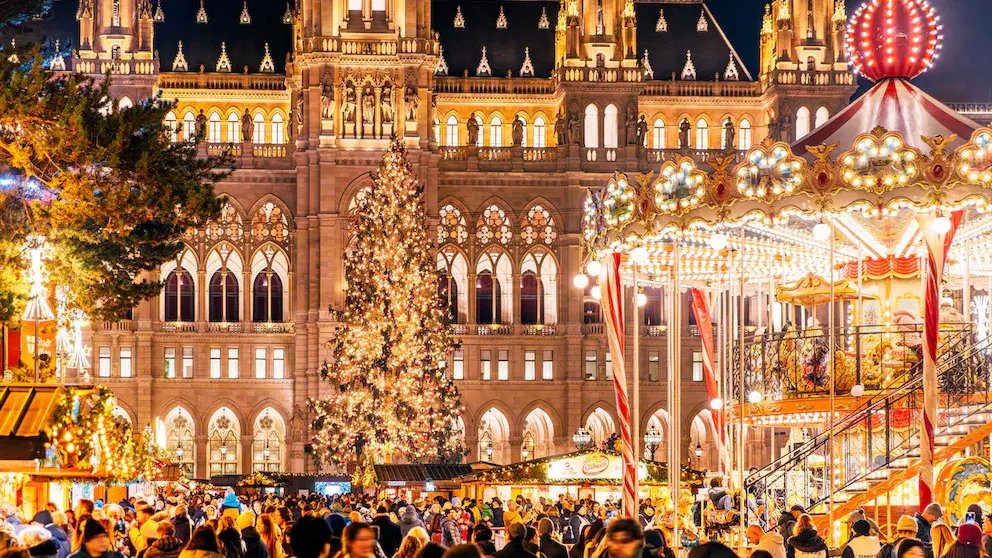
The Rathausplatz Christmas Market is Vienna's most recognizable festive market and the strongest first stop for visitors who want the classic Christmas-card setting. It occupies the square in front of Vienna City Hall, one of the city's most dramatic historic buildings.
Illuminated wooden stalls sell ornaments, handicrafts, festive sweets, warm food, and seasonal drinks. The surrounding City Hall Park adds light installations, decorative features, and family attractions, while the Vienna Ice World skating area provides an activity beyond shopping.
The scale is both the attraction and the drawback. The impressive setting makes Rathausplatz especially rewarding after dark, but the paths can become crowded on Friday and Saturday evenings.
A weekday visit around opening time is easier for browsing merchandise. Travelers primarily interested in photographs and Christmas lights may prefer late afternoon, when the sky darkens and the illuminated Rathaus becomes the focal point.
2026 dates: November 13–December 26.
Hours: Daily 10 a.m.–10 p.m.; December 24 until 6:30 p.m.
Getting there: U2 subway to Rathaus, or trams serving the Rathausplatz/Burgtheater area.
Suggested time: 60–90 minutes, excluding extended skating sessions.
Admission: Free; skating and certain activities cost extra.
The Christmas market closes December 26, but the seasonal ice-skating attraction continues until January 6, 2027, with a closure on December 31.
Rathausplatz is worth visiting once, particularly for a first Christmas trip to Vienna. It is less suitable for travelers who dislike large crowds or primarily want to buy distinctive handmade gifts in a relaxed setting.
Schönbrunn Palace offers one of the most memorable backdrops among Vienna Christmas markets. The market fills the broad forecourt of the former imperial residence, where decorated stalls sit beneath the palace's monumental Baroque facade.
The market is scheduled to feature more than 90 stalls, traditional crafts, regional food, and several family-oriented attractions. Planned activities include a carousel, Ferris wheel, children's train, craft workshop, and skating and curling facilities.
The square feels more spacious than the narrow lanes of Spittelberg, although popular weekends still draw substantial crowds. Daylight allows visitors to appreciate the palace architecture, while evening lights create a more festive atmosphere.
Schönbrunn is also one of the few major markets that can be combined with a substantial cultural attraction without leaving the area. Visitors can tour the palace with a separate ticket, explore accessible parts of the grounds, and return to the market afterward.
2026 dates: November 6, 2026–January 6, 2027.
Hours: Daily 10 a.m.–9 p.m. until December 23; December 24 until 4 p.m.; December 25–January 6, 10 a.m.–7 p.m.
Getting there: U4 subway to Schönbrunn, followed by a walk to the palace forecourt.
Suggested time: 90 minutes–2 hours for the market, longer with palace attractions.
Admission: Free to the market; palace interiors and selected activities require tickets.
The market's early opening and late closing are major advantages. It is an especially strong choice for travelers arriving before November 13 or after Christmas.
Spittelberg is one of Vienna's most distinctive Christmas markets because it occupies historic neighborhood streets rather than a large open square. The stalls extend through narrow lanes in the Neubau district, creating a more intimate setting than the city's major palace markets.
The area's older buildings, small courtyards, and winding streets give the market considerable character. Visitors can move between artisans, food stalls, small shops, and nearby cafes without feeling as though they are walking around one large commercial plaza.
Spittelberg is particularly appealing for handmade goods, sustainable products, and small gifts. Its selection traditionally emphasizes local crafts, fair-trade items, and independently produced merchandise.
The narrow streets are also its main limitation. During busy evenings, pedestrian traffic can become congested, and navigating with a stroller or mobility aid may be more challenging than at a spacious market.
2026 dates: November 13–December 23.
Hours: Monday–Friday 2–9:30 p.m.; weekends and public holidays 11 a.m.–9:30 p.m.
Getting there: U2/U3 to Volkstheater, followed by a short walk.
Suggested time: 60–90 minutes.
Admission: Free.
Spittelberg works especially well in the late afternoon or early evening. A weekday visit gives more time to inspect craft stalls before the busiest dinner-and-drinks period begins.
Art Advent at Karlsplatz is one of the strongest Vienna Christmas markets for travelers interested in handmade products rather than mass-produced souvenirs. It takes place in front of the Karlskirche, the city's imposing Church of St. Charles.
The market places particular emphasis on arts and crafts, with opportunities to see creative work and discover products made by independent artisans. Its setting also includes interactive installations, workshops, and entertainment that make it suitable for families.
One notable feature is the market's commitment to organically certified food offerings. Travelers interested in ingredient quality or more varied festive food options may appreciate this distinction.
Karlsplatz is centrally located and easy to combine with a visit to the historic city center. It also works as an afternoon stop before moving toward Belvedere Palace or other attractions in the southern part of central Vienna.
2026 dates: November 13–December 23.
Hours: Daily noon–8 p.m.; food service until 9 p.m.
Getting there: Karlsplatz subway station, served by U1, U2, and U4.
Suggested time: 60–90 minutes.
Admission: Free; purchases and certain activities may cost extra.
For travelers purchasing Christmas presents, Karlsplatz deserves more time than markets visited primarily for photographs. It is also one of the better options for families who want activities alongside food and decorations.
The Old Viennese Christmas Market at Freyung is a particularly good choice for traditional ornaments, craftsmanship, and a more compact historic setting. It occupies an elegant square in Vienna's first district.
Christmas markets have a long association with this location, including a market documented in 1772. The present-day stalls focus on crafts, ceramics, glass decorations, nativity scenes, and other traditional gifts.
The square is close to several important streets and attractions but feels different from the monumental setting at Rathausplatz. Its manageable size makes it particularly suitable for a short browsing stop.
Seasonal music adds to the atmosphere, with Advent performances traditionally beginning in the late afternoon.
2026 dates: November 14–December 23.
Hours: Daily 10 a.m.–9 p.m.
Getting there: U3 to Herrengasse or U2 to Schottentor, followed by a walk.
Suggested time: 30–60 minutes.
Admission: Free.
Freyung is best combined with Am Hof, which is only a short walk away. Visiting both provides a satisfying contrast without requiring an additional subway journey.
Am Hof is a strong alternative to the busier markets because it combines a historic central square with an emphasis on quality handicrafts and seasonal food. It sits within walking distance of Freyung, Graben, and St. Stephen's Cathedral.
The stalls sell gifts, handmade items, ornaments, and traditional seasonal products. The location also makes the market convenient for visitors exploring central Vienna on foot.
Am Hof is particularly useful as a food stop between attractions. Its catering operations continue later than the ordinary market shopping hours, which can make it suitable for a relaxed evening snack.
However, its central location still attracts visitors, especially on weekends. It should be viewed as an alternative to the largest markets rather than a guaranteed crowd-free experience.
2026 dates: November 13–December 23.
Hours: Monday–Thursday 11 a.m.–9 p.m.; Friday–Sunday and public holidays 10 a.m.–9 p.m.; food service until 10 p.m.
Getting there: U3 to Herrengasse, followed by a short walk.
Suggested time: 30–60 minutes.
Admission: Free.
A useful route is Freyung first, Am Hof second, and Stephansplatz afterward. This keeps the journey compact and allows travelers to compare three distinctly different central markets.
The K&K Christmas Market at Belvedere Palace is one of the strongest choices for visitors who prioritize architecture and atmospheric evening photographs. The 2026 market brings an imperial-themed concept to the setting outside Upper Belvedere.
The market is scheduled to feature more than 30 stalls with crafts, gift items, and seasonal food. Its concept draws on Vienna's imperial history, while the evening program introduces lounge, jazz, and electro-swing elements.
The Baroque palace facade provides a dramatic backdrop, particularly as daylight fades. It is also an appealing pairing with a museum visit, although admission to the Belvedere's art exhibitions is separate from market entry.
Unlike a market built primarily around children's rides, Belvedere is best suited to travelers interested in architecture, photography, and an evening atmosphere.
2026 dates: November 20–December 31.
Hours: Monday–Friday 11 a.m.–9 p.m.; weekends and public holidays 10 a.m.–9 p.m.; December 24 and 31 until 5 p.m.
Getting there: Tram D to Schloss Belvedere.
Suggested time: 45–75 minutes.
Admission: Free to the market; museum admission costs extra.
Belvedere is especially useful for trips extending past Christmas because it remains open until New Year's Eve. Travelers should still check individual December 24 and December 31 arrangements.
The Christmas market at Stephansplatz is an easy addition to nearly any Vienna city-center itinerary. Its stalls stand around St. Stephen's Cathedral, allowing visitors to experience a festive market directly beside one of Austria's most recognizable landmarks.
The market traditionally features Austrian crafts, decorative gifts, and seasonal foods. With approximately 40 stalls, it is more compact than Rathausplatz but occupies an exceptionally prominent location.
The cathedral itself is the main visual attraction. Visitors can appreciate the market without spending a long time shopping, making it a particularly convenient stop between Graben, Am Hof, and other old-town streets.
2026 dates: November 6–December 26 in the tourist board calendar; the municipal event calendar gives November 20 as the opening date.
Hours: Generally 11 a.m.–9 p.m.; December 24 until 4 p.m.; December 25–26 until 7 p.m.
Getting there: U1/U3 to Stephansplatz.
Suggested time: 30–45 minutes.
Admission: Free.
Given the conflicting published opening dates, travelers visiting before November 20 should verify the schedule directly before making Stephansplatz a central part of their plans.
Quieter alternatives to Vienna's main Christmas markets include the University of Vienna Campus, Türkenschanzpark, and certain smaller neighborhood markets. They are particularly useful for travelers seeking local atmosphere without spending every evening in the central sightseeing district.
These markets are not necessarily empty, especially on weekends. Their advantage is a different setting and a less landmark-focused experience.
The Christmas Village on the University of Vienna Campus offers a spacious courtyard setting in the Alsergrund district. It occupies part of the historic former General Hospital complex, an area now associated with the university.
The market includes festive food and drinks, family activities, and opportunities to socialize in a more enclosed setting than an exposed city square. Children's attractions traditionally include a carousel and train, with curling facilities providing another activity.
Its location makes it a good alternative for travelers staying near Schottentor or the ninth district.
2026 dates: November 13–December 23.
Hours: Monday–Thursday 2–10 p.m.; Friday 2–11 p.m.; Saturday 11 a.m.–11 p.m.; Sunday 11 a.m.–9 p.m.; December 23 until 8 p.m.
Getting there: Tram routes serving the Alser Straße and Spitalgasse area.
Suggested time: 45–75 minutes.
Admission: Free; activities and purchases extra.
This is a worthwhile evening option when the main aim is to spend time enjoying food and drinks rather than photographing famous landmarks.
The Christmas market at Türkenschanzpark offers a park setting away from Vienna's busiest central squares. It takes place around the park's distinctive fountain and features crafts, food, and seasonal decorations.
The selection includes artisans working with materials such as glass and jewelry, while weekend activities may include workshops for children. The surrounding park gives the market a more residential character.
It is farther from the principal sightseeing route, so visiting requires a deliberate trip rather than a short detour between central attractions.
2026 dates: November 14–December 23.
Hours: Monday–Friday 3–10 p.m.; weekends and public holidays noon–10 p.m.
Getting there: Use local tram or bus connections serving Türkenschanzpark.
Suggested time: 45–75 minutes.
Admission: Free.
This market is better for travelers staying several days than those spending only one evening in Vienna. Its distance from the center is difficult to justify unless a quieter park atmosphere is a priority.
The Winter Market on Riesenradplatz in Vienna's Prater district combines seasonal stalls with entertainment in an amusement-park setting. It is a good option for families and visitors who prefer music and activities to traditional craft shopping.
The market operates under the theme "The Prater Rocks," with live performances, food, drinks, and nearby entertainment facilities. The famous Giant Ferris Wheel provides a recognizable backdrop and an optional paid attraction.
The experience is livelier and less traditionally romantic than Freyung or Spittelberg. That makes it useful for families with older children or travelers who have already visited several conventional markets.
2026 dates: November 20, 2026–January 6, 2027.
Hours: Monday–Friday noon–10 p.m.; weekends and public holidays 11 a.m.–10 p.m.; special holiday hours apply.
Getting there: U1/U2 to Praterstern.
Suggested time: 60–90 minutes, longer with attractions.
Admission: Free to the market; amusement rides and other activities cost extra.
Prater is one of the most useful destinations after Christmas because its winter market continues into early January.
Christmas Magic at Schwarzenbergplatz introduces a new Advent market experience for 2026. The event is organized around the historic Hochstrahlbrunnen fountain, with light installations, crafts, seasonal food, and entertainment.
The market's location near Palais Schwarzenberg gives it an attractive architectural setting. It is also conveniently positioned for visitors traveling between Karlsplatz and the Belvedere area.
The planned program includes stage performances and children's activities, which may make it a practical alternative to Rathausplatz for families exploring the southeastern edge of the city center.
2026 dates: November 13–December 26.
Hours: Monday–Friday 11 a.m.–9 p.m.; weekends 10 a.m.–9 p.m.
Getting there: Trams serving Schwarzenbergplatz or a walk from Karlsplatz.
Suggested time: 45–60 minutes.
Admission: Free.
You may also be interested in our article: 25 Things to Do in Athens for Free or Very Little Money
Because this is a new event, its actual crowd patterns cannot be reliably predicted from previous seasons. It is worth considering as part of an itinerary rather than assuming it will automatically be quieter than established markets.
Two additional markets are useful for specific itineraries: Maria-Theresien-Platz and the Christmas exhibition at the Hirschstetten Botanical Gardens.
Maria-Theresien-Platz runs November 20–December 26 between the Natural History Museum and the Kunsthistorisches Museum. It is a convenient choice for travelers already visiting the museums, with approximately 70 stalls and a grand historic setting. Most visitors can comfortably combine it with Rathausplatz or Spittelberg.
Hirschstetten Botanical Gardens hosts its seasonal Christmas exhibition and market November 12–December 20, operating Thursday through Sunday. The combination of displays, plants, crafts, and food provides a different experience from the city-center squares. Its location in Vienna's 22nd district makes it better suited to a longer visit or travelers particularly interested in botanical displays.
Neither needs to be added automatically to a short trip. Their value depends on accommodation location and the activities already planned.
Rathausplatz is the best all-around choice for a first visit, but other markets outperform it for particular interests. A useful itinerary includes different kinds of markets instead of visiting the largest options repeatedly.
The comparison below highlights the main strengths and trade-offs of the most distinctive locations.
|
Priority |
Best market |
Main reason |
Trade-off |
|
First Christmas trip |
Rathausplatz |
Major decorations and City Hall setting |
Heavy peak-time crowds |
|
Romantic evening |
Spittelberg |
Narrow historic streets and warm lighting |
Congested lanes on weekends |
|
Imperial atmosphere |
Schönbrunn Palace |
Palace backdrop and large market |
Outside the central walking cluster |
|
Handmade gifts |
Karlsplatz |
Artisan-focused stalls and workshops |
Shorter evening shopping hours |
|
Traditional crafts |
Freyung |
Compact historic market and classic products |
Smaller selection than major markets |
|
Palace photographs |
Belvedere Palace |
Baroque architecture and evening lighting |
Opens only November 20 |
|
Families with activities |
Rathausplatz or Prater |
Skating, entertainment, or nearby rides |
Paid activities add to costs |
|
Relaxed neighborhood visit |
University Campus |
Courtyard setting and social atmosphere |
Outside the main old-town route |
|
After Christmas |
Schönbrunn or Prater |
Open through January 6 |
Fewer traditional Advent markets remain |
For most short visits, three carefully selected markets are enough for one day. Four or five can work when they are close together, but adding distant locations frequently makes the experience less enjoyable.
Yes. The principal public Christmas markets listed in this guide have free general admission. Visitors can walk among the stalls, enjoy decorations, and explore the festive atmosphere without buying an entry ticket.
That does not mean every attraction within the markets is free. Ice skating, amusement rides, certain workshops, museum visits, and special experiences may require separate payments.
The distinction is particularly important at Schönbrunn Palace, Belvedere Palace, and Rathausplatz. Access to the markets is free, while palace tours, art exhibitions, and recreational activities follow their own admission arrangements.
Some separate design fairs and privately organized seasonal events elsewhere in Vienna charge admission. These should not be confused with the major open-air Christmas markets.
A reasonable planning allowance is €5–€7 for a typical hot drink and approximately €7–€12 for a substantial market snack or simple meal. These are estimates based on recent market pricing, not confirmed fixed prices for every 2026 vendor.
Actual prices depend on the market, portion size, ingredients, and individual stall. Specialty drinks, elaborate dishes, and premium products can cost more.
Traditional foods worth trying include:
Not every stall sells every specialty. The larger markets generally provide the widest selection, while smaller markets may have more specialized or locally focused offerings.
Many Vienna Christmas markets serve hot drinks in reusable ceramic mugs and collect a refundable deposit, often called Häferlpfand. The deposit is charged in addition to the drink price.
Recent seasons have commonly used deposits of approximately €3–€5 per mug, although individual markets can choose different amounts.
For example, a €6 drink with a €5 mug deposit requires an initial payment of €11. Returning the mug to an eligible collection point results in the €5 deposit being refunded.
Visitors who want the decorated mug as a souvenir can normally keep it and forfeit the deposit. The designs vary by market and sometimes by year.
Do not assume a mug bought at one market can be returned at another. Deposit systems may be operated independently, so returning the mug before leaving is the safest option.
A sensible market-spending budget is approximately €25–€45 per adult, excluding accommodation, shopping, and separately ticketed attractions. This covers a modest selection of drinks, food, and small snacks.
A sample budget illustrates how costs add up.
|
Expense |
Planning estimate |
|
Entry to public Christmas markets |
€0 |
|
One mulled wine or punch |
€5–€7 |
|
One savory meal or substantial snack |
€7–€12 |
|
One sweet snack |
€4–€7 |
|
A second hot drink |
€5–€7 |
|
Temporary refundable mug deposit |
€3–€5 per mug |
|
Single digital public transport ride |
€3 |
|
24-hour digital public transport ticket |
€9.70 |
|
24-hour paper public transport ticket |
€10.20 |
An illustrative visitor buying two €6 drinks, a €10 meal, and a €5 snack would spend €27 on food and drinks, plus any transport costs and temporarily held mug deposits.
The 2026 transit prices are published fares. Food prices are planning estimates because individual Christmas market vendors set their own prices.
A visitor relying mainly on walking can keep transportation spending low. Someone visiting Schönbrunn Palace, Prater, and several central markets in one day may benefit from a 24-hour ticket.
For families, additional costs can accumulate through skating, amusement rides, souvenirs, and repeated snacks. Agreeing on an activity budget before arriving can prevent a free market visit from becoming unexpectedly expensive.
Vienna's U-Bahn, trams, and buses make visiting Christmas markets straightforward without a car. The main city-center markets are close enough to combine on foot, while Schönbrunn Palace and Prater are best reached by public transportation.
The 2026 Wiener Linien standard fare for one adult ride is €3 digitally or €3.20 on a paper ticket. A 24-hour ticket costs €9.70 digitally or €10.20 on paper.
The older regular 48-hour and 72-hour Wiener Linien passes are no longer sold under the 2026 fare structure. Travelers staying several days should compare the available 24-hour and seven-day options instead of relying on outdated ticket information.
A useful transport summary is:
|
Market |
Convenient public transport |
|
Rathausplatz |
U2 Rathaus |
|
Schönbrunn Palace |
U4 Schönbrunn |
|
Stephansplatz |
U1/U3 Stephansplatz |
|
Karlsplatz |
U1/U2/U4 Karlsplatz |
|
Spittelberg |
U2/U3 Volkstheater |
|
Freyung |
U3 Herrengasse or U2 Schottentor |
|
Am Hof |
U3 Herrengasse |
|
Belvedere Palace |
Tram D, Schloss Belvedere |
|
Prater Winter Market |
U1/U2 Praterstern |
|
Maria-Theresien-Platz |
U2/U3 Volkstheater |
Some trams or station exits may be affected by crowd-control measures during the busiest evenings. Allow a short walking buffer and check live service information before setting out.
Travelers navigating several markets can also use offline map features. The guide to the best travel apps for international trips explains which navigation and itinerary tools can help organize stops, save locations, and reduce unnecessary transfers.
The best one-day Vienna Christmas markets itinerary combines the historic center with Rathausplatz and Spittelberg. This route minimizes travel and includes traditional crafts, architecture, festive food, and the city's most famous market.
It works particularly well from November 14 through December 23, when all five suggested markets are scheduled to operate. The precise starting time should be adjusted if visiting Spittelberg on a weekday, when it opens at 2 p.m.
The route below takes approximately five to seven hours with relaxed stops.
These times are flexible. A museum visit, restaurant reservation, or skating session can extend the route considerably.
The sequence also avoids repeatedly traveling across Vienna by subway. Most of the day can be completed on foot, with public transportation needed only for reaching the starting point or returning to the hotel.
If the itinerary feels too busy, skip one of the two central traditional markets. Am Hof and Freyung are close enough that visiting both is convenient, but choosing one leaves more time for Rathausplatz and Spittelberg.
Two days allow visitors to experience several different kinds of Vienna Christmas markets without compressing everything into one evening. The most efficient plan separates the old-town markets from the palace and southern-city attractions.
This itinerary is best from November 20 through December 23, when the principal locations are scheduled to be open.
Spend the first day in the central districts, combining St. Stephen's Cathedral, Freyung, Am Hof, Rathausplatz, and Spittelberg. The walking route described above provides a practical starting point.
There is no need to rush into every stall. Allow time for a traditional lunch, photographs of the historic buildings, and one longer browsing session at a market with interesting merchandise.
Rathausplatz is particularly rewarding near dusk, while Spittelberg is a good place to finish the evening.
The second day should focus on the palace markets and the southern side of central Vienna.
Begin at Schönbrunn Palace around 10 a.m., spending approximately 90 minutes at the market. Travelers who want to tour the palace should reserve additional time and consider advance admission tickets.
Take the U4 toward Karlsplatz around midday. Explore the Art Advent stalls, have lunch, and spend time around the Karlskirche before continuing toward Belvedere.
Belvedere Palace is a convenient late-afternoon destination, especially for photographs around dusk. The nearby Schwarzenbergplatz Christmas market can be added if energy and time allow.
This route introduces three quite different settings: an imperial palace forecourt, an artisan-oriented city square, and a Baroque palace market with evening entertainment.
For travelers staying longer, Prater or the University Campus market can fill a separate evening rather than being forced into this already substantial day.
The most convenient areas for Vienna Christmas markets are the Innere Stadt, parts of Neubau, and neighborhoods with direct U-Bahn connections to Rathausplatz or Karlsplatz. Staying immediately beside the most famous market is convenient but not essential.
Vienna's transit system makes centrally connected neighborhoods practical for visitors who want to avoid paying the highest rates for hotels in the historic center.
The first district is the most convenient base for walking to Stephansplatz, Am Hof, Freyung, and other central attractions. Many of Vienna's famous shopping streets, churches, and restaurants are also nearby.
Accommodation here tends to be expensive during the Advent period, especially on popular December weekends. Travelers paying extra for a central hotel should ideally take advantage of being able to walk back after the markets close.
Neubau, particularly around Spittelberg and Volkstheater, is one of the most practical alternatives to staying in the first district. It offers convenient access to Spittelberg, Rathausplatz, Maria-Theresien-Platz, and public transit.
The neighborhood has restaurants, cafes, and smaller streets that feel less dominated by central sightseeing activity. Prices vary widely, but the area is worth comparing against hotels around St. Stephen's Cathedral.
The Karlsplatz and Wieden area is convenient for Art Advent, the Karlskirche, and routes toward Belvedere Palace. Several U-Bahn lines also make travel to other parts of Vienna straightforward.
This is a good base for travelers who want Christmas markets alongside museums, architecture, and restaurants. Hotels closer to major transport stations may offer better convenience than those immediately beside a market.
Accommodation near Schönbrunn can work well for travelers who plan to spend considerable time around the palace or prefer staying outside the busiest central districts. Direct access to the U4 helps connect this area with Karlsplatz and other central locations.
The trade-off is a longer journey after evening market visits. For a first trip focused mainly on the old town, a more central neighborhood is usually easier.
The best hotel location is one that minimizes repeated transport journeys, not necessarily one with a Christmas market visible from the window.
Book refundable accommodations early if dates remain uncertain. Compare the actual total price, cancellation conditions, and distance to an U-Bahn station rather than choosing solely by the hotel's advertised district.
Weekday mornings and early afternoons are generally the best times for browsing Vienna Christmas markets with fewer people. For evening lights, arrive shortly before dusk rather than waiting until the peak dinner-and-drinks period.
Crowds are usually strongest on Friday evenings, Saturdays, and popular holiday weekends. Rathausplatz, Schönbrunn Palace, and Stephansplatz can become especially busy because of their locations and prominence.
Timing makes a meaningful difference:
No market can be guaranteed quiet. Weather, school holidays, local events, and the number of tourists in Vienna can change demand significantly.
Travelers who dislike dense crowds should avoid making Rathausplatz their only evening destination. An early visit there followed by Spittelberg or a neighborhood market can provide a more comfortable balance.
Late November is generally better for travelers who want a wide selection of open markets without the strongest pre-Christmas demand. December offers a more developed holiday atmosphere, but it can also bring higher accommodation prices and larger crowds.
The ideal period for a first visit is often November 20 through early December. By November 20, the major market calendar is broadly established, while the busiest part of the Christmas travel period is still ahead.
Early November can work for travelers interested mainly in Schönbrunn Palace and ordinary Vienna sightseeing. However, a trip before November 13 offers fewer Christmas markets.
Late December requires a different strategy because many traditional markets close December 23, even though several major venues continue operating.
The most worthwhile Christmas market purchases are foods, decorations, and crafts that reflect Austrian traditions rather than generic souvenirs. Vienna's markets vary in quality and specialization, making it worth comparing stalls before buying expensive items.
Food is an important part of the experience, but markets can also be useful places to find locally made products or small seasonal gifts.
Mulled wine, roasted chestnuts, potato pancakes, and gingerbread are among the most recognizable Christmas market foods in Vienna. They are also practical choices for visitors who want to sample local flavors without booking a full restaurant meal.
A simple food-focused visit could begin with roasted chestnuts at Freyung, continue with a savory snack at Am Hof, and finish with a warm punch at Rathausplatz.
Travelers who do not drink alcohol can generally find nonalcoholic punch and other warm beverages at major markets. Product selections and ingredients vary by stall, so visitors with allergies or dietary restrictions should ask before ordering.
Karlsplatz, Freyung, and Spittelberg are particularly suitable for handmade Christmas gifts. Their emphasis on artisan products, traditional decorations, and creative merchandise makes them stronger choices than markets visited mainly for food and photographs.
Glass ornaments, wooden decorations, ceramics, jewelry, and handmade household items are worth considering. Buyers should check materials, craftsmanship, and country-of-origin information rather than assuming every product sold at a Christmas market was produced locally.
For fragile purchases, ask vendors about protective packaging and leave enough room in luggage. Delicate glass ornaments are generally better protected in carry-on baggage than in a tightly packed checked suitcase.
Vienna's Christmas markets are best combined with a few of the city's permanent attractions, such as palaces, museums, historic churches, and traditional coffeehouses. A trip consisting entirely of stalls and hot drinks can become repetitive after the first day.
Schönbrunn Palace and Belvedere Palace provide the most obvious combinations because the markets are located directly beside the historic complexes. Museum admission and opening hours are separate from Christmas market arrangements.
Visitors staying centrally can also explore St. Stephen's Cathedral, the Hofburg area, the Kunsthistorisches Museum, and Vienna's cafe culture between market visits.
For a winter trip with additional time in Central Europe, the best thermal baths in Europe can provide ideas for adding a warm indoor experience to a broader cold-weather itinerary. Bath visits require separate planning and should not be assumed to be available within Vienna's central market district.
One well-chosen museum or palace visit each day creates a better balance than attempting to cover ten markets and little else.
Vienna Christmas markets are easy to enjoy with basic preparation, but cold weather, crowds, opening-hour differences, and payment arrangements can affect the experience. Most problems can be avoided by keeping daily plans flexible.
The most useful precautions include:
For families, it is better to plan a limited number of activities than to visit markets continuously from morning until late evening. A warm indoor lunch can make the second half of the day noticeably more comfortable.
Travelers carrying gifts should also think about luggage size, particularly when purchasing fragile ornaments or bulky decorations.
Yes. Vienna Christmas markets can be visited on a day trip, particularly for travelers already staying within Austria or nearby Central European cities. However, the available time depends heavily on rail schedules and the distance from the departure city.
Visitors arriving at Vienna Central Station can reach the Belvedere area relatively easily, while the historic center is accessible by U-Bahn and tram connections.
A one-day trip is best limited to three or four markets. Rathausplatz, Freyung, Am Hof, and Stephansplatz provide a compact route that avoids spending too much time on transportation.
Travelers considering a multi-city Christmas itinerary should compare Vienna with other destinations before finalizing reservations. For example, the best free things to do in Prague can help build a complementary sightseeing day around historic streets and cultural attractions rather than treating every city as another Christmas market stop.
For a longer rail-based vacation, a three-week Europe itinerary offers a broader framework for grouping destinations and deciding how many nights to spend in each place.
In both cases, the most important decision is to compare total travel time with the hours actually available for exploring.
Vienna Christmas markets in 2026 have different opening dates, operating hours, and seasonal closing dates. The following answers address the most common planning questions for international visitors.
The first major opening is scheduled for November 6, 2026, at Schönbrunn Palace. Rathausplatz opens November 13, while several other important markets begin November 13–20.
Rathausplatz is the strongest all-around choice for first-time visitors. Schönbrunn Palace is best for imperial scenery, Spittelberg for atmosphere, and Karlsplatz for handmade gifts.
Yes. General admission to the main public Christmas markets is free. Visitors pay for food, drinks, shopping, and certain attractions such as skating or amusement rides.
Schönbrunn Palace opens November 6. The Vienna Tourist Board also lists Stephansplatz for that date, but the municipal calendar lists November 20, so its opening requires confirmation.
Yes, particularly from November 20 onward when the broadest selection of major markets is available. Early-November visitors will have fewer festive market options.
Several markets open on December 24 with shortened hours. Rathausplatz is scheduled until 6:30 p.m., while Schönbrunn Palace and Stephansplatz close at 4 p.m.
Schönbrunn Palace and Prater continue until January 6, 2027. Belvedere operates until December 31, while Rathausplatz, Stephansplatz, Maria-Theresien-Platz, and Schwarzenbergplatz close December 26.
Three to five markets are realistic when they are geographically close. Visiting more distant markets, such as Schönbrunn and Prater, requires additional transportation time.
Yes, general entry to the market is free. Palace tours, selected family attractions, and other paid experiences are separate.
Walk between the central markets and use public transit only when needed. With free market admission, expenses can be limited to food, drinks, and optional shopping.
Budget approximately €5–€7 for a typical serving. Prices differ by vendor, and a refundable ceramic mug deposit may be charged separately.
Yes. Most major Vienna Christmas markets operate on Sundays throughout their published seasons, although some smaller exhibitions and special events have limited schedules.
Rathausplatz, Schönbrunn Palace, and Prater are strong choices for families because they offer seasonal activities beyond shopping. Admission to the markets is free, but some attractions cost extra.
Freyung, the University of Vienna Campus, and Türkenschanzpark can be alternatives to the largest central markets. Weekday visits generally offer the best chance of avoiding peak crowds.
Allow 30–60 minutes for smaller markets and approximately 60–120 minutes for larger ones. Additional time is needed for skating, family activities, palace tours, or extended shopping.
Both cities offer historic settings and established Christmas traditions. Vienna provides a particularly wide variety of market styles, including imperial palace forecourts, artisan markets, and neighborhood locations. The better destination depends on travel dates, interests, and the overall itinerary.






Bluetooth headphones usually work perfectly well on a plane, including after airplane mode is switched on. The less obvious problem is connecting them to seatback entertainment. Here is what works, what may not, and what to pac...
 October 17, 2026
 100
Four letters on a boarding pass can change the airport routine. This guide explains the SSSS boarding pass meaning, what secondary screening may involve, whether TSA PreCheck helps, how early to arrive and what to do if SSSS fo...
October 16, 202652
A passport can still be legally valid and still get you denied boarding. The passport 6-month rule varies by destination, and some countries require three months, 30 days or only enough validity for your stay. Here is how to ch...
October 15, 202669
A power bank belongs in your carry-on, a pocket knife does not, and peanut butter counts as a liquid at TSA security. Before closing your suitcase, check 25 items travelers still pack in the wrong bag and what to do with them i...
October 14, 202657
Athens does not have to be an expensive sightseeing city. Many of its best views, ancient landmarks, neighborhoods and local experiences are completely free. Here are 25 things to do in Athens for free or very little, plus a wa...
October 10, 202664
Budapest can swallow a weekend if every famous sight becomes a separate mission. These 25 things to do combine thermal baths, Danube views, grand architecture, food and neighbourhoods into a route that leaves time to enjoy the ...
October 10, 202691
Bali is still worth visiting, but it is no longer the only answer for an Indonesian island escape. These Bali alternatives offer quieter beaches, volcanic landscapes, diving, surf, local culture and adventures that can feel far...
October 9, 202678
Jamaica’s famous rainforest bobsled runs for 3,280 feet through Mystic Mountain above Ocho Rios – but the ride is only one part of the visit. Here is how to choose tickets, avoid timing mistakes and decide whether it belongs in...
October 7, 202669
Jamaica does not have to mean expensive waterfall tours, private drivers and resort excursions. Many of the island’s best experiences cost little or nothing, from long beach walks and mountain views to local markets, street foo...
October 7, 202664
Steaming outdoor pools, snowy Alpine peaks, historic bathhouses and geothermal lagoons make winter one of the best times for a European spa trip. These are the best thermal baths in Europe, with practical advice on cost, atmosp...
October 6, 202688
Many of the best things to do in Prague cost nothing. This practical guide combines famous landmarks with free viewpoints, historic streets, parks and neighborhoods, plus a walkable itinerary that keeps unnecessary ticket spend...
October 6, 202669
Where is hot in Europe in October when summer has already disappeared farther north? These 12 destinations still offer warm days, swimmable seas, outdoor dining, and enough sunshine for a convincing late-season escape.
October 5, 2026121
Ontario camping ranges from easy lakeside weekends to remote canoe routes where the next campsite is hours away. These 15 places show where to camp in Ontario, what each park does best, when to go and what to know before booking.
October 5, 202676
Mountains, medieval streets, Roman ruins and Mediterranean beaches are all close enough to Barcelona for a day trip – but some are much easier than others. Compare 15 escapes by travel time, transport, cost and how much of your...
September 30, 202677
Looking to shine a spotlight on your project? LitiTravels has you covered! We offer article-based promotion, manage branded blogs on our platform, drive engagement through our social media channels, and create content that delivers real results. Get in touch today and let’s make your brand stand out!
The best travel guides, trip planning tips and cultural discoveries from the LitiTravels team — once a month, straight to your inbox.