


Popular articles


21 Puerto Rico Facts That Change How You See the Island
 Cultural Discoveries21 Puerto Rico Facts That Change How You See the Island
Cultural Discoveries21 Puerto Rico Facts That Change How You See the Island
21 Puerto Rico Facts That Change How You See the Island
Article content

Some of the best fun facts about Puerto Rico become much more interesting once you are actually there. The tiny frog calling outside your room after dark is part of the island’s cultural identity. The glowing water near Vieques is a real biological phenomenon, not a lighting effect. The enormous Atlantic trench north of Puerto Rico is deeper than many visitors realize, while the green mountains inland tell a completely different story from the beaches around San Juan.
Puerto Rico also resists simple labels. It is part of the United States politically, culturally unmistakably Puerto Rican and geographically an archipelago rather than just one Caribbean island. Spanish dominates everyday life, the U.S. dollar is used for purchases, and a visitor can move in a single trip from centuries-old Spanish fortifications to a tropical national forest and a beach where wild horses may appear nearby.
The most useful Puerto Rico facts are therefore not trivia for its own sake. They help explain what you are seeing, how to plan a trip and why places that look close on a map can offer completely different experiences.
Here are 21 fun facts about Puerto Rico worth knowing before a first visit in 2026.
Fun Facts About Puerto Rico at a Glance
Puerto Rico combines Caribbean geography, U.S. travel practicalities and a culture shaped by Indigenous Taíno, Spanish and African influences. A few basic facts make the rest of the island much easier to understand.
| Fact | What to know |
|---|---|
| Capital | San Juan |
| Currency | U.S. dollar |
| Official languages | Spanish and English |
| Main everyday language | Spanish |
| Time zone | Atlantic Standard Time, UTC-4 |
| Daylight saving time | Not observed |
| U.S. passport for U.S. citizens | Not required for domestic travel from the mainland |
| Famous rainforest | El Yunque National Forest |
| Famous glowing bay | Mosquito Bay, Vieques |
| UNESCO World Heritage property | La Fortaleza and San Juan National Historic Site |
| Atlantic hurricane season | June 1–November 30 |
| Legal drinking age | 18 |
| Popular local nickname | La Isla del Encanto |
These quick Puerto Rico facts explain why a trip can feel familiar and distinctly Caribbean at the same time. The differences become much more interesting once you start moving beyond the airport and resort districts.
1. Puerto Rico Is an Archipelago, Not Just One Island
One of the most basic but commonly missed fun facts about Puerto Rico is that Puerto Rico is an archipelago. The main island carries the same name, but Vieques, Culebra and numerous smaller islands and cays are also part of the territory.
That distinction matters for travelers because Vieques and Culebra are not simply beaches at the end of a scenic drive. Reaching them requires a ferry or flight, and each deserves its own planning. Vieques is known for wild horses and Mosquito Bay, while Culebra attracts travelers for beaches, snorkeling and a quieter island atmosphere.
This also explains why a week in Puerto Rico can feel like several different vacations combined. San Juan, the central mountains, Vieques and Culebra offer very different landscapes even though they belong to the same archipelago.
Travelers comparing other Caribbean stops can also look at LitiTravels’ guide to things to do in Costa Maya for another example of how Caribbean coastlines combine beaches, history and local culture in very different ways.
2. Puerto Rico Is a U.S. Territory but Has a Distinct Cultural Identity
Puerto Rico is an unincorporated territory of the United States, and people born there are U.S. citizens. For U.S. citizens traveling directly from the mainland United States, that means a trip to Puerto Rico does not require a passport in the way an international Caribbean trip normally would.
The travel experience, however, should not be mistaken for simply visiting another U.S. state. Spanish is the dominant language, Puerto Rico has its own history and cultural traditions, and a strong Boricua identity shapes music, food, festivals and everyday life.
International travelers should remember that Puerto Rico follows U.S. immigration and entry rules. Someone who would normally need authorization or a visa to enter the United States should not assume that Caribbean geography creates a separate entry system.
The practical lesson is simple: U.S. travel rules may feel familiar, but Puerto Rico should be approached as a destination with its own culture rather than as a tropical extension of the mainland.
3. Puerto Rico Uses the U.S. Dollar
Puerto Rico uses the U.S. dollar, which removes currency exchange from the planning process for American travelers. Credit cards are widely accepted in the main visitor areas, while cash remains useful for small businesses, roadside kiosks, food stands and some more rural stops.
ATMs are easy to find in San Juan and larger towns. Travelers heading into the mountains or spending time at small beach communities should still carry some cash rather than assuming every purchase will be contactless.
The familiar currency can also disguise the fact that trip costs vary enormously across the island. A beachfront hotel in San Juan, a small guesthouse in the mountains and a meal at a roadside lechonera can sit in completely different price categories.
Among the most useful Puerto Rico facts for first-time visitors, this is one of the easiest: there is no separate Puerto Rican currency to obtain before arrival.
4. The Island Does Not Observe Daylight Saving Time
Puerto Rico stays on Atlantic Standard Time, UTC-4, throughout the year. It does not move its clocks forward or backward for daylight saving time.
That produces an unusual effect for travelers from the continental United States. Puerto Rico may share the same clock time with the U.S. East Coast during part of the year but differ during another part.
The difference matters most when coordinating flights, remote work, phone calls or reservations with people elsewhere. A meeting time that lined up perfectly during summer may shift after clocks change on the mainland.
It is a small fact, but it prevents surprisingly common travel confusion.
5. Spanish and English Are Both Official Languages
Spanish and English are official languages in Puerto Rico, but Spanish is much more prominent in daily life. English is commonly understood in many tourist areas, hotels and visitor-facing businesses, particularly around San Juan.
A traveler does not need fluent Spanish to visit Puerto Rico comfortably. Learning a few useful phrases, however, makes interactions easier once you move into smaller towns, local restaurants or areas beyond the busiest tourism zones.
Street signs, menus and announcements may appear in Spanish, English or both. Names of foods, neighborhoods and cultural traditions are also best understood without trying to translate every expression literally.
One of the more useful interesting facts about Puerto Rico is therefore linguistic rather than geographical: the island is officially bilingual, but a visitor will hear far more Spanish than English in everyday settings.
6. Old San Juan Contains a UNESCO World Heritage Property
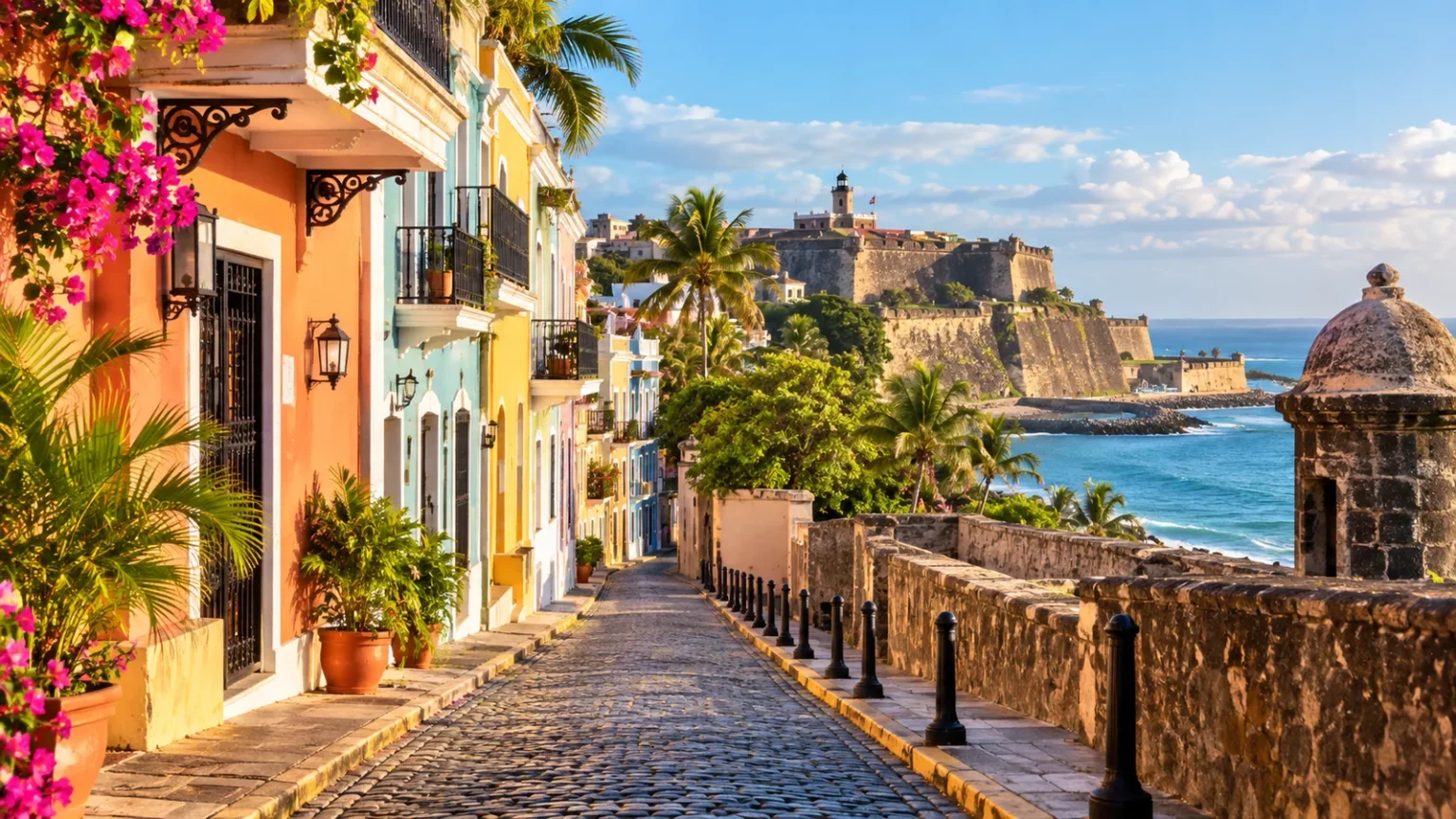
Old San Juan is not merely an attractive collection of colorful streets. La Fortaleza and the San Juan National Historic Site form a UNESCO World Heritage property recognized for military architecture developed over several centuries.
The protected property includes major fortifications such as Castillo San Felipe del Morro and Castillo San Cristóbal, along with sections of the old city wall. These defenses were positioned to protect San Juan Bay, which was strategically important to the Spanish Empire.
This historical context changes the way the area looks once you arrive. The walls, sentry boxes and enormous lawns around El Morro were functional defensive infrastructure, not decorative additions to the city.
Allow enough time to explore at least one major fort rather than treating Old San Juan exclusively as a place for photographs, shopping and restaurants.
7. La Fortaleza Still Serves as Puerto Rico’s Governor’s Residence
La Fortaleza has had several functions across its long history, including fortress, arsenal and official residence. Today it remains the seat and residence of the governor of Puerto Rico.
That makes it different from historic palaces that survive purely as museums. The building remains connected with present-day government while also forming part of the UNESCO World Heritage property.
Visitors walking through Old San Juan can see the exterior and surrounding historic district, although access naturally differs from an ordinary museum attraction. Security and official activity can affect what parts of the surrounding area are accessible.
This is one of those Puerto Rico interesting facts that turns a picturesque Old San Juan landmark into something much more significant.
8. El Yunque Is the Only Tropical Rainforest in the U.S. National Forest System
El Yunque National Forest is the only tropical rainforest within the U.S. National Forest System. The forest covers nearly 29,000 acres in northeastern Puerto Rico and extends through several municipalities.
Its scale is modest compared with some enormous national forests on the mainland, but its rainfall and biodiversity make the environment feel completely different. Mountain roads climb through thick vegetation, streams cut through the forest and weather can change rapidly as elevation increases.
El Yunque also makes a useful counterpoint to the idea that Puerto Rico is mostly beaches. Within a relatively short distance of San Juan, travelers can exchange coastal streets for wet forest, waterfalls and mountain views.
Check current Forest Service access information before leaving. Parking limitations, weather, storm recovery or road work can affect individual recreation areas.
9. The Deepest Part of the Atlantic Ocean Is North of Puerto Rico
The Puerto Rico Trench is the deepest part of the Atlantic Ocean, reaching depths of more than 8,000 meters north of the island. That puts an extraordinary geological feature surprisingly close to one of the Caribbean’s busiest travel destinations.
The trench exists along a complex boundary between the North American and Caribbean tectonic plates. The same geological setting is connected with earthquake and tsunami hazards in the region.
You cannot stand on a viewpoint and see the trench plunging into the ocean in the way you can see a canyon on land. Its scale is hidden beneath the water, which is precisely what makes this one of the most surprising fun facts about Puerto Rico.
It is a reminder that the island’s dramatic landscape continues far beyond the coastline.
10. Puerto Rico Has Three Famous Bioluminescent Bays
Puerto Rico is home to three well-known bioluminescent bays: Mosquito Bay on Vieques, Laguna Grande near Fajardo and La Parguera in Lajas. Their glow comes from microscopic organisms that emit light when the water is disturbed.
The phenomenon is best experienced at night, but conditions matter. Moonlight, weather, water conditions and light pollution can all change how intense the glow appears.
Travel photographs often make bioluminescence look like electric blue paint poured into the sea. The real experience can be subtler, with flashes and sparkling trails appearing around a paddle, hand movement or swimming fish.
This is one Puerto Rico fact worth planning an entire evening around rather than expecting to stumble across it accidentally.
11. Mosquito Bay Holds a Guinness Record for Bioluminescence
Mosquito Bay on Vieques is recognized by Guinness World Records as the brightest bioluminescent bay. The record measurement reported concentrations of up to 700,000 dinoflagellates per gallon of water.
The geography of the bay helps the organisms remain concentrated, while the surrounding mangroves contribute to the ecosystem that supports them. Minimal light pollution on Vieques also makes the glow easier to appreciate.
A darker night normally gives better viewing conditions than a bright full moon. Tour operators may structure departures around moon phase and local conditions, so check the timing rather than booking only by price.
Mosquito Bay is one of the rare amazing facts about Puerto Rico that becomes more impressive once experienced in person.
12. The Coquí Is Tiny but Can Dominate the Nighttime Soundscape
The coquí is a small tree frog whose distinctive call is one of Puerto Rico’s most recognizable sounds. Its name imitates the familiar two-note “co-quí” call that becomes particularly noticeable after dark and following rain.
Visitors often hear the frogs before seeing one. Their small size and nocturnal habits make spotting them considerably harder than recognizing the sound.
The coquí has also become a powerful cultural symbol of Puerto Rico. Images of the frog appear on souvenirs, artwork and local designs across the island.
If the first night outside San Juan comes with a surprisingly loud chorus from the vegetation, it is probably not an exotic bird. It may simply be one of Puerto Rico’s smallest residents announcing itself.
13. Wild Horses Really Do Roam Around Vieques
Vieques is known for free-ranging horses, and visitors may encounter them near roads, fields and settled areas. They are not merely part of a staged tourist attraction.
That makes driving on Vieques different from driving around San Juan. Horses can appear close to the road, and visitors should slow down rather than stopping unpredictably for photographs.
The animals have become strongly associated with Vieques’ visual identity. They add to the island’s sense of openness, but they should still be treated as animals rather than props for travel photos.
Seeing horses against a Caribbean landscape is one of the more unexpected Puerto Rico facts that travelers can confirm almost as soon as they begin exploring Vieques.
14. Puerto Rico Has Nearly 300 Miles of Coastline
Puerto Rico has nearly 300 miles of coastline, giving the archipelago far more beach variety than the phrase “Caribbean beach vacation” suggests. The experience changes considerably depending on which coast or island you choose.
Some beaches are protected and calm, while others are known for surf, stronger currents or exposed Atlantic conditions. Black sand appears on Vieques, while Culebra is better known for pale sand and clear water.
The coastline also includes mangroves, cliffs, rocky sections, bays and urban waterfronts. A week spent only on one San Juan beach therefore reveals very little about Puerto Rico’s coastal geography.
Always check local water conditions before swimming. A beach can look calm in a photograph and behave very differently on a particular day.
15. The Piña Colada Was Born in Puerto Rico but Its Inventor Is Disputed
Puerto Rico is widely accepted as the birthplace of the piña colada, but the exact creator remains disputed. The two most famous origin claims involve the Caribe Hilton and Barrachina in San Juan.
One version credits bartender Ramón “Monchito” Marrero at the Caribe Hilton in 1954. Another credits Ramón Portas Mingot at Barrachina in 1963, while additional accounts complicate the story further.
That uncertainty makes the drink more interesting rather than less important. Visitors can try versions in both locations and treat the disagreement as part of San Juan’s cocktail history.
The piña colada later became Puerto Rico’s official drink. The safest fact to remember is that the cocktail is Puerto Rican; the identity of the first bartender is the part that remains contested.
16. Puerto Rico’s Legal Drinking Age Is 18
The legal drinking age in Puerto Rico is 18, lower than the age of 21 that applies across the U.S. states. That difference can surprise younger American visitors.
An 18-year-old traveler can legally purchase alcoholic drinks in Puerto Rico, but businesses may require valid identification. Individual venues can also enforce their own entry policies.
The lower age is particularly noticeable in nightlife districts and during festivals. It does not change the need for ordinary drink-safety precautions or responsible transportation after a night out.
This is one of the most practical fun facts about Puerto Rico because it can directly affect first-time travelers’ plans.
17. Reggaetón’s Global Story Runs Straight Through Puerto Rico
Puerto Rico played a central role in the development and global rise of reggaetón. The modern genre took shape through a mix of Caribbean and Latin musical influences, hip-hop and the distinctive dembow rhythm, with Puerto Rican artists helping push the sound from underground scenes toward international audiences.
San Juan’s music culture therefore makes more sense when reggaetón is viewed as part of a longer musical history rather than only as contemporary pop. Bomba, plena, salsa and urban music overlap across different generations and communities.
The influence is still obvious in nightlife, cars, shops, festivals and street culture. Music is not restricted to concert venues – it often becomes part of the ordinary soundscape.
Travelers whose trips revolve around live performances can also explore LitiTravels’ guide to the biggest music festivals in the world for more culture-led travel ideas.
18. In Bomba, the Dancer Can Lead the Drummer
One of the most interesting facts about Puerto Rico’s music is that bomba can reverse the relationship many visitors expect between musicians and dancers. In a traditional performance, the lead drummer responds to movements made by the dancer.
The dancer creates improvised movements called piquetes, and the drummer follows those movements rhythmically. The result feels more like a conversation or challenge than choreography performed over a fixed beat.
Bomba developed from Afro-Puerto Rican traditions and remains an important expression of cultural identity. Loíza is one of the places especially associated with the tradition, although performances and classes can also be found around the San Juan area.
Watching bomba after understanding this relationship changes the experience. Instead of asking which steps match the music, watch how the music reacts to the dancer.
19. Plena Was Once Called the “Sung Newspaper”
Plena is another Puerto Rican musical tradition, and its lyrics historically carried stories about everyday events, community concerns, social issues and even gossip. That storytelling role gave plena the nickname el periódico cantado, or “the sung newspaper.”
The genre became especially associated with working-class communities in Ponce and southern Puerto Rico. Traditional instruments include hand-held drums known as panderetas, along with other percussion and string instruments.
Plena remains part of Puerto Rican cultural life rather than a frozen museum tradition. Visitors may hear it during festivals, Christmas celebrations and live cultural events.
This is one of the best Puerto Rico interesting facts to know before attending a local celebration because the music may be communicating far more than a rhythm alone.
20. Puerto Rico Has a Serious Coffee Culture in the Mountains
Puerto Rican coffee is not simply something served with breakfast in San Juan. Much of the island’s coffee-growing tradition is concentrated in the mountainous interior, where elevation, rainfall and agricultural history create conditions for coffee production.
Towns including Adjuntas, Jayuya, Lares, Yauco and Ciales have strong connections with coffee. Several working haciendas allow visitors to see how coffee is cultivated, processed and roasted before tasting it close to where it was grown.
This creates one of the easiest ways to build a trip beyond the coast. A coffee day in the Cordillera Central can combine mountain roads, cooler temperatures, local food and agricultural landscapes.
The driving deserves respect, however. Mountain roads can be narrow and winding, so journey times often matter more than the apparently short distance on a map.
21. Puerto Rico’s Christmas Season Can Run for About 45 Days
Puerto Rico has one of the longest Christmas seasons in the Western Hemisphere, with celebrations stretching from late November into mid-January. The calendar continues well beyond December 25 through Three Kings Day, the Octavitas and the Fiestas de la Calle San Sebastián.
That makes a winter trip feel very different from an ordinary tropical escape. Parrandas bring groups together for music and visiting, seasonal food appears everywhere, and major celebrations continue after many destinations have already packed away their decorations.
Three Kings Day on January 6 remains particularly significant. Children traditionally collect grass for the Magi’s camels before receiving gifts, while communities hold festivals and parades.
For travelers, the practical side matters too. Holiday celebrations can alter business hours, traffic, hotel demand and access around Old San Juan, so Christmas season should be treated as an event period rather than simply pleasant winter weather.
5 Puerto Rico Myths That Need More Context
Some commonly repeated Puerto Rico facts become misleading when they are shortened too aggressively. A little context makes the information both more accurate and more useful for a trip.
| Common claim | Better explanation |
|---|---|
| Puerto Rico is one island | Puerto Rico is an archipelago with the main island plus Vieques, Culebra and smaller islands and cays |
| Everyone speaks English | English is official, but Spanish dominates everyday life |
| The piña colada has one confirmed inventor | Puerto Rico is its birthplace, but several competing origin stories exist |
| Old San Juan itself is entirely a UNESCO site | The UNESCO property specifically covers La Fortaleza and San Juan National Historic Site |
| Bio bays always look electric blue | Visibility changes with moonlight, weather and environmental conditions |
You may also be interested in our article: 10 Things to Do in Montmartre: The Artistic Heart of Paris
These distinctions do not make the facts less exciting. They prevent the article-version of Puerto Rico from becoming more dramatic than the destination itself.
What These Fun Facts About Puerto Rico Mean for a First Trip
The most useful Puerto Rico facts can shape an itinerary rather than simply fill a trivia quiz. A traveler interested in natural wonders should reserve time for El Yunque and one of the bioluminescent bays, while someone interested in history needs more than a quick walk through Old San Juan.
For culture, San Juan alone is not enough. Ponce helps explain plena, Loíza has deep connections with bomba, and the central mountains reveal Puerto Rico’s agricultural and coffee traditions.
Vieques or Culebra also requires deliberate planning. They cannot simply be squeezed between breakfast and dinner in Old San Juan without accounting for ferries, flights, ground transport and the slower pace that makes the islands appealing in the first place.
A first-time Puerto Rico trip becomes much stronger when San Juan, nature and at least one region outside the metropolitan area all receive time.
Where to Experience the Most Interesting Puerto Rico Facts
Several of these facts can be experienced in clusters rather than as separate attractions. That makes a road trip or multi-base stay much more efficient.
| Place | What to notice |
|---|---|
| Old San Juan | UNESCO fortifications, La Fortaleza and piña colada history |
| El Yunque | Tropical rainforest, waterfalls and mountain ecosystems |
| Vieques | Mosquito Bay, wild horses and island landscapes |
| Fajardo | Laguna Grande bioluminescence and east-coast access |
| La Parguera | Southwest coast and bioluminescent waters |
| Ponce | Plena history, architecture and southern culture |
| Loíza | Afro-Puerto Rican traditions and bomba |
| Central Mountains | Coffee farms, cooler highlands and rural Puerto Rico |
Trying to experience all eight in two or three days would create more driving than discovery. For a short trip, choose one cultural cluster and one nature-focused day beyond San Juan.
Visiting Puerto Rico in September Requires Extra Weather Awareness
September can be rewarding for lower crowds and cultural travel, but it sits near the climatological peak of Atlantic hurricane activity. The official Atlantic hurricane season runs from June 1 through November 30, with historical activity peaking around September 10.
That does not mean a September trip will encounter a hurricane. It means flexible bookings, travel insurance where appropriate and regular monitoring of official weather information become more important.
Storms can also affect Puerto Rico without making a direct landfall. Heavy rain, rough seas, ferry disruption, trail closures and power interruptions may change plans even when the center of a system remains elsewhere.
For late-summer and fall trips, weather flexibility is part of good Puerto Rico planning, not a reason to panic or automatically avoid the season.
What to Know Before Visiting Puerto Rico in 2026
A few practical details connect many of these fun facts about Puerto Rico with everyday travel. The island is relatively easy to reach, but exploring beyond San Juan takes more planning than simply landing at the airport and improvising.
Keep these points in mind:
- Check entry requirements before departure. U.S. citizens traveling domestically do not need a passport, while international visitors follow U.S. entry rules.
- Carry some cash. Cards are common, but smaller businesses and rural stops may be easier with cash.
- Do not underestimate driving time. Mountain and coastal roads can make short distances slower than expected.
- Book Vieques or Culebra transport early when schedules matter. Island connections add another layer of logistics.
- Check moon phase before booking a bio bay tour. Darker conditions can improve the experience.
- Monitor weather during hurricane season. Conditions can change quickly between June and November.
- Use Spanish when possible. Even basic phrases can make travel beyond tourist zones easier.
- Check current access before visiting El Yunque. Weather, parking capacity or maintenance can affect individual areas.
These steps are simple, but they prevent several of the most common first-trip mistakes.
Puerto Rico Makes More Sense Once You Look Beyond the Beaches
The best fun facts about Puerto Rico reveal a place that is much harder to summarize than its postcards suggest. Beaches matter, but so do an Atlantic trench more than eight kilometers deep, a rainforest found nowhere else in the U.S. National Forest System, music where dancers can control the rhythm and mountain farms producing coffee far from the coast.
History is similarly layered. Spanish forts remain central to Old San Juan’s landscape, U.S. travel rules shape practical logistics and Taíno, African and Spanish influences remain visible across food, language, music and traditions.
Then there are the details that simply make a trip more memorable: the coquí calling after rain, horses beside a Vieques road, glowing water after dark and a Christmas season that can still be going strong well into January.
Puerto Rico becomes more interesting when these facts stop being trivia and start becoming things you know how to recognize while traveling.
FAQ
What are five fun facts about Puerto Rico?
Puerto Rico is an archipelago, El Yunque is the only tropical rainforest in the U.S. National Forest System, the Puerto Rico Trench is the deepest part of the Atlantic Ocean, Vieques has wild horses, and Puerto Rico has three famous bioluminescent bays.
What is Puerto Rico best known for?
Puerto Rico is known for its beaches, Old San Juan, El Yunque, bioluminescent bays, music, rum culture and Puerto Rican food. Its cultural identity reflects Indigenous Taíno, Spanish and African influences.
Is Puerto Rico a country or part of the United States?
Puerto Rico is an unincorporated territory of the United States. It has its own local government and a distinct Puerto Rican cultural identity.
Do U.S. citizens need a passport for Puerto Rico?
U.S. citizens traveling directly between the mainland United States and Puerto Rico do not need a passport for the trip. Standard identification requirements for air travel still apply.
What language is spoken in Puerto Rico?
Spanish and English are both official languages, but Spanish is the main language used in everyday life. English is common in many tourist areas.
What currency does Puerto Rico use?
Puerto Rico uses the U.S. dollar. Credit cards are widely accepted, although carrying some cash is useful for small businesses and rural areas.
What is the most surprising fact about Puerto Rico?
One of the most surprising geographical facts is that the Puerto Rico Trench north of the island is the deepest part of the Atlantic Ocean, reaching more than 8,000 meters below sea level.
Does Puerto Rico really have glowing water?
Yes. Mosquito Bay on Vieques, Laguna Grande near Fajardo and La Parguera in Lajas are known for bioluminescence created by microscopic organisms that flash when the water is disturbed.
Where is the brightest bioluminescent bay in Puerto Rico?
Mosquito Bay on Vieques is recognized by Guinness World Records as the brightest bioluminescent bay.
Is El Yunque the only rainforest in the United States?
El Yunque is the only tropical rainforest in the U.S. National Forest System. Other tropical forest environments exist under different forms of land management.
Was the piña colada invented in Puerto Rico?
Yes, Puerto Rico is widely recognized as the birthplace of the piña colada. The exact inventor and location remain disputed, with the Caribe Hilton and Barrachina among the best-known claims.
What is the coquí in Puerto Rico?
The coquí is a small frog famous for its distinctive nighttime call. It is one of Puerto Rico’s most recognizable natural and cultural symbols.
What is special about Vieques?
Vieques is known for free-ranging horses, quiet beaches, a large wildlife refuge and Mosquito Bay, the record-holding bioluminescent bay.
When is hurricane season in Puerto Rico?
Puerto Rico lies within the Atlantic hurricane region, where the official season runs from June 1 through November 30. Historical activity is highest around late August through September.
Why is Christmas so long in Puerto Rico?
Puerto Rican holiday traditions continue beyond Christmas Day through Three Kings Day, the Octavitas and the San Sebastián Street Festival. Celebrations can stretch from late November into mid-January.
Is Puerto Rico worth visiting for culture as well as beaches?
Yes. Old San Juan, Ponce, Loíza, mountain coffee towns and local music traditions offer substantial history and culture beyond the coastline.
best hikes in Maui


Author of LitiTravels Portal


Articles by the author:
All articles by author

The Dominican Republic is much bigger than a resort strip. These 13 places show where to go for beaches, history, whales, waterfalls and mountains – plus how long each stop actually deserves on a first trip.
 September 19, 2026
 4
4

Disney World can cost dramatically more depending on when you go. See which 2026–2027 travel windows offer the strongest chance of lower tickets and hotel rates, which cheap months come with weather trade-offs, and when paying ...
September 19, 2026
4
Glasgow food is much bigger than haggis. The city mixes old-school Scottish comfort dishes, legendary breakfast rolls, chippy culture, South Asian flavours and ambitious modern cooking. Start with these 15 foods and the neighbo...
September 19, 2026
5
St. Thomas can give you a calm family beach, a reef a few kicks from shore or an almost-empty Caribbean cove – but rarely in the same place. These nine beaches make it easier to choose the right stretch of sand for the day you ...
September 18, 2026
7
Subscribe to “lititravels” on Telegram for gaming intel.
No filler, no fuss—just your daily XP boost. Hop in and level up, squad!



Read also

The historic Parisian quarter of Montmartre is associated with a strong affinity for art and cultural backgrounds. This is the area where famous artists such as Picasso and Monet used to reside and work. Here, you may find art ...
May 26, 2025
452

Saint-Rémy-de-Provence is one of the oldest towns in France founded by the Celts more than 2,500 years ago and developed by both the Greeks and the Romans. Set at the base of the Alpilles Mountains and surrounded by vineyards a...
April 15, 2025
491

September is an exciting month for festivals. It brings together people from all over the world to celebrate culture, food, music, and traditions. From massive beer festivals in Germany to light-filled lantern parades in China,...
March 21, 2025
360

If you’re into history or impressive architecture, then Morocco palaces are your deal. They expose the country’s past and just-skilled local builders. Each of them has a story to tell, and each has an atmosphere of its ow...
 March 17, 2025
490
March 17, 2025
490

Spain acquires the best know-how to eat well, in fact, street food becomes one of the best ways to get into its gastronomic culture. You can be doing a lively walk in a city or lying on the beach soaking up the sunny rays; the ...
March 28, 2025
416

Music festivals are a global phenomenon that bring people together from all walks of life. Whether it’s for the music, food, fashion, or the overall vibe, these events leave lasting memories. Let’s explore the biggest and...
March 23, 2025
806

The Lemon Festival in Menton represents one of the most famous events that happen on the French Riviera. For the citizens of Menton, citrus fruits have exceptional value, so the city somehow tries to thank them every year with ...
February 13, 2025
275

History is alive in Marrakech, and tales are told by its palaces. A visit to the palaces in Marrakech affords you a peek into the decoratively royal past of Morocco. These sights create a unique city, rather than one composed o...
February 3, 2025
2542

Barolo, Italy is a region with the best vineyards in the country that produces a lot of high-quality wine yearly. Cozy villages, pasta dusted with shaved truffles, and wine that tastes of violets await you there. Learn more abo...
January 27, 2025
258

Cooperation
Looking to shine a spotlight on your project? LitiTravels has you covered! We offer article-based promotion, manage branded blogs on our platform, drive engagement through our social media channels, and create content that delivers real results. Get in touch today and let’s make your brand stand out!
Subscribe to the monthly news digest from LitiTravels
The main news and updates from the team about gadgets, sports, cars, health, and lifestyle.
