


Popular articles


9 Egyptian Temples That Change How You See Ancient Egypt
 Cultural Discoveries9 Egyptian Temples That Change How You See Ancient Egypt
Cultural Discoveries9 Egyptian Temples That Change How You See Ancient Egypt
9 Egyptian Temples That Change How You See Ancient Egypt
Article content

Egyptian temples are easy to admire and surprisingly easy to misunderstand. Walk into Karnak without context and the columns are enormous but disconnected. Reach Philae without knowing why the temple stands on its present island and one of its most remarkable stories remains invisible. Visit three Egyptian temples in a single hot afternoon and even magnificent reliefs can begin to blur together.
A better trip starts with knowing why each site matters. Karnak is the strongest choice for scale, Luxor Temple for layers of history, Hatshepsut for architecture, Dendera for surviving color, Edfu for preservation, Kom Ombo for its unusual double design, Philae for setting and relocation history, and Abu Simbel for sheer drama. Most first-time travelers do not need to see every Egyptian temple in the country. They need the right sequence, enough time and just enough history to understand what they are looking at.
The most useful Egyptian temples for a first trip also fall into a remarkably practical route. Luxor contains several major sites, while Edfu and Kom Ombo lie south along the Nile toward Aswan. Philae is reached from Aswan, and Abu Simbel sits much farther south near Lake Nasser. That geography makes it possible to build an Egyptian temples itinerary without crossing the country repeatedly.
Which Egyptian temples should you visit first?
For a first trip, prioritize Karnak, Luxor Temple, Hatshepsut, Philae and Abu Simbel. Add Edfu and Kom Ombo when traveling between Luxor and Aswan, Dendera when there is an extra day around Luxor, and Medinet Habu when detailed reliefs and a quieter visit matter more than checking off another famous name.
The table below compares the major Egyptian temples by what each site does best. It is more useful than ranking them from one to nine because the experience at Abu Simbel has almost nothing in common with a walk through Luxor Temple after sunset.
| Egyptian temple | Best for | Main period or ruler | Time to allow | Best base |
|---|---|---|---|---|
| Karnak | Monumental scale | Mainly New Kingdom, expanded over centuries | 2–3 hours | Luxor |
| Luxor Temple | Evening visit and layered history | Amenhotep III, Ramesses II and later periods | 1.5–2 hours | Luxor |
| Hatshepsut Temple | Architecture and royal history | 18th Dynasty | 1–1.5 hours | Luxor |
| Medinet Habu | Reliefs and fewer crowds | Ramesses III | 1–1.5 hours | Luxor |
| Dendera | Preserved ceilings and astronomical imagery | Mainly Ptolemaic and Roman | 2 hours | Luxor or Qena |
| Edfu | Exceptional preservation | Ptolemaic Period | 1.5–2 hours | Edfu or Nile route |
| Kom Ombo | Unusual double-temple plan | Ptolemaic and Roman | 1–1.5 hours | Aswan or Nile route |
| Philae | Island setting and Isis cult | Mainly Ptolemaic and Roman | 2–3 hours with transfers | Aswan |
| Abu Simbel | Rock-cut scale and relocation story | Ramesses II | 2 hours on site | Abu Simbel or Aswan |
Five carefully chosen Egyptian temples will usually teach you more than nine rushed visits. The best route leaves enough time to notice how the architecture, gods, rulers and inscriptions change from one site to the next.
Egyptian temples history makes more sense once you know what a temple was
Ancient Egyptian temples were conceived as residences of deities and centers of ritual, not as public congregational buildings in the modern sense. The cult statue of a deity was housed deep inside the sanctuary, and priests carried out daily rites on behalf of the king. Access became more restricted as a person moved deeper into the complex.
This changes the way Egyptian temples should be read. A monumental pylon was not simply an impressive entrance. Open courts, columned halls and dark sanctuaries created a progression from a more accessible outer world toward increasingly sacred space. In many later Egyptian temples, the floor rises and the ceiling lowers as visitors move inward, making the sanctuary feel more enclosed.
The wall scenes were not merely decoration either. Kings appear offering food, incense, wine and other goods to gods because temple imagery presented the ruler as the person maintaining divine order. In reality, priests usually carried out the daily ceremonies.
That is why an Egyptian temples travel guide should explain more than dates. Once the function of the architecture is clear, pylons, courtyards, hypostyle halls and sanctuaries stop looking like a sequence of beautiful ruins and start forming a readable system.
For travelers who plan trips around architecture as much as destinations, the details feel very different from the craftsmanship found in Morocco palaces, but both reward the same approach – slow down and look at how power is expressed through space, decoration and access.
1. Karnak is the Egyptian temple to choose if you can see only one
Karnak is the strongest introduction to Egyptian temples because its scale, long building history and surviving architecture make the development of temple design visible in one enormous complex. Ancient Thebes was a major religious center, and UNESCO includes Karnak and Luxor Temple within the World Heritage property of Ancient Thebes with its Necropolis.
The part most visitors remember is the Great Hypostyle Hall. It contains 134 columns, with the tallest central columns reaching about 21 meters according to Egypt’s Ministry of Tourism and Antiquities. Hatshepsut’s surviving obelisk rises to nearly 30 meters. The numbers matter because photographs flatten Karnak. Standing among the columns gives a much clearer sense of how architecture could make ritual power physical.
Do not try to understand every inscription on a first visit. Instead, follow a simple sequence: first pylon, Great Court, Hypostyle Hall, obelisks, inner sanctuary area and Sacred Lake. Once that route makes sense, smaller chapels and later additions become easier to place.
How long do you need at Karnak?
Allow at least two hours at Karnak, and closer to three if Egyptian temples history is one of the main reasons for visiting Luxor. Early morning is usually the easiest time to handle the scale of the complex without adding the strongest midday heat.
Karnak currently opens from 6:00 a.m. to 5:00 p.m. The official 2026 foreign adult ticket is EGP 600, including Karnak Temple and the Open Museum. Prices and hours can change, so check the official booking system shortly before visiting.
2. Luxor Temple is the Egyptian temple to save for late afternoon
Luxor Temple is one of the easiest Egyptian temples to understand in a shorter visit, and its central location makes it ideal for late afternoon or evening. The surviving core was largely built under Amenhotep III, while Ramesses II added the monumental pylon, courtyard, statues and obelisks at the front. One of those obelisks remains in Luxor; its pair has stood in Paris since the 19th century.
The site is especially useful because its history did not end with the pharaohs. Roman additions survive, and later religious history is physically layered into the complex. That makes Luxor Temple feel less like a frozen monument and more like a place repeatedly adapted over thousands of years.
It also connects conceptually with Karnak. The two temples were linked by the Avenue of Sphinxes and formed part of the religious landscape associated with the Opet Festival. Visiting both on the same day makes far more sense than treating them as unrelated attractions.
Is Luxor Temple better by day or at night?
Late afternoon into evening is the most atmospheric choice because Luxor Temple currently remains open later than most Egyptian temples in the area. The Ministry lists daily opening from 6:00 a.m. to 8:00 p.m., with a 2026 foreign adult ticket of EGP 500.
A practical Luxor day is Karnak in the morning, a midday break, then Luxor Temple later. That schedule reduces temple fatigue and creates two visually different experiences rather than two back-to-back archaeological visits under the same harsh light.
3. Hatshepsut Temple is where architecture and landscape become one
The Temple of Hatshepsut at Deir el-Bahari stands out among Egyptian temples because its terraces, ramps and cliff backdrop create one of the country’s most recognizable architectural compositions. It was a royal mortuary temple rather than a divine temple of exactly the same type as Karnak, and its location on the west bank connected it with the funerary landscape of Thebes.
Hatshepsut’s temple also contains some of the most useful reliefs for understanding how rulers told stories through temple walls. Scenes include her expedition to Punt, ritual activity and claims supporting her legitimacy as king. The sanctuary of Amun extends into the rock behind the upper level.
The site works best when paired with the Valley of the Kings or another west-bank monument, but do not overload the same morning with every major Luxor attraction. The open terraces offer little relief from strong sun, so timing matters more here than at some enclosed Egyptian temples.
The official site currently lists opening from 6:00 a.m. to 5:00 p.m. and a foreign adult ticket of EGP 440.
4. Medinet Habu is the Egyptian temple many rushed itineraries miss
Medinet Habu is one of the best Egyptian temples for travelers who want extensive reliefs without the same level of name recognition as Karnak or Abu Simbel. The main surviving complex is the mortuary temple of Ramesses III, with pylons, courts, columned spaces, sanctuaries and administrative areas.
Its walls preserve major military and religious scenes, including representations connected with Ramesses III’s campaigns. The wider complex once included a royal palace, storage areas and administrative buildings, which helps show that Egyptian temples could be major institutions rather than isolated places of worship.
Medinet Habu is particularly useful after Karnak. The scale is easier to absorb, and the reliefs can feel more readable once the basic visual language of Egyptian temples is familiar.
The site currently opens 6:00 a.m.–5:00 p.m., with a foreign adult ticket of EGP 230. That also makes it one of the more affordable major temple visits around Luxor.
5. Dendera rewards travelers who care about surviving detail
Dendera is one of the most visually distinctive Egyptian temples because substantial architectural detail and ceiling decoration survive. The principal temple is dedicated to Hathor, a goddess associated with music, joy, motherhood and the sky. Egypt’s Ministry of Tourism and Antiquities identifies the present structure primarily with the Ptolemaic Period while noting evidence for much older sacred buildings on the site.
Dendera is especially useful for travelers who have already seen New Kingdom monuments in Luxor. Its later date makes it easier to notice how Egyptian temple traditions continued and evolved under Ptolemaic rulers. The astronomical imagery is another reason to visit slowly rather than rushing through the main hall.
Dendera is not as convenient as Karnak or Luxor Temple, so it deserves its own half-day rather than being casually added between several west-bank attractions. Travelers interested in how historic destinations preserve multiple eras may also enjoy the archaeological and Roman layer around Saint-Rémy-de-Provence.
The official 2026 information lists Dendera from 7:00 a.m. to 5:00 p.m. with a foreign adult ticket of EGP 300. Additional areas such as the panorama and serdab have separate charges.
6. Edfu is one of the best-preserved Egyptian temples
Edfu is the Egyptian temple to choose when you want to understand the full architectural sequence of a large temple with unusually well-preserved walls and spaces. Dedicated to Horus, the surviving structure was begun under Ptolemy III in 237 BC and completed under Ptolemy XII in 57 BC.
Its huge pylons lead into a peristyle court, followed by hypostyle halls, transitional rooms and the sanctuary. Because so much survives, Edfu makes the standard Egyptian temple plan much easier to visualize than sites where only fragments remain.
Edfu is a common stop on Nile itineraries, which creates one drawback: large groups often arrive at similar times. If traveling independently, timing the visit outside peak group movements can make a substantial difference.
The official foreign adult ticket is currently EGP 550. The Ministry lists closing at 5:00 p.m., with opening shown as 6:00 or 7:00 a.m. depending on the day, so check the exact date before planning an early arrival.
7. Kom Ombo is different from almost every other major Egyptian temple
Kom Ombo stands out because the temple was designed around two parallel sets of sacred spaces for two divine groups. One side centers on the crocodile god Sobek and associated deities, while the other is connected with Harwer, a form of Horus, and his divine family.
That doubled arrangement gives travelers a useful comparison after visiting more conventional Egyptian temples. Instead of moving toward one central sacred focus, the architecture repeatedly mirrors itself. Wall scenes also include calendars, ritual imagery and a famous Roman-period panel interpreted as showing medical or surgical instruments.
Kom Ombo is easy to combine with a north-south Nile itinerary because the site lies directly along the route between Edfu and Aswan. It does not need half a day. Around 60–90 minutes is enough for most visitors unless the inscriptions are a particular interest.
The temple currently opens from 7:00 a.m. to 9:00 p.m., unusually late for Egyptian temples, and the foreign adult ticket is EGP 450.
8. Philae is one of the Egyptian temples with the best modern survival story
Philae is remarkable not only for its temple of Isis but because the monuments visitors see today were moved from their original island to Agilkia Island. The relocation formed part of the international campaign to save Nubian monuments threatened by water associated with the Aswan High Dam.
The boat approach is part of what makes Philae different from other Egyptian temples. Instead of arriving by road and stepping directly into an archaeological site, visitors see the pylons emerge from an island landscape. That setting helps explain why Philae often feels more atmospheric than its scale alone would suggest.
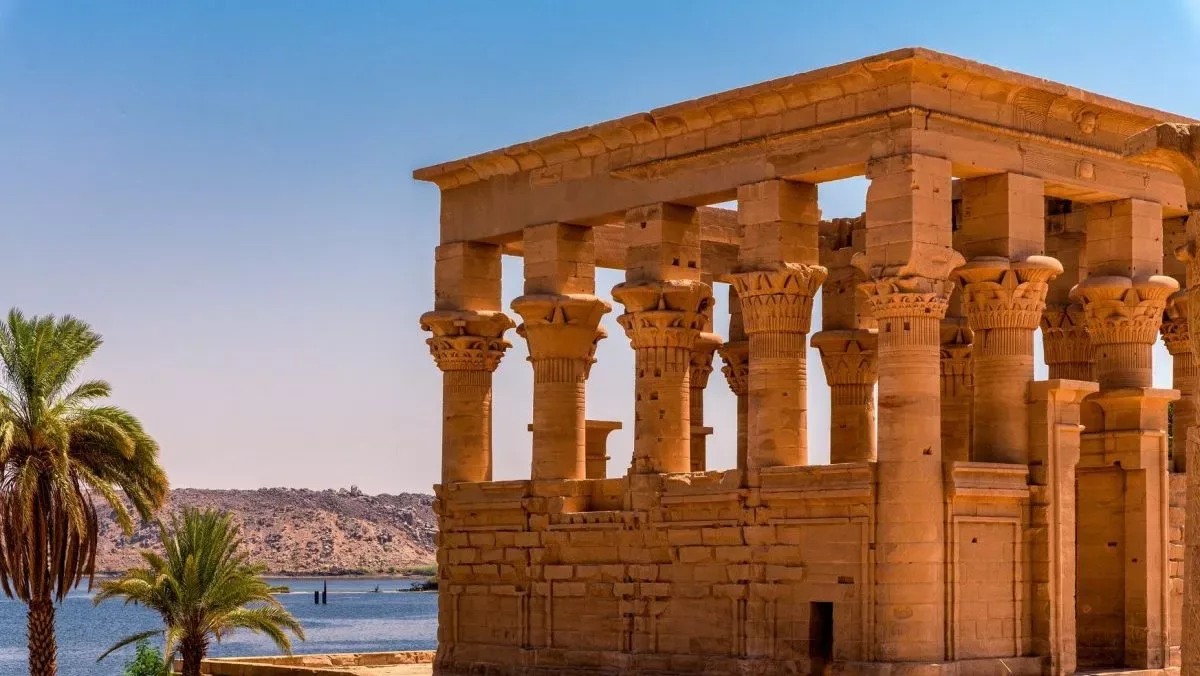
The complex is particularly important for the cult of Isis and reflects Ptolemaic and Roman-period Egyptian religion. The Kiosk of Trajan is among its best-known structures, while inscriptions and reliefs show how long Egyptian religious traditions remained active in the region.
The official site lists 7:00 a.m.–4:00 p.m. opening and a foreign adult admission of EGP 550 in 2026. Allow two to three hours for the overall experience because reaching the island adds time beyond walking through the monuments themselves.
9. Abu Simbel is the Egyptian temple complex worth the long journey
Abu Simbel earns the extra travel time because few Egyptian temples combine monumental sculpture, rock-cut architecture, royal propaganda and a modern engineering story on the same scale. Ramesses II ordered the Great Temple cut into the rock in the 13th century BC. Its façade is dominated by colossal seated figures of the king, while a smaller neighboring temple honors Hathor and Queen Nefertari.
The temples are not in their original position. They were relocated in the 1960s during the international effort to save Nubian monuments from rising waters associated with the Aswan High Dam. UNESCO’s Nubian Monuments World Heritage property includes both Abu Simbel and Philae.
The famous solar phenomenon is also real, although it is often stripped of context online. Egypt’s Ministry states that on February 22 and October 22, sunlight penetrates the Great Temple and reaches statues in the inner sanctuary. Those two dates also carry a higher official admission price.
Abu Simbel currently opens from 6:00 a.m. to 5:00 p.m. The standard foreign adult ticket is EGP 750, rising to EGP 1,200 on February 22 and October 22.
Egyptian temples tickets and opening hours in 2026
Ticket prices vary considerably, so travelers visiting several Egyptian temples should budget the archaeological part of the trip separately from transport and guiding. The figures below are the official foreign adult rates published by Egypt’s Ministry of Tourism and Antiquities and checked in September 2026. They can change, so confirm them again before the travel date.
| Egyptian temple | Official foreign adult ticket | Published opening hours |
|---|---|---|
| Karnak | EGP 600 | 6:00 a.m.–5:00 p.m. |
| Luxor Temple | EGP 500 | 6:00 a.m.–8:00 p.m. |
| Hatshepsut Temple | EGP 440 | 6:00 a.m.–5:00 p.m. |
| Medinet Habu | EGP 230 | 6:00 a.m.–5:00 p.m. |
| Dendera | EGP 300 | 7:00 a.m.–5:00 p.m. |
| Edfu | EGP 550 | Opens 6:00 or 7:00 a.m. depending on day; closes 5:00 p.m. |
| Kom Ombo | EGP 450 | 7:00 a.m.–9:00 p.m. |
| Philae | EGP 550 | 7:00 a.m.–4:00 p.m. |
| Abu Simbel | EGP 750 | 6:00 a.m.–5:00 p.m. |
You may also be interested in our article: 21 Puerto Rico Facts That Change How You See the Island
The table covers admission only. Transport, local boats, guiding, sound-and-light programs and optional areas may involve separate costs. Do not build a tight Egyptian temples itinerary around old ticket screenshots or blog prices, because admission rates have changed several times in recent years.
How to visit Egyptian temples without getting temple fatigue
The easiest way to enjoy Egyptian temples is to limit most days to two major archaeological sites. Three or four large temple complexes can technically fit into a schedule, but the inscriptions and architecture become harder to distinguish once heat and walking accumulate.
A practical temple day works better with a few simple rules:
- Visit the largest Egyptian temple first. Karnak, Dendera or Edfu deserves more attention than a smaller secondary stop.
- Use the hottest part of the day for a break or transfer. Open courtyards and stone paving can feel much hotter than the forecast suggests.
- Choose one detail to follow at each site. At Karnak it may be scale, at Dendera color, at Kom Ombo symmetry and at Philae the Isis cult.
- Carry water and sun protection. Shade is inconsistent, even inside large Egyptian temples.
- Check official opening hours the evening before. Seasonal or operational changes can affect the day’s route.
- Do not photograph every wall. Give yourself time to look before turning the visit into a documentation exercise.
- Consider a qualified Egyptologist guide for the first major site. Understanding one Egyptian temple properly makes later sites much easier to read.
The goal is not to memorize every pharaoh before arriving. A small amount of context creates a far better visit than a huge list of dates.
A simple 1-day Egyptian temples itinerary in Luxor
With one day, focus entirely on Luxor rather than trying to reach temples farther along the Nile. Karnak and Luxor Temple already provide a strong introduction to ancient Egyptian temple design, while Hatshepsut adds a contrasting mortuary monument if the day starts early.
A realistic one-day plan is:
- Start at Karnak shortly after opening.
- Spend two to three hours inside the complex.
- Take a long midday break.
- Visit Hatshepsut Temple on the west bank if transport is already arranged.
- Return to Luxor Temple in the late afternoon or evening.
This route is ambitious but geographically sensible. Trying to add Dendera, Edfu or another distant Egyptian temple on the same day would turn the itinerary into transport rather than sightseeing.
A 2-day Egyptian temples itinerary gives Luxor room to breathe
Two days are enough for the main Egyptian temples of Luxor without forcing every site into the same morning. Use day one for Karnak and Luxor Temple. Reserve day two for the west bank, with Hatshepsut and Medinet Habu as the temple priorities.
A balanced plan is:
- Day 1 – Karnak in the morning and Luxor Temple later in the day.
- Day 2 – Hatshepsut Temple, one major tomb area and Medinet Habu.
This structure also makes the history easier to follow. Day one centers on major divine temples of the east bank. Day two shifts toward royal mortuary landscapes on the west bank.
Travelers who enjoy using architecture to understand a city’s political history can apply the same approach to other heritage destinations. The surviving palaces in Marrakech tell a very different story, but they likewise make more sense when visited as expressions of power rather than decorative buildings alone.
A 3-day Egyptian temples route should add Dendera or the Nile corridor
With three days, add one destination beyond central Luxor instead of cramming more sites into the city. Dendera is the easiest choice for travelers staying based in Luxor, while Edfu becomes more logical for anyone continuing south toward Aswan.
A strong three-day version is:
- Day 1 – Karnak and Luxor Temple.
- Day 2 – Hatshepsut Temple and Medinet Habu.
- Day 3 – Dendera as a focused half-day or onward travel toward Edfu.
For a longer Nile journey, continue south through Edfu and Kom Ombo before reaching Aswan for Philae. Abu Simbel then becomes a separate extension rather than another box to tick on an already crowded day.
Myth vs fact about Egyptian temples
Several popular ideas about Egyptian temples are either incomplete or simply wrong. Knowing the difference helps travelers understand what they are seeing and prevents impressive stories from replacing documented history.
| Common claim | What the evidence shows |
|---|---|
| Egyptian temples were basically ancient churches | They were considered divine residences and ritual centers; the deepest areas were restricted |
| All Egyptian temples are from the age of the great pyramids | Major surviving temples span many later periods, including the New Kingdom, Ptolemaic and Roman eras |
| Every temple was dedicated to one god only | Some had multiple cults, and Kom Ombo was explicitly organized around two divine groups |
| Abu Simbel still stands exactly where Ramesses II built it | The temples were relocated in 1968 to protect them from rising waters |
| Philae is still on its original island | The monuments were moved to nearby Agilkia Island |
| Temple walls were simply decorative | Reliefs and inscriptions recorded ritual, royal ideology, festivals and religious texts |
| Ordinary visitors could walk into the sanctuary | Access to the sacred inner rooms was heavily restricted in antiquity |
These facts make Egyptian temples more interesting, not less mysterious. Their complexity comes from centuries of religion, politics, rebuilding and reuse rather than from modern legends.
Egyptian temples and tombs are not the same thing
A temple was primarily a place of cult and ritual, while a tomb was designed for burial and the afterlife of a deceased person. The distinction becomes confusing around Luxor because royal tombs and royal mortuary temples sit within the same larger funerary landscape.
Hatshepsut’s monument, for example, is a mortuary temple, not her tomb. Royal mortuary temples maintained cult activity connected with deceased kings, while burial places were located separately. Egypt’s Ministry explicitly describes these west-bank royal structures as temples associated with the continued cult of deceased rulers.
The pyramids create similar confusion. A pyramid itself is not simply another Egyptian temple, although pyramid complexes included temples where ritual activities connected with the dead king took place. Recognizing that difference makes the landscape of ancient Egypt much easier to understand.
What should you actually look for inside Egyptian temples?
Start with architecture before trying to decode individual hieroglyphs. Most travelers get more from Egyptian temples when they understand the route through the building first and study inscriptions second.
Look for these recurring features:
- Pylons. Massive gateway towers often marking the transition into the temple.
- Open Courts. Larger spaces closer to the public-facing part of the complex.
- Hypostyle Halls. Roofed halls supported by columns, with Karnak providing the most famous example.
- Sanctuaries. The most sacred inner spaces associated with the divine cult image.
- Offering Scenes. Images of the king presenting goods to deities.
- Processional Routes. Axes and doorways used in ritual movement and festivals.
- Royal Names and Additions. Evidence that one Egyptian temple could be expanded by several rulers across centuries.
After two or three sites, the repeating plan becomes recognizable. That is when the differences between Egyptian temples become more interesting than the similarities.
When is the best time to visit Egyptian temples?
For most travelers, the cooler months from roughly late autumn through early spring make long archaeological days easier, while early morning remains valuable throughout the year. Egyptian temples contain vast areas of exposed stone with limited shade, particularly in Luxor and farther south.
Summer visits are still possible, but planning becomes more important. Start early, reduce the number of major sites per day and avoid interpreting a short driving distance as a short overall excursion. Entry, parking, walking and waiting all add time.
The light also changes Egyptian temples dramatically. Early morning brings lower-angle light and fewer visitors at many sites, while Luxor Temple and Kom Ombo offer later opening hours that create alternative evening options. Use those differences instead of scheduling every temple at 10:00 a.m.
Are Egyptian temples worth visiting with a guide?
A guide adds the most value at the first one or two Egyptian temples, especially Karnak. Once the basic architecture, gods and ritual scenes become familiar, independent visits become much easier.
A good guide should explain why a wall scene matters instead of simply reciting lists of kings. Egyptian temples contain layers from multiple reigns and periods, so the most useful interpretation connects architecture with religion, political power and chronology. Travelers who already know the basics of ancient Egyptian history may prefer a shorter guided introduction followed by independent time.
Either way, do not allow a guided schedule to eliminate quiet looking. Some of the strongest moments inside Egyptian temples happen after the explanation ends and there is time to walk back through a hall without rushing toward the next fact.
Which Egyptian temples belong on a first trip?
Choose Karnak and Luxor Temple for the clearest introduction, Hatshepsut for architecture, Philae for atmosphere and Abu Simbel for the most dramatic finale. That five-site combination already covers New Kingdom royal power, later Egyptian religious traditions, mortuary architecture, island relocation and monumental rock-cut design.
Add Edfu when preservation matters, Kom Ombo when traveling naturally along the Nile, Dendera for ceilings and later-period detail, and Medinet Habu for reliefs and a quieter Luxor experience. There is no need to see every Egyptian temple simply because it appears on a map between Cairo and Aswan.
The best Egyptian temples itinerary is the one where each site still feels different when you leave it. Build the route around contrasts, not quantity, and ancient Egypt becomes far easier to read.
FAQ about Egyptian temples
What are the most famous Egyptian temples?
Karnak, Luxor Temple, Abu Simbel, Philae, Edfu and Hatshepsut Temple are among the best-known Egyptian temples for travelers. Karnak and Luxor form part of UNESCO-listed Ancient Thebes, while Abu Simbel and Philae belong to the UNESCO-listed Nubian Monuments property.
What is the largest Egyptian temple?
Karnak is Egypt’s largest major temple complex and one of the largest religious complexes of the ancient world. Its Great Hypostyle Hall alone contains 134 columns.
What were Egyptian temples used for?
Egyptian temples were religious institutions centered on divine cult, ritual offerings and the care of sacred images. They also had administrative and economic roles and could control significant resources.
Could ordinary people enter Egyptian temples?
Access was limited, especially toward the inner sanctuary. Ancient Egyptian temples were not designed primarily as large public prayer halls, and the deepest sacred areas were reserved for priests and ritual activity.
Which Egyptian temple is best for a first visit?
Karnak is the strongest first choice because its scale and architecture introduce many of the features that appear again at other Egyptian temples. Pair it with Luxor Temple to understand the wider religious landscape of ancient Thebes.
How much are Egyptian temples tickets in 2026?
Major foreign adult tickets currently range from about EGP 230 at Medinet Habu to EGP 750 at Abu Simbel among the sites covered here. Abu Simbel costs EGP 1,200 on February 22 and October 22. Prices should be rechecked before travel because official rates can change.
Which Egyptian temples were moved?
Abu Simbel and the monuments of Philae were among the Nubian sites relocated during the international rescue campaign associated with construction of the Aswan High Dam. Philae’s monuments now stand on Agilkia Island.
Is Abu Simbel worth the trip from Aswan?
Yes, when Egyptian history is a major part of the trip. Abu Simbel is considerably farther south than the Aswan temples, so it should be treated as a dedicated excursion rather than a quick add-on.
How many Egyptian temples should you visit?
Four to six major Egyptian temples are enough for most first trips. A strong combination is Karnak, Luxor Temple, Hatshepsut, Philae and Abu Simbel, with Edfu, Kom Ombo, Dendera or Medinet Habu added according to the route.
Are Egyptian temples older than the pyramids?
Not the major surviving temples covered in this guide. The great pyramids of the Old Kingdom predate most of the monumental temple structures travelers visit today, many of which belong to the New Kingdom or later Ptolemaic and Roman periods.
Paris weather in October


Author of LitiTravels Portal


Articles by the author:
All articles by author

Key Largo is famous for turquoise water, but its coastline is not lined with endless sandy beaches. This guide shows which Key Largo beaches are actually worth visiting, where to swim and snorkel, and when driving farther into ...
 September 21, 2026
 1
1

Swiss food is much bigger than fondue and chocolate. Travel from Zurich to Valais and Ticino and the menu changes completely. These 15 dishes show what to order, where each specialty makes sense and which famous foods are actua...
September 21, 2026
1
Maui hiking can mean bamboo forest, volcanic crater, cloud-covered ridge or wild lava coast – sometimes on the same trip. These 10 Maui hikes show which trail fits your fitness, schedule and weather before you commit to the drive.
September 20, 2026
7
Nashville food starts with fiery hot chicken, but stopping there means missing half the city. From meat-and-three lunches and biscuits to barbecue, banana pudding and Goo Goo Clusters, here is what to eat and how to order it.
September 20, 2026
5
Subscribe to “lititravels” on Telegram for gaming intel.
No filler, no fuss—just your daily XP boost. Hop in and level up, squad!



Read also
Puerto Rico is more than beaches and Old San Juan. These 21 fact-checked Puerto Rico facts explain the glowing water, rainforest, music, food, history and everyday details you can actually notice on a trip – plus the myths wort...
September 20, 2026
6

The historic Parisian quarter of Montmartre is associated with a strong affinity for art and cultural backgrounds. This is the area where famous artists such as Picasso and Monet used to reside and work. Here, you may find art ...
May 26, 2025
453

Saint-Rémy-de-Provence is one of the oldest towns in France founded by the Celts more than 2,500 years ago and developed by both the Greeks and the Romans. Set at the base of the Alpilles Mountains and surrounded by vineyards a...
April 15, 2025
495

September is an exciting month for festivals. It brings together people from all over the world to celebrate culture, food, music, and traditions. From massive beer festivals in Germany to light-filled lantern parades in China,...
March 21, 2025
363

If you’re into history or impressive architecture, then Morocco palaces are your deal. They expose the country’s past and just-skilled local builders. Each of them has a story to tell, and each has an atmosphere of its ow...
 March 17, 2025
496
March 17, 2025
496

Spain acquires the best know-how to eat well, in fact, street food becomes one of the best ways to get into its gastronomic culture. You can be doing a lively walk in a city or lying on the beach soaking up the sunny rays; the ...
March 28, 2025
428

Music festivals are a global phenomenon that bring people together from all walks of life. Whether it’s for the music, food, fashion, or the overall vibe, these events leave lasting memories. Let’s explore the biggest and...
March 23, 2025
811

The Lemon Festival in Menton represents one of the most famous events that happen on the French Riviera. For the citizens of Menton, citrus fruits have exceptional value, so the city somehow tries to thank them every year with ...
February 13, 2025
278

History is alive in Marrakech, and tales are told by its palaces. A visit to the palaces in Marrakech affords you a peek into the decoratively royal past of Morocco. These sights create a unique city, rather than one composed o...
February 3, 2025
2546

Barolo, Italy is a region with the best vineyards in the country that produces a lot of high-quality wine yearly. Cozy villages, pasta dusted with shaved truffles, and wine that tastes of violets await you there. Learn more abo...
January 27, 2025
261

Cooperation
Looking to shine a spotlight on your project? LitiTravels has you covered! We offer article-based promotion, manage branded blogs on our platform, drive engagement through our social media channels, and create content that delivers real results. Get in touch today and let’s make your brand stand out!
Subscribe to the monthly news digest from LitiTravels
The main news and updates from the team about gadgets, sports, cars, health, and lifestyle.
