


Popular articles


18 Australian Foods That Tell You More Than Vegemite Ever Could
 Cultural Discoveries18 Australian Foods That Tell You More Than Vegemite Ever Could
Cultural Discoveries18 Australian Foods That Tell You More Than Vegemite Ever Could
18 Australian Foods That Tell You More Than Vegemite Ever Could
Article content

Australian food has a branding problem. Ask travelers what Australians eat and the answers often stop at Vegemite, meat pies and something cooked on a barbecue. Those foods matter, but treating them as the entire cuisine of Australia is like describing Italy through pizza alone.
Modern Australian food developed through layers of influence rather than one neat culinary tradition. Aboriginal and Torres Strait Islander peoples have used native Australian ingredients for tens of thousands of years, British and Irish settlement profoundly changed everyday eating, and generations of migration from Europe, Asia, the Middle East and elsewhere transformed restaurant, café and home cooking. Australia is one of the world’s most multicultural countries, and its food reflects that history.
That means the best Australian dishes are not necessarily the ones marketed most aggressively as “Aussie.” A bakery meat pie, fresh barramundi, lamington, pub chicken parmigiana and good flat white can tell you as much about everyday Australia as kangaroo or crocodile. The smartest tasting strategy is to mix iconic foods with the things Australians actually order for breakfast, lunch, dinner and snacks.
What Food Is Australia Known For?
Australia is known for meat pies, Vegemite, lamingtons, barramundi, sausage rolls, Anzac biscuits, pavlova, barbecue and a strong café culture. Yet Australian cuisine is unusually difficult to define through a fixed list because contemporary eating has been shaped by Indigenous food knowledge, British traditions, immigration and access to excellent seafood and agricultural produce.
Tourism Australia itself highlights foods including lamingtons, barramundi and meat pies while describing everyday Australian eating through brunch, fresh seafood, casual dining and multicultural influences. That broader definition is much more useful for travelers than searching for one supposedly national menu.
| Australian food | What it is | Best place to look for it | First-timer tip |
|---|---|---|---|
| Meat pie | Pastry filled with meat and gravy | Local bakery | Eat it hot and expect a messy first attempt |
| Vegemite toast | Yeast spread on buttered toast | Café or breakfast table | Use much less Vegemite than you think |
| Barramundi | Firm Australian fish | Seafood restaurant | Try it simply grilled |
| Chicken parmigiana | Crumbed chicken with tomato and cheese | Pub | Expect a substantial portion |
| Sausage roll | Sausage meat wrapped in pastry | Bakery | Best eaten fresh and warm |
| Lamington | Sponge cake with chocolate and coconut | Bakery or café | Try a classic version before elaborate variations |
| Anzac biscuit | Oat and golden syrup biscuit | Bakery or supermarket | Try both chewy and crunchy versions |
| Pavlova | Meringue dessert with cream and fruit | Restaurant or bakery | Share after a large meal |
| Flat white | Espresso with steamed milk | Independent café | A good introduction to Australian café culture |
| Kangaroo | Lean native meat | Restaurant or butcher | Do not expect it to taste like beef |
| Moreton Bay bug | Sweet lobster-like crustacean | Queensland seafood restaurant | Keep preparation simple |
| Damper | Traditional Australian bread | Cultural or regional setting | Context matters as much as flavor |
| Fairy bread | Buttered bread with sprinkles | Parties and nostalgic food events | Think childhood tradition, not fine dining |
| Tim Tam | Chocolate-coated biscuit | Supermarket | Try the classic version first |
| Vanilla slice | Custard-filled pastry | Bakery | One portion can be substantial |
| Golden Gaytime | Toffee-and-vanilla ice cream | Convenience store | An easy hot-weather snack |
| Potato scallop/cake | Battered fried potato slice | Fish-and-chip shop | The name changes by state |
| Native ingredients | Foods such as wattleseed and finger lime | Contemporary Australian restaurant | Look for dishes using them thoughtfully |
No traveler needs to eat all 18. A bakery breakfast, café coffee, seafood lunch and pub dinner can cover several sides of Australian food culture in a single day without turning the trip into an eating contest.
1. Meat Pie – Australia’s Great Handheld Lunch
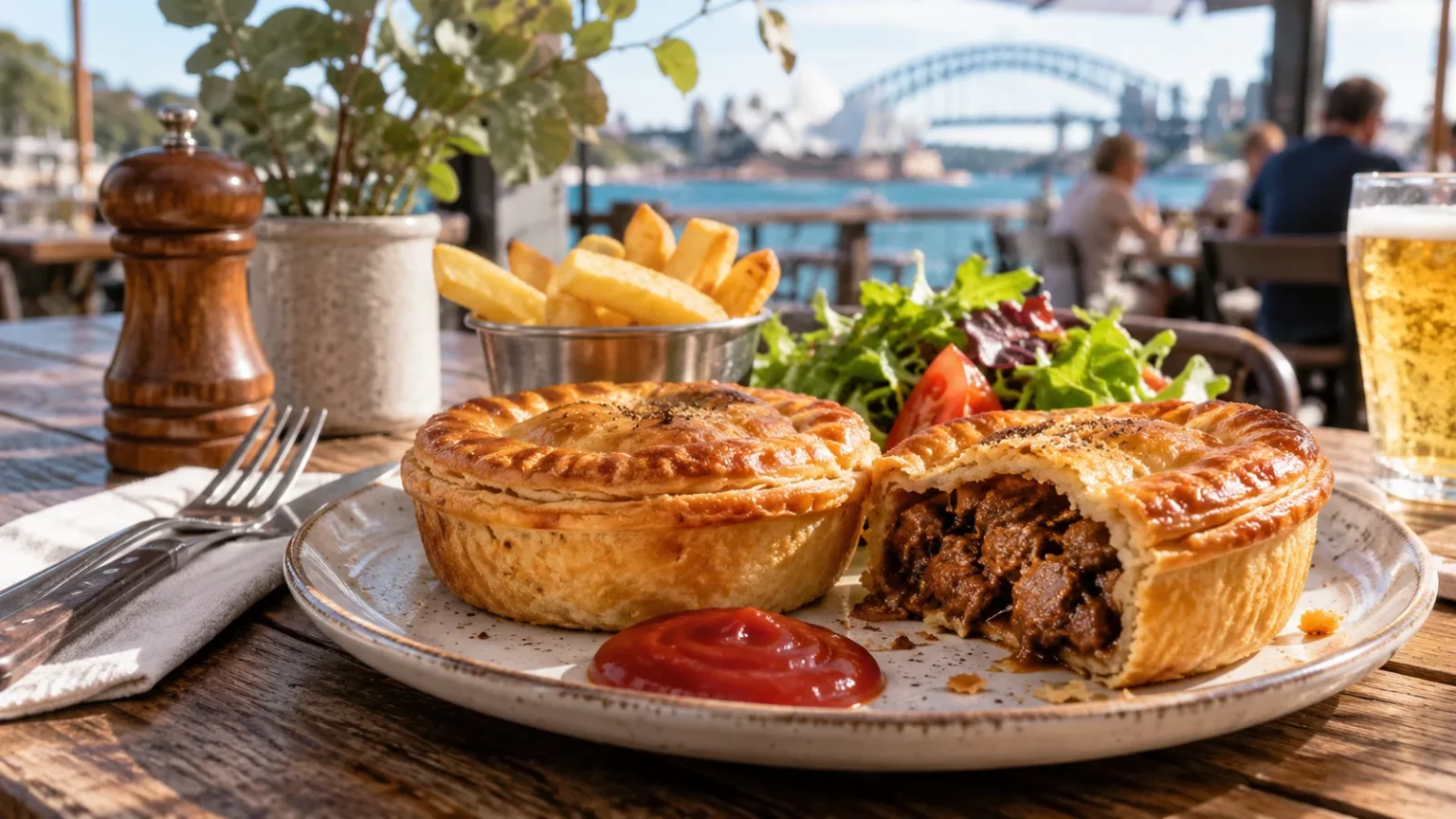
The Australian meat pie is a compact pastry filled with minced or diced meat and rich gravy. Versions can include beef, pepper, mushrooms, curry or other additions, but the basic formula remains deliberately uncomplicated. Tourism Australia describes the meat pie as part of Australian working-class history and one of the country’s familiar inexpensive snacks.
A local bakery is often a better place to understand the appeal than an elaborate restaurant. The pastry should hold together well enough to eat by hand, although the combination of hot gravy and flaky crust means first-time visitors should expect at least some structural failure.
Tomato sauce is a common addition. Whether it improves a good pie is a debate best left to whoever is eating it.
How do you eat an Australian meat pie without wearing it?
Do not squeeze it. Keep the pie level, take smaller bites around the edge and give a freshly heated filling time to cool before committing to the center. Hot gravy can escape surprisingly quickly once the pastry wall collapses.
A knife and fork are perfectly acceptable if the pie is served on a plate. Australian authenticity does not require burning your mouth while trying to prove that a meat pie is portable.
2. Vegemite – The Australian Food Tourists Most Often Eat Wrong
Vegemite is a dark, salty yeast extract spread and one of Australia’s most recognizable foods. Its intense flavor makes sense in a thin layer over generously buttered toast. It makes considerably less sense when a first-time visitor spreads it as thickly as peanut butter.
That mistake explains a large percentage of dramatic first reactions. Vegemite is concentrated, salty and umami-rich, so more is not necessarily better. Butter softens the intensity and lets the toast remain part of the experience.
Start with a tiny amount. If that tastes good, add more to the next piece.
Does Vegemite actually taste bad?
It tastes strong, not objectively bad. Someone expecting chocolate spread will probably be horrified, while people accustomed to salty fermented or umami-heavy foods may find it much less strange.
The useful comparison is seasoning rather than jam. Treat Vegemite almost like a concentrated condiment and it suddenly makes much more sense.
3. Barramundi – The Fish That Belongs on an Australian Food List
Barramundi is a firm white-fleshed fish and one of the most useful foods for travelers who want something distinctly connected with Australian waters rather than another pastry or dessert. Tourism Australia particularly highlights barramundi in Darwin, where the fish is closely associated with northern Australian food experiences.
Its relatively mild flavor makes elaborate preparation unnecessary. Grilling or pan-frying allows the fish itself to remain the focus, especially when the catch is fresh.
Barramundi also demonstrates an important point about Australian cuisine: the country’s enormous coastline makes seafood central to the food experience. A tasting guide dominated entirely by meat misses that completely.
In northern Australia, look beyond one fish as well. Prawns, oysters, mud crab and other seafood can be just as memorable depending on location and season.
4. Chicken Parmigiana – The Pub Meal That Became an Australian Institution
Chicken parmigiana – usually shortened to “parma” or “parmi,” depending partly on where you are – consists of crumbed chicken topped with tomato sauce and melted cheese. It commonly arrives with chips and salad at pubs around Australia. Portions can be enormous.
The dish has Italian-American ancestry rather than ancient Australian origins, which is exactly why it belongs in this guide. Modern Australian food is full of dishes that arrived through migration, adaptation and local eating habits before becoming deeply embedded in everyday culture.
Regional naming adds another layer of fun. Australians can become surprisingly invested in whether the correct abbreviation is parma or parmi.
Travelers do not need to choose a side. Ordering the full name is an effective diplomatic solution.
5. Sausage Roll – The Other Australian Bakery Essential
A sausage roll wraps seasoned sausage meat in flaky pastry and bakes the whole thing until golden. It is less internationally famous than the meat pie but just as useful for understanding Australia’s bakery culture. You will find versions in neighborhood bakeries, cafés, service stations and supermarkets.
Like a meat pie, it is designed for convenience rather than ceremony. Tomato sauce is a common partner, and the quality varies dramatically between mass-produced versions and good independent bakery rolls.
The smartest strategy is not deciding between a pie and sausage roll. Share both with another person and compare them while they are still hot.
Australian bakeries deserve their own meal slot, particularly on a road trip where regional bakeries can become destinations in themselves.
6. Lamington – A Cake That Looks Simpler Than It Tastes
A lamington is traditionally a cube or square of sponge cake coated in chocolate and rolled in desiccated coconut. Some versions add jam or cream through the middle. Tourism Australia describes it as a beloved local delicacy commonly found in neighborhood bakeries and cafés.
Its strength comes from texture. Soft sponge, a thin chocolate coating and dry coconut create something more interesting than the short ingredient list suggests.
The exact origin of the lamington has inspired competing stories and historical debate. Travelers do not need to resolve those arguments before eating one.
Try a straightforward bakery lamington before a heavily reinvented restaurant version. The classic gives you a baseline for understanding what later variations are changing.
7. Anzac Biscuits Come With a Story That Is Often Told Incorrectly
Anzac biscuits are sweet biscuits traditionally made with ingredients including rolled oats and golden syrup. They are closely associated with Anzac Day and remembrance in Australia and New Zealand. They can be crunchy or chewy depending on the recipe and baking style.
A common story says the modern sweet biscuits were exactly what Australian and New Zealand troops ate at Gallipoli. The history is more complicated. The Australian War Memorial distinguishes the sweet Anzac biscuit from the extremely hard army biscuits – or hardtack – issued as military rations.
The precise origin of the sweet Anzac biscuit is contested. The Australian War Memorial notes that the familiar oat-and-golden-syrup style became established in recipe books after the First World War, while the relationship between those recipes and wartime food parcels is not as simple as popular retellings suggest.
That makes the biscuit more interesting, not less. It is a perfect example of how food memory, national history and family tradition can become intertwined over generations.
8. Pavlova – Delicious Dessert, Dangerous Historical Conversation
Pavlova is a meringue-based dessert with a crisp outer shell and soft interior, typically topped with cream and fruit. Passionfruit, berries, kiwi and other fresh fruits commonly appear depending on the version. It is light in texture but not necessarily light after a full meal.
The dessert is named after Russian ballerina Anna Pavlova. Australia and New Zealand have famously argued over its origins, and attempts to reduce that history to a simple national ownership claim tend to create more heat than clarity.
For travelers, the solution is much easier: eat pavlova in Australia and eat it in New Zealand if the trip reaches both countries. Comparing versions is more enjoyable than adjudicating a century-old culinary dispute.
LitiTravels already has a guide to Auckland for first-time visitors, which makes a useful starting point if New Zealand follows Australia on the itinerary.
9. Flat White – Australian Food Culture Comes in a Coffee Cup Too
A flat white combines espresso and steamed milk with a relatively thin layer of microfoam. Exact definitions vary between cafés, and arguments over whether Australia or New Zealand should receive credit for its invention remain unresolved. What matters to travelers is that the drink became deeply connected with modern café culture in both countries.
Australia’s coffee culture extends much further than one drink. Melbourne is particularly famous for independent cafés, espresso and brunch culture, but serious coffee is hardly confined to one city. Tourism Australia itself presents café brunch as part of contemporary Australian eating.
A flat white therefore belongs on an Australian tasting itinerary even though it is not a “dish.” Order one with breakfast rather than squeezing another snack into an already full afternoon.
Coffee also reveals Australia’s multicultural food story. Italian migration had a profound influence on espresso culture, while later generations of café owners and roasters continued changing how Australians drink coffee.
10. Avocado Toast Is More Australian Than the Internet Joke Suggests
Avocado toast became a global café cliché, but smashed avocado on toast has strong associations with Australian brunch culture. Modern versions can arrive with feta, eggs, seeds, herbs, tomato, lemon, chili or numerous other additions. The concept is simple enough that execution matters more than novelty.
This is another example of Australian food that does not fit the stereotype of old national recipes. Contemporary cuisine can become culturally representative without being centuries old.
A café breakfast built around eggs, good bread, avocado and excellent coffee often gives travelers a more realistic glimpse of urban Australian eating than searching for kangaroo at every meal.
Not every Australian food experience needs to involve something unusual. Sometimes the cultural difference is in how ordinary ingredients become part of a daily ritual.
11. Kangaroo – Native Meat Worth Approaching With Context
Kangaroo meat is available in Australia and has a distinctive place in conversations about native foods. It is very lean, dark and noticeably different from conventional beef or lamb. Because of its low fat content, overcooking can quickly make it dry.
Travelers sometimes approach kangaroo as a novelty or dare, which misses the more interesting story. Kangaroos are native animals that have been consumed on the continent for thousands of years, long before European settlement.
That does not mean every dish containing kangaroo represents Aboriginal cuisine. Modern restaurant preparations and Indigenous food traditions are not interchangeable concepts.
If trying kangaroo, choose a kitchen that treats it as an ingredient rather than a tourist stunt. The difference between cultural curiosity and gimmick matters.
12. Native Australian Ingredients Open an Entirely Different Food Story
Native Australian ingredients are sometimes grouped under the broad term “bush foods” or “bush tucker,” but travelers should avoid treating them as a basket of exotic curiosities. Aboriginal and Torres Strait Islander peoples developed sophisticated food knowledge over tens of thousands of years, with ingredients and practices differing across Country and communities.
Contemporary menus may feature ingredients such as wattleseed, finger lime, lemon myrtle, Davidson plum or native pepper. Some are used by Indigenous-owned businesses and chefs, while others have entered the broader Australian restaurant industry.
Context matters when trying them. A dessert containing finger lime at a fashionable restaurant can be delicious, but it should not automatically be presented as a complete experience of Indigenous Australian cuisine.
For travelers interested in First Nations food culture, Indigenous-led food experiences provide much more meaningful context than simply checking a native ingredient off a list.
13. Moreton Bay Bugs Are Much Better Than Their Name Sounds
A Moreton Bay bug is not an insect. It is a type of slipper lobster found in Australian waters, with sweet flesh that makes it particularly prized in seafood cooking. The alarming name becomes much less alarming once the shellfish reaches the plate.
Queensland is an obvious place to look for it, especially around seafood-focused restaurants and markets. Preparation can be as simple as grilling with butter, garlic or lemon.
This is exactly the kind of Australian food travelers may miss if they concentrate entirely on nationally branded classics. Coastal Australia has access to exceptional seafood, and regional catches deserve space alongside meat pies and Vegemite.
If a menu offers locally sourced seafood you have never heard of, ask about it. The unfamiliar option may reveal far more about the destination than another generic fish-and-chips order.
14. Damper – Simple Bread With a Complicated History
Damper is a simple Australian bread traditionally associated with cooking over campfires in the bush. Basic versions use flour and water, although modern recipes often add milk, butter or other ingredients. It is commonly connected in popular imagination with stockmen, drovers and colonial life.
Its story is more complicated than a romantic campfire image. Forms of bread made from ground native seeds existed in Aboriginal food traditions long before European settlement, while the flour-based damper most travelers recognize is associated with colonial ingredients and bush life.
That distinction is worth preserving. Calling every form of Australian bush bread “the same thing” erases meaningful differences in ingredients, techniques and history.
Modern damper is often served with butter, golden syrup or other accompaniments. For travelers, it makes the most sense in a regional, historical or cultural setting rather than as a random supermarket purchase.
15. Fairy Bread Is Not Sophisticated – and That Is the Point
Fairy bread is sliced white bread spread with butter or margarine and covered with colorful sprinkles, traditionally hundreds and thousands. It is strongly associated with Australian children’s parties and nostalgia. No complicated cooking technique is hiding underneath.
For international travelers, this can be one of the stranger famous Australian foods because it looks too simple to qualify as a national cultural reference. That simplicity is exactly why it works. People remember it from childhood rather than restaurant tasting menus.
You are unlikely to structure an entire meal around fairy bread. It is better understood as a piece of Australian food nostalgia.
If you encounter a chef reinventing it as an elaborate dessert, remember that the original appeal involved almost no sophistication whatsoever.
16. Tim Tams Are the Supermarket Stop Worth Making
Tim Tams are chocolate-coated biscuits with a creamy filling between crisp biscuit layers. They are sold in supermarkets across Australia and come in numerous flavors, making them one of the easiest Australian foods to try without adding another restaurant to the itinerary.
The famous “Tim Tam Slam” involves biting opposite corners off the biscuit and using it like a straw for a hot drink before eating the softened biscuit. It is messy, structurally risky and much more entertaining than simply opening the packet.
Start with the classic chocolate version. Limited editions can wait until you know whether you actually like the basic biscuit.
This is also an easy souvenir, although chocolate and hot Australian weather are not always cooperative travel companions.
17. Vanilla Slice Can Turn a Bakery Stop Into Dessert
A vanilla slice typically consists of thick custard between layers of pastry, finished with icing or another topping. Variations exist across Australian bakeries, and the balance between flaky pastry and soft custard determines whether eating it is elegant or chaotic.
The dessert has European ancestry rather than being a uniquely isolated Australian invention. Like many Australian foods, however, it became embedded in local bakery culture through adaptation and repetition.
Regional bakeries can become surprisingly serious about their vanilla slices. Road-trippers may encounter competitions, local claims and enormous versions that turn a casual snack into a full dessert.
Sharing is sensible. A substantial vanilla slice after a meat pie and sausage roll is a formidable bakery lunch.
18. Potato Scallop, Potato Cake or Potato Fritter – Same Snack, Different Argument
One of Australia’s most entertaining food disputes concerns a battered slice of potato sold at fish-and-chip shops. Depending on the state and speaker, it may be called a potato scallop, potato cake or potato fritter. The food is simple; the terminology is not.
In parts of New South Wales and Queensland, “potato scallop” is familiar. Victorians commonly use “potato cake,” while other regional terminology appears elsewhere. Australians can debate these names with an intensity wildly disproportionate to the complexity of fried potato.
This makes the snack more useful to travelers than its ingredient list suggests. Ordering one can become a tiny lesson in Australian regional identity.
Whatever the local name, expect a slice of potato coated in batter and deep-fried until crisp. Eat it hot, ideally from a proper fish-and-chip shop rather than treating it as a culinary museum exhibit.
Wait – What About Australian Barbecue?
Australian barbecue absolutely belongs in the food conversation, but it is better understood as an eating culture than one specific dish. Sausages, steaks, lamb, seafood and other foods can all end up on the grill, particularly during social gatherings and warm-weather events.
The stereotypical “shrimp on the barbie” line is largely an international marketing cliché. Australians generally use the word prawn, not shrimp, for the seafood being referenced. Travelers repeating the phrase may therefore sound more like an old tourism advertisement than a local.
A sausage in bread from a community barbecue can be more culturally recognizable than an elaborate grilled dinner. The famous “sausage sizzle” is essentially a sausage served in bread, often with onions and sauce, and frequently appears at community or fundraising events.
The broader lesson is useful: Australian barbecue is about social context as much as the food on the grill.
The Australian Foods That Are Actually Worth Planning a Meal Around
Not every iconic Australian food deserves its own restaurant reservation. Vegemite can be tried at breakfast, Tim Tams come from a supermarket and a lamington works perfectly well as an afternoon bakery stop. Saving entire meal slots for these foods would make the itinerary unnecessarily difficult.
Seafood, pub food and contemporary Australian cooking deserve more time. A good dinner can introduce local fish, seasonal produce and native ingredients simultaneously, while a pub lunch provides a completely different experience.
| Food | Plan a meal around it? | Best strategy |
|---|---|---|
| Meat pie | Sometimes | Make it a bakery lunch |
| Vegemite | No | Add it to breakfast |
| Barramundi | Yes | Order at a seafood-focused restaurant |
| Chicken parmigiana | Yes | Have a pub lunch or dinner |
| Sausage roll | No | Share during a bakery stop |
| Lamington | No | Coffee and afternoon snack |
| Anzac biscuit | No | Bakery or café snack |
| Pavlova | Sometimes | Share after dinner |
| Flat white | No | Build it into breakfast |
| Kangaroo | Yes, if interested | Choose a restaurant that handles it carefully |
| Native ingredients | Yes | Look for a thoughtful or Indigenous-led experience |
| Moreton Bay bug | Yes | Try in Queensland or a strong seafood restaurant |
You may also be interested in our article: 15 London Museums Worth Your Time in 2026 – From Mummies to Modern Art
This approach keeps the tasting guide realistic. The goal is to understand Australian food, not spend an entire holiday recovering from the previous meal.
What Does a Realistic One-Day Australian Food Crawl Look Like?
A good Australian food crawl should move through different eating formats rather than jumping from one heavy national dish to another. Breakfast belongs in a café, lunch can come from a bakery or pub, afternoon is ideal for something sweet and dinner should reflect the produce or seafood of the region.
The exact foods will change between Melbourne, Sydney, Brisbane, Adelaide, Perth and Darwin. The structure, however, works surprisingly well across the country.
- Breakfast – Flat White and Café Breakfast. Start with good coffee, eggs, avocado toast or another modern Australian café dish.
- Late Morning – Vegemite Toast if You Haven’t Tried It. Keep the layer thin and use plenty of butter.
- Lunch – Meat Pie or Pub Meal. Choose a bakery pie for a lighter day or chicken parmigiana if lunch is the main meal.
- Afternoon – Lamington or Vanilla Slice. Pair one bakery sweet with coffee rather than ordering several desserts.
- Snack – Tim Tam or Anzac Biscuit. Share if several iconic sweets remain on the list.
- Dinner – Australian Seafood or Regional Produce. Barramundi, prawns, oysters or another local catch provides a completely different side of the cuisine.
- Optional – Native Ingredients. If a reputable restaurant uses them thoughtfully, finish the day with a dish or dessert incorporating native Australian produce.
This route intentionally avoids kangaroo, pavlova, sausage rolls and every other food appearing in the guide. Trying everything in one day is neither necessary nor particularly enjoyable.
Sydney, Melbourne, Brisbane or Darwin – Where Should You Eat What?
Australia is too large for one city to represent its entire cuisine. Climate, migration, agriculture and access to seafood create meaningful regional differences, while each major city has developed its own dining personality.
Melbourne is particularly useful for café culture and multicultural dining. Sydney combines an enormous restaurant scene with seafood and coastal experiences, while Brisbane provides access to Queensland produce and seafood. Darwin offers a very different tropical food environment and is especially relevant for barramundi and influences from Australia’s proximity to Asia.
| Destination | Food experience to prioritize |
|---|---|
| Sydney | Seafood, contemporary Australian dining, multicultural restaurants |
| Melbourne | Coffee, brunch, bakeries, multicultural food |
| Brisbane | Queensland produce, seafood, casual dining |
| Darwin | Barramundi, tropical produce, markets, Asian influences |
| Adelaide | Markets, regional produce and South Australian dining |
| Perth | Seafood, produce and Western Australian ingredients |
| Tasmania | Seafood, dairy, cool-climate produce |
| Regional Australia | Bakeries, pubs, local produce and road-trip food |
Travelers heading into inland New South Wales can combine food stops with an Australian outback itinerary. LitiTravels’ guide to things to do in Broken Hill covers one of the site’s existing Australian destinations and works naturally as the next planning step.
Why Australian Food Is So Multicultural
Australia’s food culture cannot be separated from immigration. Italian, Greek, Chinese, Vietnamese, Lebanese, Malaysian and many other communities have shaped what Australians cook, buy and consider ordinary food. The result is not simply a collection of separate immigrant cuisines but decades of exchange and adaptation.
The Australian Department of Foreign Affairs and Trade, for example, describes Malaysian food such as laksa, satay, mee goreng and nasi lemak as deeply familiar within Australian cities. It also points to Melbourne café culture moving in the opposite direction through cultural exchange.
That is why defining authentic Australian food only through colonial-era dishes produces an incomplete picture. A bowl of excellent laksa in an Australian city can tell a genuine story about contemporary Australia even if laksa originated elsewhere.
This does not mean every dish eaten in Australia becomes “Australian cuisine.” It means the cuisine of Australia is shaped by the people who live there, and multicultural influence is fundamental rather than peripheral.
Indigenous Australian Food Is Not a Tourist Novelty
No guide to Australian food is complete without acknowledging that food culture on the continent predates European settlement by tens of thousands of years. Aboriginal and Torres Strait Islander peoples developed food systems adapted to highly diverse environments, from tropical north to deserts, forests and coastal areas.
The phrase “bush tucker” is widely recognized but can flatten that enormous diversity when used as though one national Indigenous cuisine exists. Food traditions, ingredients and knowledge differ between peoples and Country.
Travelers interested in this history should look for Indigenous-owned restaurants, tours, cultural experiences and businesses where food is presented with appropriate knowledge and context. Native ingredients appearing on a mainstream restaurant menu can still be excellent, but the experience is not automatically equivalent.
This distinction makes the food journey richer. It moves the conversation away from “strange ingredients to taste” and toward one of the world’s oldest continuing food cultures.
Australian Food Myths Travelers Should Stop Repeating
Australian food attracts myths partly because a handful of jokes and advertising campaigns became more internationally famous than the cuisine itself. Vegemite is probably the greatest victim: travelers deliberately spread a huge spoonful on bread, dislike the result and conclude Australians have inexplicable taste.
The “shrimp on the barbie” stereotype is another example. Barbecuing seafood is entirely plausible, but Australians normally call the relevant crustaceans prawns. The phrase became famous internationally through tourism marketing rather than ordinary Australian speech.
Anzac biscuits have their own historical confusion. The modern sweet oat biscuit should not be casually described as the same hard ration soldiers ate at Gallipoli; the Australian War Memorial explicitly distinguishes the two.
Then there is the idea that Australian cuisine is simply British food in better weather. British and Irish influences are undeniable, but that description ignores Indigenous food cultures, Mediterranean migration, Asian immigration, modern café culture and the country’s enormous seafood resources.
How to Order and Eat Like a Local in Australia
Australian dining is generally informal, but the service model changes between cafés, pubs and restaurants. Some cafés provide table service, while others expect customers to order and pay at the counter. Pubs may require ordering meals at a bar or dedicated counter even when diners are seated at tables.
A few terms are useful:
- Brekkie. Breakfast.
- Takeaway. Food ordered to go.
- Flat White. Espresso with steamed milk and fine microfoam.
- Parma or Parmi. Regional shorthand for chicken parmigiana.
- Bottle-O. A shop selling alcoholic drinks, not a restaurant.
- Servo. Service station or petrol station, sometimes relevant on long road trips.
- Sanga. Informal shorthand for sandwich.
- Snag. Sausage, especially in barbecue contexts.
Travelers do not need to imitate Australian slang to order successfully. Understanding it is useful; forcing it into every conversation usually is not.
Is Australian Food Expensive?
Australia can be an expensive destination for dining, particularly in major cities and tourist areas. Café breakfasts, restaurant meals and alcoholic drinks add up quickly, while premium seafood and destination restaurants can push daily food budgets much higher.
Fortunately, iconic Australian foods exist at several price levels. A bakery pie, sausage roll or supermarket Tim Tam costs far less than a seafood dinner. Markets, food courts and takeaway meals can also keep spending under control.
A useful strategy is to spend selectively. Have one excellent regional dinner, then use bakeries, cafés and markets for other meals rather than booking three restaurants every day.
Road trips require extra planning. Remote locations may have fewer choices and higher prices, so buying snacks and water before long drives can be both cheaper and more practical.
What Australian Foods Work for Vegetarians?
Modern Australian cities are generally easy for vegetarian and vegan travelers because contemporary cafés and restaurants commonly accommodate different dietary preferences. Tourism Australia also notes that vegetarian and vegan options are widely catered for, including in many pubs.
Traditional iconic-food lists are less balanced. Meat pies, sausage rolls, chicken parmigiana, kangaroo and much seafood obviously do not work, but café culture opens far more possibilities. Avocado toast, plant-based brunch dishes, bakery products and multicultural restaurants provide plenty of alternatives.
Desserts require individual checking rather than assumptions. Pavlova contains egg, while biscuits and cakes may include butter or other animal products.
Native plant ingredients can also appear in vegetarian dishes, but again, the surrounding preparation matters more than the ingredient name.
What Australian Foods Make Good Souvenirs?
Packaged foods are easier than attempting to transport anything fresh. Vegemite, Tim Tams and packaged Anzac biscuits are obvious options because they travel relatively well and immediately connect with Australian food culture.
Heat is the enemy of chocolate. Tim Tams packed into luggage during an Australian summer can arrive at the destination in a substantially different physical state.
Biosecurity rules also matter when crossing international borders. A product being legal to buy in Australia does not automatically mean another country allows it to be imported.
Check the destination country’s customs requirements before packing food. The safest souvenir is one that survives both the flight and border inspection.
A Better Way to Taste Australian Food
Do not build the trip around finding a restaurant that serves every famous Australian dish. Such a menu is more likely to resemble a tourist checklist than the way Australians actually eat. Instead, use different places for different parts of the food culture.
Visit a bakery for a meat pie and lamington. Use a café for breakfast and coffee, a pub for chicken parmigiana, a fish market or seafood restaurant for local catch and a thoughtful contemporary restaurant for native ingredients.
Then allow multicultural Australian food into the itinerary rather than treating it as a distraction from “authentic” cuisine. Australia’s cultural diversity is part of the authenticity.
Travelers who enjoy using casual food to understand destinations can also explore LitiTravels’ guide to street food in Spain. The same principle applies in both countries: ordinary food can reveal as much about a place as a formal restaurant.
Australian Food Is Hard to Define – and That Is Exactly the Point
There is no single Australian meal that neatly explains the country. A meat pie speaks to bakery and working-class traditions, barramundi reflects the continent’s waters, Vegemite represents an unmistakable everyday icon and a flat white points toward a sophisticated modern café culture.
Then the picture becomes much larger. Indigenous food knowledge reaches back tens of thousands of years, while generations of immigration transformed Australian cities into places where Mediterranean, Asian, Middle Eastern and other food traditions became part of daily life. Australia’s geography adds seafood, tropical produce, cool-climate agriculture and ingredients found nowhere else.
That complexity is what makes Australian food worth exploring. Do not travel across Australia looking for one national dish – let each city and region tell a different part of the story.
FAQ About Australian Food
What is traditional Australian food?
Traditional Australian food can refer to several very different culinary histories. Indigenous Australian food traditions predate European settlement by tens of thousands of years, while later Australian cooking developed through British and Irish influences followed by extensive multicultural migration. Meat pies, Vegemite, lamingtons, Anzac biscuits and barbecue are familiar icons, but they represent only part of the picture.
What food is Australia most famous for?
Vegemite, meat pies, lamingtons, Anzac biscuits and pavlova are among the most internationally recognized Australian foods. Barramundi, sausage rolls, pub chicken parmigiana, café breakfasts and seafood are also useful foods for travelers to try.
What is Australia’s national dish?
Australia does not have one universally agreed official national dish. Meat pies, roast lamb and other foods are sometimes informally proposed, while Vegemite is one of the country’s strongest food symbols. It is more accurate to describe Australia through several iconic foods than force the cuisine into one national dish.
What Australian food should you try first?
A meat pie is one of the easiest starting points because it is widely available, inexpensive and closely connected with Australian bakery culture. Add Vegemite toast at breakfast, a flat white, local seafood and a lamington to cover several very different sides of Australian eating.
What does Vegemite taste like?
Vegemite is salty, savory and strongly umami-rich because it is a concentrated yeast extract spread. First-time visitors should spread a small amount over generously buttered toast rather than applying it as thickly as peanut butter.
What food is unique to Australia?
Australia has native ingredients and foods that originate on the continent, including numerous plants used by Aboriginal peoples as well as native animals such as kangaroo. Modern icons including Vegemite and lamingtons are also closely associated with Australia, although the history of individual dishes can involve outside influences.
What is the most popular Australian dessert?
Pavlova and lamingtons are two of Australia’s best-known desserts, while vanilla slice and various bakery sweets are also popular. Pavlova’s origin is famously disputed between Australia and New Zealand.
Are Anzac biscuits the biscuits soldiers ate at Gallipoli?
Not exactly. Australian soldiers at Gallipoli received very hard army biscuits or hardtack, sometimes called Anzac wafers or tiles. The sweet oat-and-golden-syrup Anzac biscuit familiar today has a different and more complicated history.
What food should you try in Sydney?
Sydney is particularly useful for seafood, multicultural dining and contemporary Australian restaurants. A traveler can combine a café breakfast, bakery stop and seafood dinner without needing to search for one restaurant serving every iconic Australian food.
What food should you try in Melbourne?
Melbourne is particularly well suited to coffee, brunch, bakeries and multicultural food. Its café culture makes a flat white and breakfast an obvious starting point, while markets and neighborhood restaurants broaden the experience considerably.
What Australian food should you try in Queensland?
Queensland is a strong destination for seafood and tropical produce. Moreton Bay bugs are an especially distinctive option, while coastal areas provide access to prawns, fish and other fresh seafood.
Do Australians really eat kangaroo?
Kangaroo meat is commercially available and appears in supermarkets, butcher shops and restaurants, although it is not an everyday meal for every Australian. Travelers interested in trying it should look for a kitchen that prepares the lean meat carefully rather than treating it as a novelty challenge.
cruise packing checklist


Author of LitiTravels Portal


Articles by the author:
All articles by author


Bolivia's Uyuni Salt Flats can look like an endless white desert or the world's largest natural mirror depending on when you arrive. This guide explains the science, history and practical choices that determine what your trip w...
 September 27, 2026
 5
5

Scotland's busiest months are not automatically its best. May can beat midsummer for road trips, September brings a quieter Highlands experience, and winter has advantages of its own. Here's how to choose the right month for yo...
September 26, 2026
14

Romania looks compact on a map, but castles, medieval cities, mountain roads and the Danube Delta can turn poor planning into hours of backtracking. These 17 places show what is truly worth seeing and how to connect them into a...
September 25, 2026
11

London has enough museums to fill an entire trip, and many of the biggest cost nothing to enter. This 2026 guide shows which museums deserve your limited time, what to see first and how to avoid spending a day wandering galleri...
September 24, 2026
16
Subscribe to “lititravels” on Telegram for gaming intel.
No filler, no fuss—just your daily XP boost. Hop in and level up, squad!



Read also
London has enough museums to fill an entire trip, and many of the biggest cost nothing to enter. This 2026 guide shows which museums deserve your limited time, what to see first and how to avoid spending a day wandering galleri...
September 24, 2026
16
Thailand's best meals do not always come with reservations. They arrive sizzling from a wok, smoking over charcoal or packed into a paper tray. These 18 Thai street foods are the ones worth knowing before your first market visit.
September 23, 2026
24

Karnak is overwhelming, Philae sits on an island and Abu Simbel was moved piece by piece. These nine Egyptian temples make far more sense once you know what to look for – and which ones actually fit the same trip.
September 21, 2026
18

Puerto Rico is more than beaches and Old San Juan. These 21 fact-checked Puerto Rico facts explain the glowing water, rainforest, music, food, history and everyday details you can actually notice on a trip – plus the myths wort...
September 20, 2026
19

The historic Parisian quarter of Montmartre is associated with a strong affinity for art and cultural backgrounds. This is the area where famous artists such as Picasso and Monet used to reside and work. Here, you may find art ...
May 26, 2025
470

Saint-Rémy-de-Provence is one of the oldest towns in France founded by the Celts more than 2,500 years ago and developed by both the Greeks and the Romans. Set at the base of the Alpilles Mountains and surrounded by vineyards a...
April 15, 2025
518

September is an exciting month for festivals. It brings together people from all over the world to celebrate culture, food, music, and traditions. From massive beer festivals in Germany to light-filled lantern parades in China,...
March 21, 2025
388

If you’re into history or impressive architecture, then Morocco palaces are your deal. They expose the country’s past and just-skilled local builders. Each of them has a story to tell, and each has an atmosphere of its ow...
 March 17, 2025
517
March 17, 2025
517

Spain acquires the best know-how to eat well, in fact, street food becomes one of the best ways to get into its gastronomic culture. You can be doing a lively walk in a city or lying on the beach soaking up the sunny rays; the ...
March 28, 2025
450

Music festivals are a global phenomenon that bring people together from all walks of life. Whether it’s for the music, food, fashion, or the overall vibe, these events leave lasting memories. Let’s explore the biggest and...
March 23, 2025
833

Cooperation
Looking to shine a spotlight on your project? LitiTravels has you covered! We offer article-based promotion, manage branded blogs on our platform, drive engagement through our social media channels, and create content that delivers real results. Get in touch today and let’s make your brand stand out!
Subscribe to the monthly news digest from LitiTravels
The main news and updates from the team about gadgets, sports, cars, health, and lifestyle.
