Home Travel PlanningTraveling Internationally With Prescription Medication: What to Check Before You Fly
Travel PlanningTraveling Internationally With Prescription Medication: What to Check Before You Fly
Traveling internationally with prescription medication is usually possible, but a medicine that is legal in one country may be restricted or prohibited in another. Even when the medication itself is permitted, travelers may need an original prescription, a medical certificate, an import authorization, or a specific quantity of medicine to satisfy border requirements.
The most common mistake is assuming that a doctor's prescription automatically makes a medication legal everywhere. It does not. Certain ADHD medications, opioid painkillers, sleeping pills, and anxiety medications receive particular scrutiny because countries classify their active ingredients differently.
Airport security and customs also enforce separate sets of rules. A bottle of prescription medicine may be allowed through security and onto an aircraft but still be prohibited at the destination. Similarly, the familiar 100 mL cabin liquid limit does not automatically apply to medically necessary liquids, yet those exceptions do not override a country's medicine import restrictions.
The safest approach is to verify the exact active ingredient, check every relevant country's requirements, prepare supporting documentation, and carry medication in its original packaging.
This guide explains the rules for traveling internationally with prescription medication, including country-specific examples, controlled substances, injections, refrigerated medicines, connecting flights, and what to do when an essential medication cannot legally enter the destination.
The main rule is straightforward: check both the legality of the medicine and the conditions for bringing it into each country on the itinerary. An ordinary prescription, a doctor's letter, and an airline's approval may not be sufficient for a controlled or prohibited substance.
There is no worldwide medication allowance, no universally accepted doctor's certificate, and no single list covering every country's restrictions.
Before departure, the following requirements need attention.
|
What to check |
General rule |
Why it matters |
|
Medication legality |
Verify every active ingredient |
A prescribed medicine may be restricted abroad |
|
Quantity allowed |
Follow destination-specific limits |
Countries may permit different supply lengths |
|
Original packaging |
Keep pharmacy labels and medicine identifiers |
Helps identify the product and its owner |
|
Prescription |
Carry a valid prescription or copy |
May be required at customs |
|
Doctor's letter |
Obtain one when required or advisable |
Explains medical necessity and dosage |
|
Import permit |
Apply before departure when required |
A prescription alone may not authorize import |
|
Carry-on baggage |
Keep essential medication accessible |
Reduces loss, delay, and temperature risks |
|
Liquid medicines |
Check medical exemptions at security |
Essential liquids may exceed ordinary limits |
|
Transit countries |
Verify relevant transit and entry rules |
Restrictions may apply during connections |
|
Refrigeration |
Follow medicine-specific storage instructions |
Improper temperature can damage medication |
|
Emergency replacement |
Check refill availability and insurance |
A foreign prescription may not be accepted |
These are preparation principles rather than guarantees of legal entry. The final requirements depend on the medication, the country, the traveler's status, and the purpose and length of the visit.
The most reliable method is to check the medication's generic active ingredient against the destination country's official health, pharmaceutical, or customs regulations. Brand names alone are not enough because the same substance can be sold under different names internationally.
A traveler taking a medicine sold under one brand in the United States may encounter a different brand name, different approval status, or a prohibition in another country.
Identify the active ingredient, strength, dosage form, and prescribed daily amount for every medicine being packed. These details are normally available on the pharmacy label, prescription record, or manufacturer's packaging.
For example, Adderall contains mixed amphetamine salts, while Vyvanse contains lisdexamfetamine. Both may be prescribed for ADHD, but their legal status is not identical internationally.
Japan provides a particularly important example: medicines containing amphetamine, including Adderall, cannot be imported for personal treatment, while prescribed lisdexamfetamine may be imported with advance authorization.
The condition being treated does not determine the border rule. The exact substance does.
Combination medicines require additional care because a product can contain more than one active ingredient. Travelers should check every ingredient rather than focusing only on the best-known one.
The appropriate authority is usually the destination's national health regulator, medicine agency, customs administration, or department responsible for controlled substances.
Useful official starting points include:
The International Narcotics Control Board also collects country information about travelers carrying controlled substances. However, its country submissions are not always complete or current, so they should not replace direct verification with the destination authority.
If official information is unclear, contact the appropriate embassy or regulator and request written clarification identifying the medication's active ingredient, quantity, and intended travel dates.
An itinerary can involve more than one country's medication laws. A traveler might depart from Canada, change planes in Japan, and continue to another Asian destination.
The legal requirements depend partly on whether the traveler remains in an international transit area, clears immigration, retrieves checked baggage, or enters the country during an overnight connection.
A transit exemption in one country does not create the same exemption elsewhere.
Check the return journey as well. Bringing medication into the original country of residence can be subject to different rules from taking it out.
Countries regulate personal medication imports differently, particularly when controlled substances are involved. Some publish quantity-based exemptions, while others require individual permits or prohibit specific ingredients regardless of prescription status.
The following examples illustrate why travelers should not rely on a universal 30-day or 90-day rule.
|
Country or region |
General personal-use framework |
Important exception |
|
United States |
A supply of no more than 90 days is a general CBP rule of thumb, not blanket permission |
FDA approval, DEA rules, and controlled-substance restrictions apply |
|
United Kingdom |
Certain lawfully prescribed controlled medicines may be carried for up to 3 months |
Drug classification, proof of prescription, and special licensing rules matter |
|
Japan |
Many ordinary prescription drugs may enter without import confirmation up to a 1-month supply |
Controlled drugs and larger supplies have separate requirements |
|
Australia |
Many medicines qualify for a traveler exemption of up to 3 months |
Prohibited substances and permit requirements remain applicable |
|
Singapore |
Qualifying noncontrolled medicines may be brought in up to a 3-month supply |
Controlled ingredients require prior approval; some products are prohibited |
|
Schengen Area |
Certain eligible Schengen residents use a medical certificate for travel with controlled medicines |
Certificate validity is up to 30 days; other travelers must check national rules |
These figures are not interchangeable. A three-month allowance in Australia does not authorize a three-month supply in Japan, and a quantity allowance does not legalize a prohibited ingredient.
The United States generally expects imported medication to be for legitimate personal use and to comply with Food and Drug Administration requirements. Controlled substances must also comply with Drug Enforcement Administration rules.
U.S. Customs and Border Protection advises travelers to carry medication in its original container with the prescription or a doctor's note, preferably in English.
A supply of no more than 90 days is a commonly stated planning guideline, but it is not an automatic legal allowance for every medicine.
Medication that is not approved for use in the United States may face import restrictions even when a foreign physician has prescribed it. Special rules also apply to particular controlled substances and circumstances.
The United Kingdom permits certain controlled medicines for personal use under its published personal import policy, generally covering no more than a three-month supply when the applicable conditions are met.
For these medicines, travelers should carry proof of lawful prescription and a clinician's letter showing the medication, dosage, strength, and travel arrangements.
Some substances have stricter requirements. Certain Schedule 1 controlled drugs cannot normally be brought into the UK without a license, and such licenses are limited to exceptional purposes.
A traveler who needs longer-term treatment in the UK may have to arrange a consultation with a UK clinician rather than expect an additional supply to arrive through the mail.
Japan generally permits up to a one-month supply of many ordinary prescription medications for personal use without requiring an import confirmation. Bringing more may require an Import Confirmation Certificate, commonly referred to as a Yunyu Kakunin-sho.
This exemption does not apply to every medication.
Japan separately regulates narcotics, psychotropic substances, stimulants, and stimulant raw materials. Some require advance authorization, while certain substances cannot be imported for personal treatment at all.
For example:
A doctor's letter is not a substitute for a required Japanese government authorization. The exact substance and applicable procedure should be checked before booking.
Australia's Therapeutic Goods Administration provides a traveler's exemption for many personal medicines and medical devices.
The general conditions include original packaging, a prescription or doctor's letter, personal use, and a supply not exceeding three months.
Certain controlled or prohibited products remain subject to additional rules, and some medicines require a permit.
The exemption also does not generally authorize carrying medication for unrelated people. The rules distinguish personal use and qualifying immediate family members traveling together from bringing products for others.
Singapore's Health Sciences Authority requires travelers to check whether their medication contains prohibited ingredients or controlled substances requiring advance approval.
Qualifying medicines that do not require approval may generally be brought in up to a three-month supply. Travelers are expected to carry appropriate prescription documentation and keep products in their original, labeled packaging.
For medicines that require approval, Singapore advises submitting the application at least two weeks before arrival. An application submitted later may not be processed in time.
Some medicines cannot be imported at all. Importantly, Singapore's prohibited-medication rules can remain relevant even when a traveler stays in the airport transit zone.
Some travelers carrying narcotic or psychotropic medicines between Schengen countries need a certificate under Article 75 of the Schengen Implementing Convention.
This certificate is intended for eligible residents of Schengen states traveling to another Schengen state with prescribed controlled medicines. Its maximum validity is 30 days.
A visitor arriving from a country outside the Schengen Area should not assume that the same certificate is available or sufficient.
National rules still matter, including restrictions on the medicine itself, the quantity carried, and the documentation required.
A trip through several European countries is therefore not automatically covered by a prescription issued in the traveler's home country.
Medications most likely to require additional checks include stimulants, opioids, sedatives, sleeping pills, and other substances classified as controlled drugs.
However, some medicines that are not controlled in the traveler's home country may also face restrictions abroad.
The list below identifies categories that deserve particular attention, not a universal list of prohibited medications.
Yes, in some countries, but ADHD medication requires careful ingredient-by-ingredient verification. Stimulant medications may be controlled or prohibited even when lawfully prescribed elsewhere.
Examples include products containing amphetamine, lisdexamfetamine, and methylphenidate. These substances do not necessarily share the same classification or entry procedure.
Japan's distinction between amphetamine-containing Adderall and lisdexamfetamine-containing Vyvanse demonstrates why choosing another brand name is not enough.
Do not switch or discontinue prescribed ADHD medication simply to comply with travel rules without consulting the prescribing clinician. If the medicine cannot enter the destination, discuss an appropriate medical plan well before departure.
Many travelers can carry prescribed anxiety medication or sleeping pills internationally, but certain ingredients are classified as controlled psychotropic substances.
Medicines containing alprazolam, diazepam, lorazepam, or zolpidem may require documentation, quantity limits, or authorization depending on the destination.
The same medicine may be available by prescription in one country and subject to tighter import controls in another.
Travelers should verify the generic ingredient and obtain a clinician's letter explaining the prescribed treatment when required.
Some prescription painkillers are permitted for personal use, while opioid-containing medicines often face stricter controls.
Examples requiring particular attention include medications containing oxycodone, morphine, fentanyl, and certain codeine formulations.
A medicine's status may depend on its ingredients, strength, formulation, and intended use.
Even a prescription from a licensed physician does not automatically override restrictions on controlled substances. Advance authorization may be necessary.
Medical cannabis is particularly complicated because national laws differ substantially. Permission to possess cannabis under a domestic medical program does not establish a right to transport it into another country.
Some destinations prohibit personal imports of cannabis products, including certain medically prescribed preparations. Others regulate specific pharmaceutical cannabinoid products differently from cannabis flower, oils, or other preparations.
Travelers should check the exact ingredients and product classification with the destination's competent authority.
Do not assume that a medical cannabis card, prescription, or legal purchase at home is valid internationally.
Yes. A medicine sold without a prescription in one country may be regulated as a prescription-only or controlled product in another.
Certain cold medicines, decongestants, sleep aids, and combination products can present problems because of specific ingredients.
For example, Japan applies special controls to stimulant raw materials, including some products containing pseudoephedrine, depending on their formulation and regulatory classification.
Travelers should check the active ingredients of over-the-counter medication just as carefully as prescription drugs.
There is no universal quantity limit. The permissible amount depends on the destination, medication classification, import authorization, and sometimes the length of the visit.
For planning purposes, calculate the actual quantity needed, then compare it with the legally permitted amount.
A simple formula is:
Required quantity = Prescribed daily dose × Travel days + Approved contingency supply.
For example, a traveler prescribed two tablets per day for a 14-day trip requires 28 tablets for the planned journey.
An additional three-day supply would bring the total to 34 tablets, but that extra amount is appropriate only when permitted by the relevant laws, prescription, and clinical instructions.
Extra medication may be useful if flights are delayed, but the amount must comply with the destination's import rules.
The CDC advises carrying enough medication for the entire trip and an additional supply for possible disruptions. That is a preparedness recommendation, not permission to exceed a country's legal limit.
For controlled medications, the maximum permissible supply may be substantially smaller than a traveler would prefer.
If the allowed quantity is insufficient, arrange a lawful alternative with the prescribing clinician rather than packing additional tablets without authorization.
No. These figures appear in several national regulations and travel recommendations, but they do not establish a worldwide standard.
Japan generally allows up to one month of many ordinary prescription medicines without import confirmation. Australia and Singapore have qualifying three-month exemptions, while other destinations use different systems.
The correct quantity must be determined separately for each medicine and destination.
Long trips require more preparation because the destination may prohibit importing the full supply.
Travelers may need to arrange care with a licensed clinician abroad, establish how local prescriptions work, or seek special authorization where such procedures exist.
It is risky to assume that relatives can simply mail additional medicine internationally. Shipping prescription products and controlled substances can trigger separate import and export restrictions.
Discuss long-term access before departure, particularly when the treatment must continue without interruption.
The most useful documents are a valid prescription, an original pharmacy label, and a signed clinician's letter where required or advisable. Controlled medicines may also require an official permit or medical certificate.
Documentation should clearly connect the medication to the person carrying it.
A travel letter should identify the patient, the medicine, the prescribed dose, and the reason the medication or medical equipment is necessary.
A typical letter can include:
The exact format depends on national requirements. Some countries require specific official forms, translations, authentication, or certificates issued by a competent authority.
A standard letter on clinic letterhead may be helpful, but it does not replace a government import permit.
Sometimes, but not always. For certain ordinary medications, a prescription copy and properly labeled packaging may satisfy the relevant requirements.
Controlled substances and particular destinations may require additional documents.
You may also be interested in our article: Your First International Trip: The Checklist That Starts Before Packing
A digital prescription can be useful as a backup, but travelers should verify whether printed or original documents are necessary at the border.
When uncertain, carry a printed prescription copy alongside the medicine and any required authorization.
Some countries require supporting medical documents in a specific language, while others accept English or another internationally used language.
Do not assume that a translation prepared independently will satisfy a requirement for an official, certified, or authenticated document.
Check the destination's published rules and arrange any necessary translation before departure.
Matching identification helps customs and security personnel establish that the medicine belongs to the traveler.
A difference caused by marriage, a legal name change, or another legitimate reason may require supporting documentation.
If the pharmacy label uses a different name from the passport, consult the dispensing pharmacy or relevant authority before departure rather than attempting to alter the label.
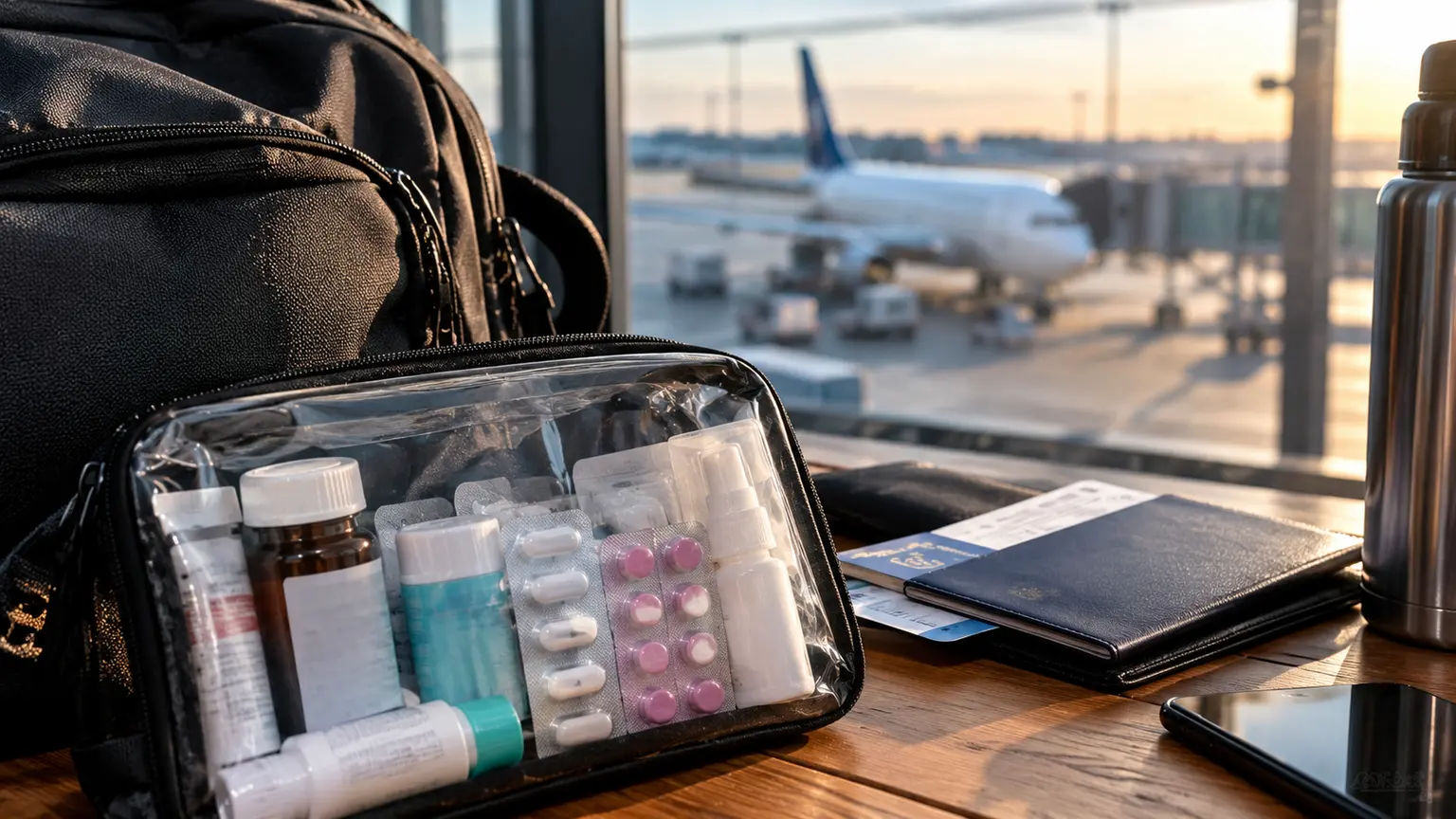
Keep essential medication in carry-on baggage, in its original labeled packaging, with documentation readily accessible. This reduces the risk of losing access to treatment if checked luggage is delayed or misplaced.
The CDC recommends original containers and carry-on transport for medicines taken internationally.
Carry-on baggage is generally the better choice for essential prescription medication. It keeps the medicine accessible during flight delays and reduces exposure to conditions in the baggage handling system.
Some airlines and regulators permit certain medication in checked luggage, but that does not make it the best choice for medicines that must be taken regularly.
Check carry-on size and weight limits, especially when transporting substantial medical equipment.
If an airline unexpectedly requires a cabin bag to be gate-checked, remove essential medication and permitted medical supplies first.
Travelers reviewing their broader packing arrangements can use the guide explaining what you cannot bring on a plane to distinguish ordinary cabin restrictions from medical exceptions.
The two questions remain separate: whether something is permitted aboard the aircraft and whether it may legally cross the destination's border.
Pill organizers can be convenient for daily medication management, but original labeled containers are preferable when transporting medicines internationally.
A loose tablet in an unmarked compartment is harder to identify during an inspection. For controlled medicines, the absence of original labeling may create additional complications.
Keep medication in its pharmacy-dispensed packaging during international travel unless the relevant authorities have confirmed another arrangement is acceptable.
After reaching the destination, a traveler may use a daily organizer if doing so is consistent with local rules and the medicine's storage requirements.
Not every country's airport screening rules require original prescription bottles. For example, the U.S. Transportation Security Administration does not generally require pills to remain in pharmacy bottles solely for security screening.
However, this does not override customs rules, local prescription-labeling laws, or the requirements of other countries.
Original labeled packaging remains the safest general recommendation for international border crossings.
Blister packs and pharmacy cartons can also provide identification when they contain the required information.
Medically necessary liquids can often exceed the ordinary 100 mL or 3.4-ounce carry-on limit, including under U.S. TSA and applicable European aviation security rules.
However, quantities must be reasonable for the journey, and passengers may need to present the medication separately for screening.
The rules at a connecting airport can differ, so medical-liquid exemptions should be verified for every relevant security checkpoint.
Under U.S. TSA procedures, passengers may bring medically necessary liquids, gels, and creams in quantities exceeding the standard 3.4-ounce limit.
Travelers should tell security officers about the medicine at the checkpoint and be prepared for additional inspection.
In the European Union, essential medicines needed during travel are also exempt from the ordinary 100 mL container limit, although travelers may be asked to establish that the product is genuinely required.
The exemption does not automatically apply to every liquid labeled as a health product.
Yes, insulin and necessary injection equipment can generally be carried through airport security under applicable medical exceptions, but passengers must comply with the rules of the countries and airports involved.
The TSA allows unused syringes when accompanied by injectable medication and requires travelers to declare these items for inspection.
A clinician's letter identifying the medication and need for injection supplies is advisable. The CDC also recommends medical documentation for travelers who use injectable medicines.
The destination's import rules for syringes and medical devices should be checked separately.
Epinephrine auto-injectors can generally travel with passengers when permitted by the relevant national rules. They should remain accessible because they may be needed urgently.
Carry the device in its original packaging with the prescription and a clinician's letter where appropriate.
Do not place essential emergency medication in inaccessible checked baggage. Follow the manufacturer's storage instructions and carry the number of devices prescribed by the treating clinician.
Temperature-sensitive medication requires an approved storage plan for the entire journey, including the airport, flight, transfers, and accommodation.
Not every injectable medication requires continuous refrigeration, and the correct temperature range may change after a product is opened or first used.
The manufacturer's instructions and advice from the dispensing pharmacist should determine the transport method.
Cooling accessories for medically necessary products may be permitted through security, subject to inspection and local rules.
In the United States, TSA procedures allow qualifying cooling supplies for medically necessary liquids. Travelers should declare the items and follow security instructions.
A suitable medical travel cooler can help, but the product should maintain the required temperature without freezing medicines that must not be frozen.
Do not place temperature-sensitive medication directly against ice or frozen gel packs unless the manufacturer's instructions specifically allow that arrangement.
Use a temperature-controlled transport solution suitable for the medicine and expected travel time. Consider the combined duration of ground transportation, airport waiting, the flight, immigration, and the journey to the hotel.
A scheduled ten-hour flight can require significantly more than ten hours of temperature control.
For particularly sensitive medicines, discuss storage arrangements with the pharmacy and obtain written manufacturer guidance if necessary.
Do not assume that airline cabin crew can refrigerate medication or provide suitable cold storage. Confirm available assistance before departure.
Not automatically. A hotel minibar may not maintain the stable temperature required for medication, and some units are designed primarily to cool drinks rather than store temperature-sensitive medical products.
Ask the hotel about an appropriate refrigerator before arrival. Confirm that the storage arrangement is accessible when medication is needed, including overnight.
If a medicine requires strict temperature control, a suitable monitored storage solution may be necessary.
A layover can create additional requirements when travelers clear immigration, recheck baggage, or pass through another country's customs system.
The most important distinction is whether the traveler remains in a secure international transit area or formally enters the transit country.
They can. Some countries provide exemptions for travelers who remain airside without clearing immigration, while others restrict certain substances even during transit.
Singapore, for example, generally does not require a personal medication approval for travelers remaining in the transit zone without immigration clearance. However, its rules still prohibit certain medications from being carried through, even during such transit.
A connection in the United Arab Emirates has its own published arrangements for travelers who do not leave the airport transit area.
Because these rules differ, travelers should not assume that remaining airside makes every medicine legal.
If travelers must pass immigration and enter the country, the relevant medication import rules can apply.
A hotel stay outside the airport, a change between airports, or collecting baggage may require formal entry.
Before booking a self-transfer itinerary, confirm whether the connection requires immigration clearance and whether the medication can legally enter the country.
An airport change normally requires entering the country and traveling through public areas. This can make the country a destination for customs purposes, even when the stop lasts only a few hours.
A medicine permitted at the final destination may still be prohibited during the transfer.
For travelers carrying highly restricted medicines, choosing a routing that avoids problematic border crossings may be necessary.
If a medicine is prohibited or cannot be imported under the proposed arrangements, discuss the situation with the prescribing clinician before travel.
Do not conceal it, relabel it, or substitute another product without medical advice.
Possible solutions depend on the medicine, medical circumstances, and destination.
A clinician may be able to consider an appropriate alternative that is legally available at the destination. However, not every medicine has a clinically suitable substitute.
A change may require a period of adjustment or monitoring, so this should be addressed well before departure.
The traveler should still verify the substitute medicine's import status rather than assume that another product in the same treatment category is automatically permitted.
Sometimes, but availability is not guaranteed. A foreign pharmacy may require a prescription issued by a locally licensed clinician.
Medicines can also differ in brand, formulation, strength, and approved indications.
The CDC warns travelers about counterfeit and substandard medicines in some countries. Products should be obtained through properly licensed pharmacies and medical services.
A traveler who relies on continuous treatment should not assume that a refill will be available immediately after arrival.
International shipping is not a reliable substitute for verifying import rules.
Mailing prescription medicine, especially controlled substances, may require separate permits and professional import arrangements or may be prohibited entirely.
The fact that someone can legally purchase a medicine at home does not mean they can legally ship it internationally.
Discuss long-stay treatment plans with a clinician and the destination authority before relying on mailed refills.
Medication schedules may need special planning when a trip crosses several time zones. The appropriate approach depends on the medicine's dosing interval, the reason it is prescribed, and the length of the journey.
There is no single adjustment formula suitable for every medication.
Ask the prescribing clinician or pharmacist how to maintain the appropriate dosing interval. Some medicines can be adjusted gradually, while others require more precise timing.
The CDC advises considering the time since the previous dose rather than simply taking medication at the same clock time in the new destination.
Do not double a dose or skip treatment solely to synchronize with local time without medical guidance.
For complex treatment schedules, request a written plan before departure.
Set reminders based on the clinician-approved schedule, and account for overnight flights, arrival delays, and changes in local time.
A phone reminder may need adjustment after crossing time zones, particularly if an app automatically changes its clock settings.
Offline access to essential prescription information is also useful. The guide to travel apps that make international trips easier covers tools for organizing documents, navigating unfamiliar places, and managing travel disruptions.
Keep a written or offline copy of medication instructions in case the phone loses power or internet access.
Yes, but cruise passengers need to consider the laws of the ports they visit, not only the country where the ship departs.
Some medicines may be subject to restrictions in particular destinations even when they are permitted in the departure country.
Cruise operators can also have their own policies on medical equipment, storage, and onboard healthcare support.
Yes. Essential medicines should remain in the passenger's hand luggage because checked cruise baggage may not reach the cabin immediately.
Travelers should carry prescriptions, original packaging, and any required authorization.
For broader luggage preparation, the cruise packing checklist covers practical items to keep accessible during boarding and throughout the voyage.
The ship's medical center should not be assumed to stock every prescription medication, especially specialized treatments.
Yes. Going ashore may involve entering a country where different medication rules apply.
Check the laws of the relevant ports and whether travelers will carry medication ashore or retain supplies aboard the vessel.
For controlled substances, obtain clarification before sailing rather than relying on assumptions about short visits.
The appropriate response depends on the medication, medical urgency, and reason it is unavailable. Contact a qualified healthcare professional promptly when interruption of treatment could be harmful.
Do not purchase an unfamiliar substitute simply because the product name sounds similar.
Contact the prescribing clinician or a licensed local healthcare provider to discuss continuity of treatment. Provide the medicine's generic name, strength, prescribed dose, and available prescription documentation.
Travel insurance assistance services may help locate appropriate medical care or a licensed pharmacy, depending on the policy.
A local professional can determine what treatment is legally available and clinically appropriate.
Follow the instructions of the relevant authorities and ask for clarification about the legal basis for the restriction.
A valid prescription may help identify the medication but does not guarantee that customs will release a prohibited product.
If essential treatment becomes inaccessible, seek urgent clinical advice about a legal alternative.
Do not attempt to conceal the medicine, cross another border with it, or arrange an unauthorized shipment.
Some travel insurance policies cover eligible emergency medical expenses, replacement prescriptions, or assistance services. Coverage depends on the contract, exclusions, reimbursement rules, and whether the condition is covered.
Preexisting-condition provisions can be particularly relevant.
Before departure, confirm whether the policy covers the traveler's medical circumstances, medication-related emergencies, and treatment interruption.
Begin checking the legal requirements before committing to nonrefundable arrangements when traveling with potentially controlled medication. Official permissions may require processing time, and an unavailable medicine can affect destination or route choices.
The timeline below provides a practical preparation schedule rather than a universal government deadline.
|
When to prepare |
Recommended action |
|
4–6 weeks before departure |
Check medication legality, transit restrictions, and quantity limits |
|
3–4 weeks before departure |
Speak with the prescriber about documentation, refills, or alternatives |
|
At least 2 weeks before departure |
Submit applications requiring advance processing, where applicable |
|
1 week before departure |
Confirm permits, labels, medication supply, storage arrangements, and insurance |
|
1–2 days before departure |
Pack medicines in carry-on baggage and save accessible copies of documents |
|
At airport security |
Present medical liquids and equipment as required by local procedures |
|
At customs |
Declare medications when required and provide documentation on request |
Some countries require applications earlier than this schedule. Singapore, for example, recommends applying at least two weeks before arrival for medicines requiring its approval.
A permit should be received and valid before travel when advance permission is mandatory. Submitting an application is not equivalent to having authorization.
The final checklist should confirm three things: the medication is legally permitted, the documentation is sufficient, and the treatment remains accessible throughout the journey.
Use this checklist for every medicine, not simply the one considered most important.
The most important check is legal authorization for the specific medicine. Good packing and documentation cannot make a prohibited substance permissible.
Traveling internationally with prescription medication requires more than placing a prescription bottle in a carry-on bag. The destination may regulate the medicine by its active ingredient, limit the permitted supply, or require authorization issued before the journey begins.
For ordinary medicines, preparation may be as simple as keeping the original packaging and carrying a prescription copy. Controlled substances, injections, and long-term treatment plans can involve additional documentation and travel arrangements.
The key decisions should be made before departure: verify the medicine's legality, confirm permitted quantities, obtain required paperwork, and organize storage and access throughout the journey.
A prescription explains why a medicine is needed. Only the destination's applicable laws and required authorizations determine whether it can legally cross the border.
Yes, provided the medication is permitted under the relevant national rules and the traveler satisfies any quantity, documentation, and authorization requirements.
Not universally, but original labeled packaging is strongly recommended for international travel. Customs authorities may require reliable identification of the medication and proof that it belongs to the traveler.
Some countries or medicines require one, while others may accept a valid prescription. A letter is particularly useful for controlled substances, injectable treatments, and specialized medical equipment.
There is no universal limit. The amount permitted depends on the medicine and destination. Some countries allow certain supplies for one month, others for three months, and controlled substances may have stricter rules.
Sometimes, but not automatically. A 90-day supply may be permitted in certain countries under specified conditions, while other destinations impose shorter limits or require special authorization.
Possibly. ADHD medications containing stimulants may be restricted or prohibited depending on the country and active ingredient. Verify the exact medicine and obtain any required permit before travel.
No. Japan prohibits personal importation of Adderall because it contains amphetamine. A prescription from another country does not override this prohibition.
Prescribed lisdexamfetamine, sold as Vyvanse and under other brand names, may be brought into Japan with the required advance authorization. Travelers must complete the applicable Japanese procedures before arrival.
Many are permitted on aircraft, but their import into a destination may be restricted. Medicines containing ingredients such as alprazolam or diazepam require country-specific verification.
Yes, medically necessary liquids can exceed the standard cabin limit under U.S. TSA and applicable EU security rules. Travelers may need to present them for additional screening.
Generally, yes, under applicable medical exemptions. Carry the medication and supplies together, keep supporting documentation available, and check the procedures at each relevant airport.
It may be permitted in some circumstances, but original labeled containers are safer for international border crossings. A pill organizer alone may make identification difficult during customs inspection.
They can. Requirements depend on the transit country, the substance, and whether immigration clearance occurs. Some countries restrict prohibited medicines even for passengers remaining airside.
Qualifying noncontrolled medication may be permitted without prior approval, generally up to a three-month supply. Controlled medicines may require advance authorization, while certain substances are prohibited.
Declaration requirements differ by country and medicine classification. Some controlled substances must be declared or accompanied by official authorization, while qualifying ordinary medicines may not require a separate declaration.
Rules vary. Some countries permit medicines for accompanying immediate family members, while others restrict transport to the patient. Carrying medication for unrelated people can create legal problems.
Sometimes. Availability, prescription recognition, and pharmacy requirements differ. A local medical consultation may be necessary, and equivalent medicines may have different formulations or strengths.
Consequences can include confiscation, fines, detention, denial of entry, or criminal proceedings. A valid home-country prescription does not necessarily prevent enforcement.
Coverage varies. Some policies include eligible emergency replacement costs or medical assistance, while others exclude particular conditions or circumstances. Review the policy before departure.
Confirm the exact medicine is permitted, follow the destination's quantity rules, obtain required documents, retain original packaging, and carry essential supplies in hand luggage with an appropriate treatment and storage plan.






Berlin's best experiences don't have to come with expensive tickets. Explore 23 free and budget-friendly attractions, from the Reichstag dome and Berlin Wall to street art, hidden courtyards, and local parks - plus realistic da...
 November 4, 2026
 0
The biggest first-trip mistakes happen before the suitcase comes out. This practical checklist puts passport and entry rules first, then walks through booking, budgeting, insurance, airport procedures, and the first hour after ...
November 4, 20260
As the sun sets over Dubai, dates and water appear on tables, families gather, and the evening call to prayer marks the end of the daily fast. Tourists can share this tradition without being Muslim or fasting. Here's how to fin...
November 3, 20261
Finding halal food in South Korea gets more complicated once you leave Seoul. But a little preparation opens the door to Korean barbecue, local specialties, and memorable food experiences. Discover where to eat, which labels to...
November 3, 20261The biggest first-trip mistakes happen before the suitcase comes out. This practical checklist puts passport and entry rules first, then walks through booking, budgeting, insurance, airport procedures, and the first hour after ...
November 4, 20260
Too little cash can leave you stranded at a taxi stand or market. Too much creates a security problem. Learn how to calculate a realistic arrival amount, balance cash with cards, avoid conversion fees, and check customs rules a...
October 30, 20260
An airport Wi-Fi outage or a dead roaming connection should not leave your reservation details out of reach. This international travel documents checklist explains exactly which files to download, which originals to carry, and ...
October 29, 20262
Pack a small paper activity folder for a family trip: coloring stories, mazes, counting games and a simple travel journal, with free printable examples.
October 27, 20260
A passport can still be legally valid and still get you denied boarding. The passport 6-month rule varies by destination, and some countries require three months, 30 days or only enough validity for your stay. Here is how to ch...
October 15, 202670
A power bank belongs in your carry-on, a pocket knife does not, and peanut butter counts as a liquid at TSA security. Before closing your suitcase, check 25 items travelers still pack in the wrong bag and what to do with them i...
October 14, 202657
The best honeymoon destinations in the world are not simply the places with the prettiest beaches. This 2026/27 shortlist compares 15 romantic trips by season, budget, privacy, travel time and what couples can realistically do ...
October 13, 202668
A canceled flight can turn an airport into chaos within minutes, but the longest customer-service line is not always the best place to start. This step-by-step guide explains how to get rebooked faster, protect your refund righ...
October 12, 202677
The best travel backpack is not necessarily the biggest or most expensive. These 2026 picks cover budget city breaks, European low-cost flights, week-long trips and premium one-bag travel, with practical sizes and prices to hel...
October 9, 2026123
A wrong name does not always mean buying another flight. Learn when you can change the name on a plane ticket, why a typo differs from transferring a ticket, how the U.S. 24-hour rule can help and what to do before contacting t...
October 7, 202664
Looking to shine a spotlight on your project? LitiTravels has you covered! We offer article-based promotion, manage branded blogs on our platform, drive engagement through our social media channels, and create content that delivers real results. Get in touch today and let’s make your brand stand out!
The best travel guides, trip planning tips and cultural discoveries from the LitiTravels team — once a month, straight to your inbox.