


Popular articles


eSIM vs Physical SIM for Travel: Which Should You Use Abroad?
 Tips & GuideseSIM vs Physical SIM for Travel: Which Should You Use Abroad?
Tips & GuideseSIM vs Physical SIM for Travel: Which Should You Use Abroad?
eSIM vs Physical SIM for Travel: Which Should You Use Abroad?
Article content

Landing in another country without mobile data can turn simple tasks into immediate problems. The hotel address is buried in an email, the rideshare app will not load, the train platform changed, or the QR code for the airport transfer is sitting somewhere in the cloud.
Travelers once had two obvious choices: pay their home carrier for international roaming or buy a local SIM card after arrival. eSIM has changed that calculation because a compatible phone can download another cellular plan without physically replacing the SIM already inside it.
For most short international vacations, eSIM is now the more convenient choice. It can often be purchased before departure, activated digitally and used for mobile data while the traveler’s normal line remains installed. But that does not make a physical SIM obsolete. Local physical SIMs can still make more sense for longer stays, travelers who need a local phone number, older phones, certain destinations and situations where a local carrier offers substantially better value.
The real eSIM vs physical SIM travel decision therefore depends on six things: phone compatibility, destination, trip length, data needs, whether a local number is necessary and how important it is to keep the home number active.
eSIM vs Physical SIM Travel: The Quick Answer
Choose an eSIM for most short vacations and multi-country trips if the phone supports it and is unlocked. Choose a physical SIM when the device does not support eSIM, a local carrier has a substantially better prepaid offer, or a genuine local phone number is important.
For some travelers, the best setup is neither eSIM nor physical SIM alone. It is both: keep the normal home line active for calls and important texts while using a travel eSIM or local SIM for inexpensive mobile data.
The main differences are easier to see side by side.
| Feature | Travel eSIM | Local physical SIM |
|---|---|---|
| Buy before departure | Usually yes | Usually no, unless ordered in advance |
| Get online immediately after landing | Usually yes if installed correctly | Usually requires buying/activating SIM first |
| Remove home SIM | Usually no | Often yes on single-SIM phones |
| Keep home number installed | Usually easier | Depends on Dual SIM support |
| Local phone number | Not always | Common with local carrier plans |
| Data-only plans | Very common | Available, but voice/text bundles are also common |
| Multi-country plans | Common | Usually tied to one carrier/region |
| Works on older phones | No if eSIM unsupported | Often yes |
| Can physically lose SIM | No | Yes |
| Switching plans | Digital | Requires SIM swap unless phone has multiple slots |
| Cheapest for long stays | Sometimes | Often competitive |
| Best for short trips | Usually | Sometimes |
| Requires unlocked phone for another carrier | Yes | Yes |
The important point is that eSIM vs physical SIM travel is not primarily a coverage comparison. Both ultimately connect the phone to mobile networks. The quality of service depends on the carrier and network the plan uses, not simply on whether the subscriber identity is stored digitally or on a removable card.
What Is an eSIM?
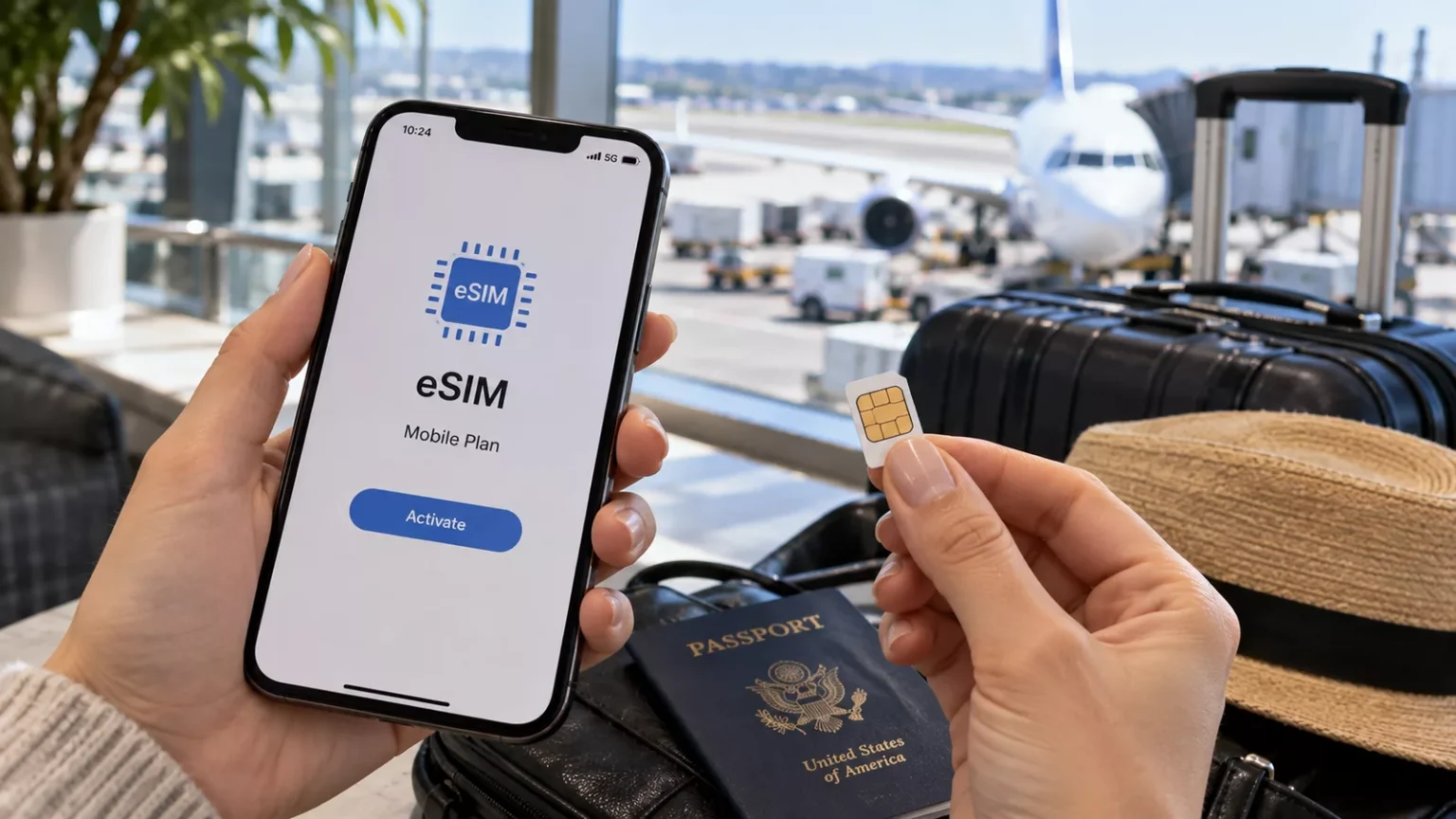
An eSIM is a digital SIM that allows a compatible device to activate a cellular plan without inserting a removable plastic SIM card. The technology uses an embedded secure element in the device and a remotely provisioned carrier profile.
For travelers, the practical advantage is simple: another mobile plan can be added digitally. Depending on the phone and provider, activation may involve scanning a QR code, following a carrier link or completing setup through an app or device settings.
A travel eSIM is not necessarily a mobile network itself. Many travel eSIM products provide access through partner networks in the destination.
That distinction becomes important when comparing coverage. Two eSIM plans for the same country can perform differently because they may connect to different local networks.
What Is a Physical SIM?
A physical SIM is the familiar removable card inserted into a phone’s SIM tray. It performs the same fundamental subscriber-authentication role but can physically be moved between compatible devices.
For international travel, a traveler might remove the home SIM after landing and replace it with a prepaid SIM purchased from a local mobile carrier. Phones with Dual SIM capabilities may allow both lines to remain available.
Physical SIMs remain useful because they are widely understood, easy to move between compatible devices and can provide direct access to local prepaid plans. The disadvantages are the need to obtain the card, handle a tiny physical object and potentially remove the home SIM.
eSIM vs Physical SIM for International Travel: Which Is Better?
For a typical one- or two-week international vacation, an eSIM is generally more convenient. For a long stay in one country, a physical SIM from a local carrier deserves a price comparison before buying anything.
That distinction is more useful than declaring one technology universally better.
Choose an eSIM if:
- The trip lasts several days or a few weeks.
- The itinerary crosses multiple countries.
- Mobile data is needed immediately after landing.
- The traveler wants to buy connectivity before departure.
- Keeping the home SIM installed matters.
- The phone has reliable eSIM and Dual SIM support.
- Data matters more than having a local voice number.
Choose a physical SIM if:
- The phone does not support eSIM.
- A local carrier offers a better prepaid package.
- The trip lasts several weeks or months.
- A local phone number is important.
- The plan needs extensive local calling or SMS.
- Local eSIM choices are limited.
- The SIM may need to be moved easily between compatible phones.
Neither list is absolute. Compare the actual plan rather than choosing solely because one option is newer.
Is eSIM Cheaper Than a Physical SIM for Travel?
Not always. Travel eSIMs can be inexpensive, but convenience and price are separate advantages, and an eSIM does not automatically provide the lowest cost per gigabyte.
A travel eSIM provider may sell a small international data package that is ideal for a seven-day vacation. A local mobile operator may sell a larger prepaid package at a lower cost per gigabyte, making the physical SIM more attractive for a month-long stay.
The fairest eSIM vs physical SIM travel comparison should include:
- Total Plan Price.
- Amount Of High-Speed Data.
- Plan Duration.
- Local Calls And Texts.
- International Calls.
- Hotspot Or Tethering Availability.
- Network Used At The Destination.
- Any Speed Throttling After A Data Threshold.
- Activation Or SIM Fees.
- Taxes And Local Registration Costs Where Applicable.
A $10 plan is not necessarily cheaper than a $15 plan if the first provides 3 GB and the second provides 20 GB plus local calls.
Why eSIM Is So Convenient for Short International Trips
The strongest advantage of eSIM for travel is that connectivity can often be arranged before the trip begins. Instead of landing, finding an airport SIM kiosk and comparing unfamiliar plans while carrying luggage, the traveler can install the plan at home.
That is particularly useful when arriving late at night or needing transportation immediately. Maps, messaging, hotel information and rideshare services can work as soon as the travel line connects.
Installation and activation are not always the same thing, however. Some plans begin their validity when installed, while others begin when they first connect to a supported network. Read the activation conditions before installing an eSIM several days before departure.
This is exactly the type of small preparation that makes an international itinerary easier. LitiTravels’ Travel Planning guides cover other practical decisions that are better handled before departure rather than after landing.
Why a Physical SIM Can Still Be Better for Long Trips
A local physical SIM can be a strong option when spending several weeks or months in one country. Local carriers often design prepaid plans for residents and domestic users rather than short-term visitors, which can mean larger data allowances and useful local calling features.
A real local number can also matter. Restaurants, accommodations, delivery services, local contacts or appointment systems may expect a domestic number.
Travelers staying long enough to build a routine may care less about spending 30 minutes in a carrier store on the first day. In that scenario, the convenience advantage of eSIM becomes less important.
eSIM vs Physical SIM Travel for Multi-Country Trips
eSIM has a particularly strong advantage on multi-country itineraries because regional plans can cover several destinations without repeated physical SIM swaps. A traveler moving through France, Italy, Austria and Germany, for example, may be able to keep one compatible regional plan active throughout the route.
That does not mean every regional eSIM provides identical service in every country. The underlying network partner can change at the border, and coverage quality can vary.
Check the complete country list before purchasing. “Europe eSIM” does not automatically mean every European country is included.
Travelers building a longer European route can pair connectivity planning with LitiTravels’ three-week Europe itinerary to see why avoiding repeated SIM purchases becomes useful when crossing several borders.
Does eSIM Have Better Coverage Than a Physical SIM?
No, not inherently. eSIM and physical SIM describe how a cellular subscription is stored and activated, not how powerful the network signal will be.
Coverage depends primarily on the network the plan uses. A physical SIM from a strong local carrier can outperform a travel eSIM using a weaker partner network, while an eSIM connected to the best available local network can perform extremely well.
Before purchasing an international eSIM, check:
- Which local network or networks it uses.
- Whether 5G is available.
- Whether network switching is supported.
- Whether rural areas are important to the itinerary.
- Whether hotspot use is permitted.
- Whether advertised “unlimited” data has a high-speed threshold.
Travelers heading beyond major cities should care about the network partner more than whether the plan is an eSIM.
Does eSIM Work Without Wi-Fi?
Yes, once an eSIM has been correctly installed and activated, it uses cellular service just like a physical SIM. Wi-Fi is not required for ordinary mobile data use.
The complication is setup. Downloading or installing an eSIM profile may require internet access, which is why installing it before leaving home is usually safer.
A traveler who waits until arrival and then discovers that the airport has unreliable Wi-Fi can end up in exactly the situation the eSIM was supposed to prevent.
Install the eSIM before departure when the provider permits it, but activate it according to the provider’s instructions so the plan does not start too early.
Can You Keep Your Normal Number With a Travel eSIM?
Often yes. Dual SIM-capable phones can allow a home line and travel eSIM to remain installed at the same time.
For example, Apple supports Dual SIM configurations that can use one number as the home line and another plan for travel data. The exact combination depends on the iPhone model and region.
Keeping the home number active can be useful for receiving important calls or text messages. But there is a major caveat: keeping a home SIM switched on abroad can still create roaming charges.
The safe configuration often involves setting the travel eSIM as the cellular-data line and disabling data roaming on the home line. Exact menus and behavior vary by phone.
Can You Receive Bank Verification Texts With an eSIM?
Yes, if the home line remains active and the phone supports the necessary Dual SIM configuration, but receiving SMS and using cellular data are separate functions. The travel eSIM itself may be data-only and may not provide a telephone number capable of receiving traditional SMS.
This distinction matters for banks, credit cards, work accounts and other services using one-time passcodes.
Before departure, check whether critical services rely on SMS. If they do, determine whether the home carrier charges for receiving texts abroad and whether the line can remain active without triggering unwanted data roaming.
Whenever possible, set up app-based authentication or another approved backup method before traveling. Do not wait until a banking login fails in another country.
Do Travel eSIMs Give You a Phone Number?
Some do, but many do not. A large number of travel eSIM products are data-only, meaning they provide internet access without a traditional local number for voice calls and SMS.
That is usually fine for travelers who communicate through WhatsApp, iMessage, FaceTime, Signal, Messenger or other internet-based services.
It can be inconvenient when a local service requires a domestic phone number. Hotels and restaurants increasingly use internet messaging, but local booking platforms, delivery apps and verification systems can still rely on SMS.
If a local number is essential, confirm that the plan explicitly includes one before purchasing.
Can You Make Calls With a Travel eSIM?
Yes if the plan includes traditional voice service. If it is data-only, internet-based calling apps can still work over the mobile data connection.
This is one area where physical local SIM plans may be simpler. Domestic prepaid plans frequently bundle local minutes, SMS and data.
Do not assume the word “unlimited” means unlimited calls. On a travel eSIM, it may refer only to data, and even unlimited data can be subject to speed-management policies.
Does WhatsApp Work With a Travel eSIM?
Yes. WhatsApp can continue using the existing account and number while mobile data comes from another SIM or eSIM.
Changing the data SIM does not automatically require changing the WhatsApp account number. That makes data-only eSIMs practical for many international travelers.
The same general principle applies to internet-based communication apps: they need a working data connection, not necessarily a new local phone number.
Can You Use an eSIM if Your Phone Is Carrier-Locked?
Usually not with an eSIM from a different carrier. A phone generally needs to be unlocked to use service from another provider.
This is one of the most important checks before purchasing a travel eSIM. eSIM compatibility alone is not enough.
A phone can support eSIM technically while still being restricted by its home carrier. Check the device’s lock status before spending money on an international plan.
The same issue applies to physical SIM cards from another carrier. Buying a physical SIM does not bypass a carrier lock.
How Do You Know if Your Phone Supports eSIM?
Check the exact model, region and manufacturer specifications. Do not rely only on the phone family name because hardware configurations can differ between markets.
On iPhone, eSIM support exists across many recent generations, but physical-SIM availability and Dual SIM configurations vary by model and country. Apple also notes that eSIM availability is not identical in every region.
Android support is similarly model-specific. Google Pixel, Samsung Galaxy and other device families include many eSIM-capable phones, but not every model, carrier variant or regional version supports the same features.
The safest method is to check the manufacturer’s specifications for the exact model number.
Why Phone Region Matters More Than Travelers Expect
Two phones with the same marketing name can have different SIM configurations because they were sold in different markets. This has become increasingly important as manufacturers move some devices toward eSIM-only designs while retaining physical SIM support elsewhere.
A traveler should therefore avoid statements such as “all iPhones have a SIM slot” or “all new phones are eSIM-only.” Neither is universally true.
Check the actual device before the trip. This is particularly important when buying a phone abroad and expecting to use it with a carrier at home.
eSIM vs Physical SIM Travel for iPhone
eSIM is particularly convenient on compatible iPhones because Dual SIM allows a traveler to keep a home line and add another cellular plan. Apple specifically identifies adding a local data plan while traveling as a use case for Dual SIM.
Recent iPhone models support multiple eSIM configurations, although exact capabilities differ by generation and market. Some models and regions no longer include a physical SIM tray.
The practical setup for many travelers is:
- Keep the home line installed.
- Install the travel eSIM before departure.
- Label the lines clearly, such as “Home” and “Travel.”
- Set the travel line for cellular data after arrival.
- Turn off data roaming on the home line unless the home plan includes the destination.
- Enable roaming on the travel eSIM if its provider specifically requires it.
- Check mobile data switching settings to prevent unexpected use of the home line.
Menu names can change between iOS versions, so follow the current device instructions rather than an old screenshot-based tutorial.
eSIM vs Physical SIM Travel for Android
The decision is similar on Android, but eSIM support varies more widely across manufacturers, models and regional versions. Many recent premium Android phones support eSIM, while some budget or older devices remain physical-SIM only.
Before purchasing, check whether the exact phone supports:
- eSIM installation.
- Dual SIM operation.
- The destination’s network bands.
- 5G on the intended travel plan.
- Hotspot use.
- The desired combination of physical SIM and eSIM.
Do not assume that because a friend’s version of the same phone supports eSIM, yours necessarily does.
Is eSIM Safer Than a Physical SIM?
An eSIM cannot simply fall out of a phone or be physically removed and lost during a SIM swap. Apple specifically highlights that an eSIM cannot be removed from a lost or stolen iPhone in the way a physical SIM can.
That is a practical security advantage for travelers. There is also no tiny home SIM to store somewhere in a wallet or hotel room after replacing it with a local card.
However, eSIM does not eliminate account security risks. Travelers still need strong device security, carrier-account protection and caution around fraudulent QR codes or phishing.
Use legitimate carrier or provider channels when downloading an eSIM profile.
What Happens if You Lose Your Phone With an eSIM?
Losing a phone abroad is disruptive regardless of SIM type. With an eSIM, there is no physical card to pull out and place immediately into another phone.
Recovery depends on the provider’s process. Some carriers can transfer or reissue an eSIM digitally, while others require identity verification or customer support.
A physical SIM has an advantage when immediate transfer between compatible unlocked phones matters. But it can also be physically lost, damaged or stolen.
Before traveling, keep account credentials and provider support information somewhere accessible without the phone itself.
Can You Transfer an eSIM to Another Phone?
Sometimes, but the process depends on the carrier, provider, operating system and devices involved. Some eSIMs can be transferred digitally, while others require a new activation or replacement profile.
Travel eSIM policies can be more restrictive. A QR code may be single-use, and deleting an active profile can sometimes make reinstalling it difficult or impossible without provider assistance.
Do not delete a travel eSIM simply because it temporarily stops connecting. Troubleshoot first and check whether the provider permits reinstallation.
Can You Hotspot From a Travel eSIM?
Often yes, but not always. Hotspot or tethering rules are determined by the plan rather than by eSIM technology itself.
A traveler planning to connect a laptop, tablet or another person’s phone should confirm tethering before purchasing.
This can materially change the value comparison. A slightly more expensive plan allowing generous hotspot use may be more useful than a cheaper “unlimited” plan that restricts tethering.
Is Unlimited eSIM Data Really Unlimited?
Sometimes unlimited means unlimited total data but not unlimited high-speed data. A provider may reduce speeds after a daily or total high-speed allowance.
This is not unique to eSIMs. Physical prepaid plans can also apply fair-use policies and throttling.
Before buying, look for terms such as:
- High-speed data allowance.
- Fair-use policy.
- Daily high-speed limit.
- Reduced speed after threshold.
- Hotspot limit.
- Video streaming restriction.
A plan advertised as unlimited can be excellent for maps and messaging after throttling but frustrating for video calls or laptop tethering.
How Much Travel Data Do You Actually Need?
Light travelers using maps, messaging, email and occasional browsing can often manage with a few gigabytes over a short trip. Heavy social media use, video streaming, cloud backups and hotspot use can increase consumption dramatically.
Instead of automatically buying the largest package, check recent cellular-data usage on the phone before departure.
A rough planning framework is:
| Travel use | Approximate data need | Typical traveler |
|---|---|---|
| Very light | 1–3 GB per week | Maps, messaging, email |
| Light to moderate | 3–7 GB per week | Maps, browsing, social media |
| Heavy | 7–15+ GB per week | Frequent video/social uploads |
| Very heavy | 15+ GB per week | Streaming, hotspot, remote work |
You may also be interested in our article: 27 Date Ideas in London That Feel Better Than Just Dinner and Drinks
These are planning ranges rather than guarantees. Video use and tethering can change the numbers quickly.
Downloading offline maps, playlists, translation packs and entertainment over Wi-Fi before departure can significantly reduce travel data consumption.
eSIM vs Physical SIM Travel for Remote Areas
The local network matters more than the SIM format. A physical SIM does not inherently provide better rural coverage, and an eSIM does not inherently provide worse coverage.
The question is which network each plan accesses.
For remote travel, identify the carrier with the strongest coverage along the actual route, then determine whether that carrier is available through a local physical SIM, local eSIM or travel eSIM partner.
This becomes especially important on road trips, mountain routes and sparsely populated destinations where several carriers may perform similarly in cities but very differently outside them.
eSIM vs Physical SIM for a 1-Week Trip
For a one-week international vacation, eSIM is usually the more convenient choice when the phone supports it. The ability to arrange data before departure often outweighs small differences in price.
A short trip also means that time spent finding a SIM store represents a larger share of the vacation.
A physical SIM can still win if it is exceptionally easy to obtain or the destination offers an inexpensive tourist SIM with much more useful data and calling.
eSIM vs Physical SIM for a 2-Week Trip
For two weeks, compare actual packages rather than relying on a general rule. eSIM still has a major convenience advantage, particularly for a multi-country itinerary.
A local physical SIM becomes more attractive when the entire two weeks are spent in one country and the local prepaid market offers a strong package.
Travelers should also consider how much data they genuinely need. Paying extra for 50 GB has little value if normal usage will be 5 GB.
eSIM vs Physical SIM for a Month or Longer
For a month or longer in one country, a local carrier plan deserves serious consideration. Physical SIMs can provide competitive data allowances, local calls and a domestic number.
But “local plan” no longer necessarily means “physical SIM.” Many mobile carriers now offer eSIM directly, so the best long-stay solution may actually be a local carrier eSIM rather than a travel eSIM or physical SIM.
That creates an important three-way distinction:
Travel eSIM vs local carrier eSIM vs local physical SIM.
The first prioritizes easy international purchase. The latter two provide service directly from a local carrier but use different SIM formats.
Local Carrier eSIM vs Travel eSIM
A local carrier eSIM can combine many advantages of both options: digital activation plus a direct local mobile plan. Where available to visitors, it may offer better value and a local number.
The disadvantage is accessibility. Local carriers may require identity verification, local payment methods, store visits or plans intended primarily for residents.
Travel eSIMs are usually designed to make international purchase simpler. That convenience can justify paying somewhat more per gigabyte.
For longer stays, check local carrier eSIM availability before assuming the only digital option is an international travel-eSIM company.
eSIM vs International Roaming
International roaming is the easiest option because nothing needs to be changed if the home plan already includes the destination. It can also be the most expensive option when the carrier charges daily travel fees or high pay-as-you-go rates.
A travel eSIM often reduces cost while preserving the home line.
Before buying anything, check the existing mobile plan. Some home carriers include roaming in certain countries or offer a travel pass that is competitive once calls, texts and convenience are considered.
Paying for an eSIM that duplicates roaming already included in the monthly plan saves nothing.
The Best eSIM vs Physical SIM Setup for Most Travelers
For a compatible unlocked Dual SIM phone, one of the most practical international setups is:
Home SIM/eSIM for the normal number + travel eSIM for mobile data.
This keeps the normal number available while directing internet use to the travel plan.
Before takeoff:
- Install The Travel eSIM.
- Label Both Lines Clearly.
- Keep The Home Line Available If Needed For Calls Or SMS.
- Disable Data Roaming On The Home Line.
- Set The Travel eSIM As The Data Line At The Appropriate Time.
- Check Whether The Travel eSIM Requires Data Roaming To Be Enabled.
- Turn Off Automatic Cellular Data Switching If It Could Trigger Home-Line Roaming.
- Download Offline Maps And Essential Reservations Anyway.
The final step matters because no mobile plan is infallible. A phone should not be the only place where essential travel information exists.
How to Install a Travel eSIM Before a Trip
The exact procedure depends on the device and provider, but installation usually takes only a few minutes. The safest time to do it is while reliable Wi-Fi is available before departure, provided the plan’s validity will not begin prematurely.
A typical process looks like this:
- Confirm The Phone Is eSIM-Compatible And Unlocked.
- Purchase A Plan Covering Every Required Destination.
- Read The Activation Policy Before Installing It.
- Connect To Reliable Wi-Fi.
- Install The Profile Using The Provider’s QR Code, App Or Manual Details.
- Label The New Line “Travel.”
- Keep It Turned Off Until The Correct Activation Time If Required.
- After Arrival, Select It For Cellular Data.
- Enable Data Roaming On The Travel Line If The Provider Requires It.
- Test Maps Or A Webpage Before Leaving The Airport.
Do not throw away activation details until the plan is working.
7 eSIM Mistakes That Can Cost Money Abroad
Most eSIM problems are not caused by eSIM technology itself. They come from configuration, compatibility or misunderstanding the plan.
Watch for these common mistakes:
- Buying An eSIM Before Checking Whether The Phone Is Unlocked.
- Installing A Plan Too Early When Validity Starts At Installation.
- Leaving Data Roaming Enabled On The Home Line.
- Allowing Automatic Data Switching To Use The Home SIM.
- Assuming A Data-Only eSIM Includes A Local Number.
- Deleting The eSIM Before Checking Whether It Can Be Reinstalled.
- Buying “Unlimited” Data Without Reading The High-Speed Limit.
A few minutes of setup before departure can prevent unexpected roaming charges and connectivity problems after landing.
When a Physical SIM Is Definitely the Better Choice
A physical SIM remains the obvious choice when the phone simply does not support eSIM. It can also be preferable when a traveler needs to move one subscription repeatedly between compatible devices.
Other strong cases include long stays with excellent local prepaid offers, destinations where the desired carrier does not offer practical eSIM activation to visitors and travelers who specifically need a local voice/SMS plan.
Physical SIM is therefore not outdated technology that travelers should avoid. It is one connectivity option with different trade-offs.
When eSIM Is Definitely the Better Choice
eSIM has the clearest advantage when convenience is the priority. A short international trip with an unlocked compatible phone, a straightforward data requirement and several border crossings is almost an ideal use case.
It is also useful when removing the home SIM would create problems. Keeping the normal line installed reduces the chance of losing the tiny card and can preserve access to calls and authentication messages.
For travelers moving frequently, digital plan switching is simply easier than collecting plastic SIM cards from each destination.
Should You Buy an eSIM at Home or After You Land?
Buying before departure is usually more convenient because the plan can be researched and installed with reliable internet access. It also means there is no need to depend on airport Wi-Fi after arrival.
But activation timing matters. Some plans begin their validity immediately when installed or activated, while others begin only when they connect to a supported network at the destination.
Read those terms before pressing the final activation button.
For a trip with multiple destinations, also confirm whether the plan’s validity is measured in calendar days, 24-hour periods or another way.
Do You Still Need Offline Maps With an eSIM?
Yes. Mobile connectivity should make travel easier, but essential navigation should not depend entirely on it.
Download offline maps for the destination, save hotel addresses and keep transportation details accessible without mobile data. Network outages, underground transit, rural dead zones and configuration problems can happen with both eSIM and physical SIM.
For destinations where road travel is central to the itinerary, offline preparation is particularly useful. LitiTravels’ Iceland Golden Circle route guide is a good example of a trip where mobile connectivity is helpful but downloaded navigation remains a sensible backup.
eSIM vs Physical SIM Travel: Which One Should You Choose?
For most travelers with a recent unlocked smartphone, an eSIM is the easiest option for a short international vacation. It can be purchased before departure, avoids swapping tiny SIM cards and works particularly well on multi-country itineraries.
A physical SIM remains competitive for long stays, travelers who need a local phone number and destinations where local prepaid packages provide better value.
The best decision can be summarized by trip type:
| Trip type | Usually the better starting option |
|---|---|
| 3–7 day vacation | Travel eSIM |
| 1–2 week vacation | Travel eSIM |
| Multi-country trip | Regional eSIM |
| One month in one country | Compare local SIM/eSIM with travel eSIM |
| Several months abroad | Local carrier plan |
| Need local phone number | Local SIM or local carrier eSIM |
| Older phone | Physical SIM if eSIM unsupported |
| Locked phone | Check home carrier options first |
| Remote-area trip | Choose by underlying network coverage |
| Need home number for SMS | Dual SIM setup if supported |
There is no reason to be loyal to one format for every trip. The smartest eSIM vs physical SIM travel strategy is to choose connectivity the same way flights and hotels are chosen: based on the specific destination, duration and actual needs.
FAQ About eSIM vs Physical SIM Travel
Is eSIM better than a physical SIM for international travel?
For many short international trips, yes. eSIM is usually easier to purchase and install before departure and can work alongside a home line on compatible Dual SIM phones. A physical SIM may be better for long stays, local numbers or older devices.
Is eSIM cheaper than a physical SIM for travel?
Not always. Travel eSIMs can be inexpensive, but local physical SIMs or local carrier eSIMs may provide more data for less money, especially during longer stays. Compare total price, data, validity and included calls.
Is eSIM better than roaming?
Often, but not automatically. A travel eSIM can be cheaper than international roaming, while some home mobile plans already include overseas service or offer competitive travel passes. Check the existing plan before buying additional service.
Does eSIM have worse signal than a physical SIM?
Not because it is an eSIM. Signal quality depends primarily on the cellular network the plan uses, the device and local conditions. Check which network a travel eSIM connects to at the destination.
Can you use eSIM and a physical SIM at the same time?
Many Dual SIM phones can use an eSIM alongside a physical SIM, although exact capabilities depend on the device. Some newer phones can also maintain two active eSIMs.
Can I keep my normal SIM while using an eSIM abroad?
Usually yes on a compatible Dual SIM phone. Set the travel eSIM as the cellular-data line and configure the home line carefully to avoid unwanted roaming charges.
Will I still receive texts on my normal number with a travel eSIM?
Potentially, if the home line remains active and the device supports the configuration. Charges depend on the home carrier, so check roaming conditions before relying on SMS abroad.
Does a travel eSIM give you a new phone number?
Not necessarily. Many travel eSIMs are data-only and do not include a conventional phone number for calls or SMS. Check the plan details if a local number is required.
Does WhatsApp work with an eSIM?
Yes. WhatsApp can use mobile data from a travel eSIM while the account remains associated with the existing phone number. There is normally no need to change the WhatsApp number simply because the data SIM changes.
Can I use hotspot with an eSIM?
Often yes, but tethering depends on the specific plan. Some travel eSIMs allow normal hotspot use, while others restrict it or apply separate data limits.
Do you need Wi-Fi to activate an eSIM?
Internet access is generally needed to download or install an eSIM profile. Installing the profile over reliable Wi-Fi before departure is usually safer than depending on airport connectivity.
Can I install an eSIM before traveling?
Yes, and doing so is often advisable. However, check when the plan’s validity begins because some plans start at installation or activation while others start when the eSIM first connects at the destination.
Can you use an eSIM on a locked phone?
A phone generally must be unlocked to use an eSIM from another carrier. Supporting eSIM technology does not automatically mean the device can accept service from a different provider.
Is an eSIM safer than a physical SIM?
An eSIM cannot be physically removed or lost during a SIM swap, which provides a practical security advantage. It does not eliminate account fraud, phishing or device theft, so normal digital-security precautions still matter.
What happens to an eSIM if you lose your phone?
The plan may need to be transferred or reissued to another compatible device. The process depends on the carrier or eSIM provider, so keep account credentials and support information accessible separately from the phone.
Can you transfer an eSIM to another phone?
Sometimes. Transfer rules depend on the carrier, provider and devices. Some eSIM profiles transfer easily, while others require a new activation and some travel eSIM QR codes cannot simply be reused.
Is a local eSIM better than a travel eSIM?
It can be. A local carrier eSIM may offer a local number, larger data allowance or lower price, while a travel eSIM usually offers easier purchase before arrival. Long-stay travelers should compare both.
Is a physical SIM better for a one-month trip?
Sometimes. A local physical SIM or local carrier eSIM can offer better value during a long stay in one country. For a month split across several countries, a regional travel eSIM may still be more convenient.
How much data do you need for international travel?
Light users relying on maps, messaging and email may use only a few gigabytes per week. Video, social media uploads, cloud backups and hotspot use can increase consumption significantly, so checking previous phone usage is the best starting point.
Should you turn off your home SIM when using a travel eSIM?
Not necessarily. Keeping it active can preserve calls and SMS, but cellular data and roaming settings must be configured to prevent unexpected charges. Travelers who do not need the home line abroad may choose to disable it entirely.
What is the best eSIM vs physical SIM travel setup?
For many travelers with an unlocked Dual SIM phone, a practical setup is to keep the home SIM or eSIM for the normal number and use a separate travel eSIM for mobile data. Long-term travelers should also compare local carrier SIM and eSIM plans before deciding.


Author of LitiTravels Portal


Articles by the author:
All articles by author


London makes it easy to plan a memorable date – and surprisingly easy to overcomplicate one. These 27 date ideas cover free afternoons, first meetings, rainy days, big anniversaries and unusual nights, with practical ways to ch...
 October 8, 2026
 5
5

Jamaica’s famous rainforest bobsled runs for 3,280 feet through Mystic Mountain above Ocho Rios – but the ride is only one part of the visit. Here is how to choose tickets, avoid timing mistakes and decide whether it belongs in...
October 7, 2026
8

Jamaica does not have to mean expensive waterfall tours, private drivers and resort excursions. Many of the island’s best experiences cost little or nothing, from long beach walks and mountain views to local markets, street foo...
October 7, 2026
9

A wrong name does not always mean buying another flight. Learn when you can change the name on a plane ticket, why a typo differs from transferring a ticket, how the U.S. 24-hour rule can help and what to do before contacting t...
October 7, 2026
7
Subscribe to “lititravels” on Telegram for gaming intel.
No filler, no fuss—just your daily XP boost. Hop in and level up, squad!



Read also
London makes it easy to plan a memorable date – and surprisingly easy to overcomplicate one. These 27 date ideas cover free afternoons, first meetings, rainy days, big anniversaries and unusual nights, with practical ways to ch...
October 8, 2026
5
Taking a power bank on a plane is still allowed in 2026, but the rules have changed. A new two-power-bank limit, strict carry-on requirements and airline-specific restrictions mean travelers should check more than the mAh numbe...
October 6, 2026
14
A phone full of travel apps does not necessarily make a trip easier. These are the best travel apps in 2026 for the jobs that actually matter – from finding flights and building an itinerary to navigating offline, translating m...
October 1, 2026
32

The wrong London hotel can add an hour of Tube travel to every day. This guide compares 10 areas that actually work for visitors, from walkable Covent Garden to museum-friendly South Kensington and Heathrow-ready Paddington.
September 22, 2026
97

Chicago has enough great coffee to turn café-hopping into a full day out. These 12 Chicago coffee shops range from pioneering specialty roasters to tiny neighborhood favorites – plus there is a realistic route for tasting them ...
September 22, 2026
43

Swiss food is much bigger than fondue and chocolate. Travel from Zurich to Valais and Ticino and the menu changes completely. These 15 dishes show what to order, where each specialty makes sense and which famous foods are actua...
September 21, 2026
61

Glasgow food is much bigger than haggis. The city mixes old-school Scottish comfort dishes, legendary breakfast rolls, chippy culture, South Asian flavours and ambitious modern cooking. Start with these 15 foods and the neighbo...
September 19, 2026
50

San Francisco is easier to navigate safely when you know how quickly conditions can change from one block to the next. Here is what visitors need to know in 2026 about neighborhoods, nighttime travel, transit, car break-ins and...
September 18, 2026
75

Edinburgh is much easier to enjoy when you stop treating it as one long checklist. This 2026 guide picks the sights worth your time, shows which ones fit together and reveals where to go when the Royal Mile starts feeling too c...
September 17, 2026
46

Looking for the right beach hotel in Greece? Here’s an honest review of Alboro Seaside Suites. When travelers imagine Greece, they often picture whitewashed buildings, crowded beaches, and busy promenades. But there are still p...
 September 21, 2025
509
September 21, 2025
509

Cooperation
Looking to shine a spotlight on your project? LitiTravels has you covered! We offer article-based promotion, manage branded blogs on our platform, drive engagement through our social media channels, and create content that delivers real results. Get in touch today and let’s make your brand stand out!
Subscribe to the monthly news digest from LitiTravels
The main news and updates from the team about gadgets, sports, cars, health, and lifestyle.
