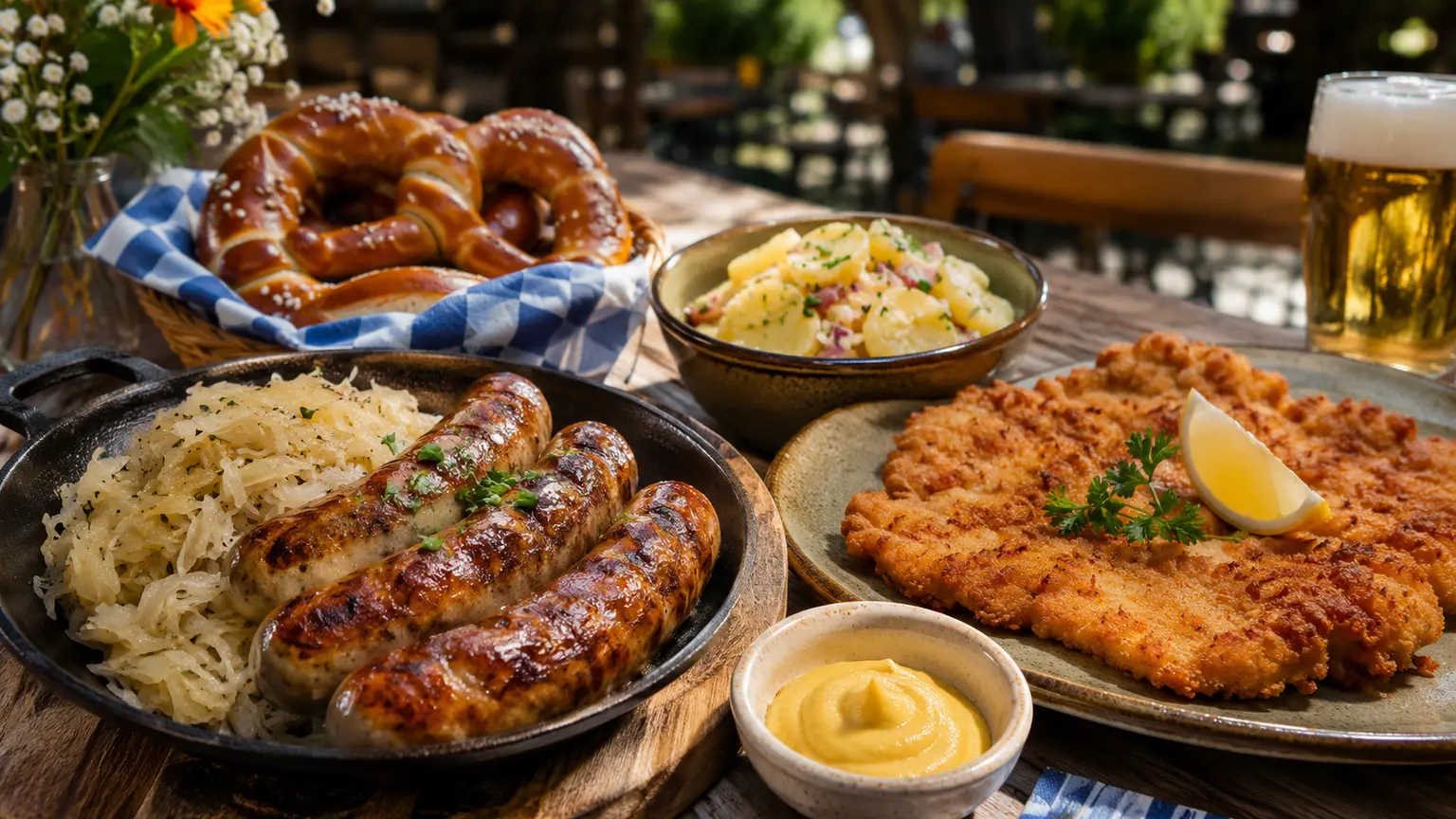
German food is much more varied than bratwurst, schnitzel, and sauerkraut. The best German foods to try include Berlin's curry sausage and döner kebab, Bavaria's white sausages and roast pork, Swabian cheese noodles, Hamburg's fish sandwiches, and regional specialties that rarely appear on international restaurant menus. What to order in Germany depends heavily on where you're traveling, and some of the most memorable dishes are also among the cheapest.
A first-time visitor can eat remarkably well without booking expensive restaurants. Traditional bakeries serve fresh pretzels and breakfast rolls, market stalls sell local sausages and sandwiches, and neighborhood restaurants offer substantial regional meals. The key is to know which specialties belong to each city instead of expecting the same menu throughout the country.
Autumn and winter are particularly rewarding seasons for exploring German cuisine. Cooler weather brings roast meats, hearty stews, potato dishes, and seasonal baked goods, while Christmas markets offer traditional gingerbread, roasted nuts, and regional street food. Spring has its own specialties, including white asparagus and strawberry desserts.
This German food guide covers 27 traditional and contemporary favorites, the regions associated with them, what each dish contains, where locals eat, and how to choose satisfying meals without unnecessary tourist prices.
What Is Traditional German Food?
Traditional German food is a collection of regional cuisines built around bread, potatoes, meat, seasonal vegetables, dumplings, fish, and baked goods. Although pork, sausages, and cabbage are widely associated with Germany, the country's cooking traditions vary substantially between the northern coast, central regions, and Alpine south.
Bavaria is associated with roast pork, white sausages, pretzels, and dumplings. Swabia, in southwestern Germany, is known for filled pasta and soft egg noodles, while northern Germany has a strong tradition of fish and seafood. The Rhineland and Hesse contribute vinegar-marinated roasts, distinctive cheeses, and herb-based sauces.
Modern German food also reflects immigration and international influences. Berlin's döner kebab culture, for example, is an essential part of the city's everyday food scene, even though its roots lie in Turkish culinary traditions.
There is no single officially designated national dish of Germany. Bratwurst, schnitzel, sauerbraten, and potato dishes may appear throughout the country, but regional specialties often provide a better introduction to local food culture.
Which German Foods Should First-Time Visitors Try?
For a first trip, bratwurst, schnitzel, pretzels, potato salad, cheese spaetzle, and at least one regional main course provide an accessible introduction. The following comparison makes it easier to decide which foods match the cities on an itinerary.
|
German food |
What it is |
Best place to try it |
|
Bratwurst |
Grilled or pan-fried sausage |
Nuremberg, Thuringia, Bavaria |
|
Currywurst |
Sausage with spiced tomato-curry sauce |
Berlin |
|
Döner kebab |
Meat or vegetables in flatbread with salad and sauces |
Berlin |
|
White sausage |
Mild Bavarian sausage traditionally served with sweet mustard |
Munich |
|
Leberkäse |
Baked meat loaf served in a roll or with sides |
Bavaria |
|
Fish sandwich |
Bread roll filled with fish, onions, and other toppings |
Hamburg |
|
Schnitzel |
Thin breaded meat cutlet |
Throughout Germany |
|
Sauerbraten |
Marinated and slow-braised pot roast |
Rhineland |
|
Roast pork |
Slow-roasted pork with gravy and dumplings |
Bavaria |
|
Pork knuckle |
Roasted or boiled pork hock |
Bavaria and northern Germany |
|
Beef roulades |
Rolled beef with savory filling and gravy |
Throughout Germany |
|
Labskaus |
Northern German potato and corned-beef dish |
Hamburg and northern Germany |
|
Cheese spaetzle |
Soft egg noodles with cheese and fried onions |
Swabia and Allgäu |
|
Maultaschen |
Large filled pasta pockets |
Stuttgart and Swabia |
|
Potato pancakes |
Crispy fried grated potatoes |
Rhineland and other regions |
|
Potato salad |
Boiled potatoes with regional dressings |
Throughout Germany |
|
Sauerkraut |
Fermented cabbage, often served warm |
Throughout Germany |
|
Potato dumplings |
Soft potato-based dumplings |
Bavaria and Thuringia |
|
Frankfurt green sauce |
Cold seven-herb sauce served with eggs and potatoes |
Frankfurt |
|
Cologne cheese roll |
Rye roll with cheese, mustard, and onions |
Cologne |
|
Pretzel |
Soft baked bread with a brown crust and coarse salt |
Bavaria |
|
German rye bread |
Dark or mixed-grain bread |
Throughout Germany |
|
Black Forest cake |
Chocolate, cherries, cream, and cherry brandy |
Black Forest |
|
Franzbrötchen |
Flaky cinnamon pastry |
Hamburg |
|
Berliner doughnut |
Jam-filled fried pastry |
Berlin and nationwide |
|
Lebkuchen |
German spiced gingerbread |
Nuremberg |
|
Dresden stollen |
Rich Christmas fruit bread |
Dresden |
Many of these foods are available outside their home regions, but regional origin still matters. A fish sandwich in Hamburg, a cheese spaetzle dish in Swabia, and a freshly grilled Nuremberg sausage each provide a stronger sense of place than ordering the same generic plate in every city.
Famous German Street Foods Worth Trying First
German street food is an inexpensive and practical introduction to the country's cuisine. Sausages, filled rolls, fish sandwiches, and kebabs are widely available from market stalls, takeout counters, and small neighborhood businesses.
These foods are especially convenient between sightseeing stops because most require no reservation and can be eaten without committing to a long restaurant meal.
1. Bratwurst – Germany's Classic Grilled Sausage
Bratwurst is one of the most recognizable German foods, usually made from pork, although regional versions may include veal or beef. Seasoning, texture, size, and preparation methods vary, so ordering bratwurst in different cities can produce surprisingly different experiences.
Nuremberg is particularly famous for its small grilled sausages. A traditional street-food serving contains three sausages inside a bread roll with mustard, locally described as "three in a bun."
Thuringian bratwurst is longer and characteristically seasoned with herbs and spices. Bavarian versions offer additional variations, often served with mustard, cabbage, or potato salad.
 Where to try it: Nuremberg's Old Town, Thuringian market stalls, or traditional sausage stands in Bavaria.
Best for: An inexpensive lunch, snack, or introduction to German street food.
For first-time visitors, a sausage served in a bread roll is generally the simplest and more affordable choice than a full restaurant plate with several side dishes.
2. Currywurst – Berlin's Famous Curry Sausage
Currywurst is a sliced sausage covered with seasoned tomato sauce and curry powder. It is one of Berlin's signature street foods and is commonly served with French fries or a bread roll.
The dish became popular in postwar Berlin and remains part of everyday food culture. Different vendors use different sausages and sauces, ranging from mildly sweet to noticeably spicy.
One important detail is that currywurst does not taste like a conventional South Asian curry. The defining flavor comes from the combination of sausage, tomato-based sauce, and curry seasoning.
Where to try it: Berlin's Kreuzberg, Prenzlauer Berg, Mitte, or traditional neighborhood snack stands.
Best for: A quick lunch or late-night meal.
Budget tip: Ordering currywurst with a bread roll instead of a large fries-and-drink combination can keep the cost lower.
3. Döner Kebab – A German Street-Food Essential
Döner kebab is one of the most common contemporary street foods in Germany, especially in Berlin. The familiar sandwich combines meat cooked on a vertical rotisserie with flatbread, fresh vegetables, and sauces.
Its culinary roots are Turkish, while the stuffed-bread version became closely associated with Berlin's Turkish-German community during the late 20th century.
Popular fillings include chicken, beef, veal, and mixed meats, depending on the establishment. Vegetable versions may feature grilled vegetables, cheese, or plant-based alternatives.
Where to try it: Berlin's Kreuzberg and Neukölln neighborhoods.
Best for: A substantial, relatively inexpensive meal.
Döner is particularly useful for budget travelers because one filled sandwich can be satisfying enough to replace a sit-down lunch. Prices and portion sizes vary considerably, so comparing nearby counters is worthwhile.
4. White Sausage – Munich's Traditional Breakfast
White sausage is a mild Bavarian sausage traditionally made with veal and pork back bacon, seasoned with ingredients such as parsley, lemon, and spices. Unlike grilled bratwurst, it is typically heated in hot water and served in its pale casing.
The classic accompaniment is sweet mustard and a soft pretzel.
White sausage is strongly associated with breakfast or late morning in Munich. Traditional custom favors eating it before noon, although modern restaurants do not all follow that schedule strictly.
Where to try it: Traditional Bavarian restaurants and sausage counters around Munich's Old Town.
Best for: Breakfast or brunch.
A common local approach is to remove the casing before eating the sausage. Visitors unfamiliar with the custom can simply cut it lengthwise and eat the filling.
5. Leberkäse – Bavarian Meat Loaf in a Roll
Leberkäse is a finely ground, baked meat loaf with a smooth texture and browned crust. Despite the literal translation of its name, Bavarian versions generally do not contain liver or cheese.
It is frequently sold as a thick, warm slice inside a bread roll with mustard. Restaurants also serve it with potato salad, potatoes, or a fried egg.
The flavor is mild and savory, making it a useful alternative for visitors who prefer something less strongly seasoned than certain sausages.
Where to try it: Munich butcher shops, market counters, bakeries, and casual restaurants.
Best for: A quick and filling lunch.
Budget tip: A slice in a roll is usually more economical than ordering a full plated meal.
6. Fish Sandwich – Hamburg's Coastal Classic
Hamburg's fish sandwich is one of the best German foods for travelers interested in the country's northern cuisine. A bread roll is filled with fish, often accompanied by onions, pickles, lettuce, or sauce.
Popular fish choices include herring, pickled herring fillets, smoked salmon, and other regional seafood.
Unlike the sausage-centered specialties associated with southern Germany, this dish reflects Hamburg's maritime history and connections with the North Sea.
Where to try it: Hamburg's harbor area, especially around the waterfront landing piers and Fish Market.
Best for: A quick lunch during waterfront sightseeing.
Check the type of fish before ordering. Some versions use pickled or cold fish rather than hot fried fish, which can surprise travelers expecting a conventional fish sandwich.
Traditional German Main Dishes That Deserve a Restaurant Meal
Traditional German main courses are generally heartier than street-food snacks. Slow-roasted meats, marinated beef, breaded cutlets, and regional stews commonly appear in restaurants serving home-style cooking.
These dishes make the most sense as a main lunch or dinner rather than as small snacks between attractions.
7. Schnitzel – The Crispy Breaded Cutlet
Schnitzel is a thin cutlet coated in breadcrumbs and fried until golden. It is widely available across Germany and is often served with potato salad, French fries, potatoes, or a green salad.
The main thing to understand is the difference between pork and veal versions.
Wiener schnitzel traditionally refers to a breaded veal cutlet associated with Austrian cuisine. In Germany, menus may list a similar dish made with pork as "Viennese-style schnitzel."
The distinction matters because veal is generally more expensive than pork.
Where to try it: Traditional restaurants throughout Germany, especially Bavaria and southern regions.
Best for: A reliable first German restaurant meal.
Budget tip: Compare lunchtime specials with evening menus. Pork schnitzel can be a more economical choice than veal.
8. Sauerbraten – Germany's Marinated Pot Roast
Sauerbraten is a traditional pot roast, most commonly made with beef that has been marinated in a mixture containing vinegar, wine or water, spices, and aromatics before slow cooking.
The result is tender meat with a rich sauce that combines savory and gently acidic flavors.
Regional recipes differ. Rhenish versions may include sweet ingredients to balance the sauce, while other preparations are less sweet.
Sauerbraten is often served with potato dumplings and red cabbage.
Where to try it: Cologne, Düsseldorf, and traditional restaurants in the Rhineland.
Best for: A substantial traditional lunch or dinner.
This is a dish worth ordering in a restaurant that specializes in regional cooking rather than from a generic international menu.
9. Roast Pork – Bavaria's Hearty Sunday Classic
Roast pork is one of the defining dishes of Bavarian home-style cuisine. Pork is slowly roasted and served with gravy, usually accompanied by potato dumplings and cabbage.
Different cuts and cooking methods produce different textures. Some versions have a crisp exterior, while others emphasize tender meat and a rich sauce.
The gravy is an essential part of the meal because it complements the dumplings and prevents them from tasting dry.
Where to try it: Munich, Regensburg, and traditional Bavarian inns.
Best for: A filling lunch after sightseeing or a substantial evening meal.
Restaurant portions can be generous, so ordering several additional sides may be unnecessary.
10. Pork Knuckle – A German Dish for Big Appetites
Pork knuckle is a substantial meat dish made from the lower part of a pig's leg. In Bavaria, it is commonly roasted until the skin becomes crisp, while some northern German versions are boiled or simmered.
The Bavarian roasted version is particularly associated with beer halls and traditional restaurants.
It is usually served with dumplings, cabbage, or potatoes.
Where to try it: Munich beer halls and traditional Bavarian restaurants.
Best for: Travelers who enjoy rich roasted meat.
Budget tip: Check the portion size before ordering. A full pork knuckle may be large enough for two people, although restaurants can have individual-serving policies.
11. Beef Roulades – Slow-Cooked German Comfort Food
Beef roulades are thin slices of beef wrapped around a savory filling, commonly including mustard, onions, pickles, and bacon. The rolls are browned and then slowly cooked until tender.
The cooking liquid becomes a rich gravy, usually served with potatoes, dumplings, or red cabbage.
This is a traditional family-style dish often associated with Sunday meals and special occasions.
Where to try it: Traditional German restaurants throughout the country.
Best for: Travelers looking for a home-style dish beyond schnitzel and sausages.
Because preparation takes time, roulades may appear as a daily special rather than a permanent menu item.
12. Labskaus – Northern Germany's Unusual Potato and Beef Dish
Labskaus is a traditional northern German dish commonly prepared from mashed potatoes, corned beef, and onions, with regional variations. It is often served with a fried egg, pickled vegetables, and herring.
Its appearance can be surprising because the potato and meat mixture is frequently pink or reddish.
The dish is closely associated with northern German port and seafaring traditions, although exact recipes vary between cities.
Where to try it: Hamburg, Bremen, and other northern German destinations.
Best for: Travelers interested in distinctive regional dishes.
Labskaus is not necessarily the safest choice for a selective eater, particularly when served with pickled herring. However, it offers a more specific taste of northern German food culture than ordering another generic sausage plate.
German Comfort Foods, Dumplings, and Regional Side Dishes
German cuisine includes many dishes based on noodles, potatoes, cheese, and vegetables. Some are substantial enough to serve as complete meals, while others traditionally accompany roasted meat.
These foods are especially useful for travelers looking beyond the country's meat-centered reputation.
13. Cheese Spaetzle – Germany's Comforting Cheese Noodles
Cheese spaetzle combines small, soft egg noodles with melted cheese and fried onions. It is associated with Swabia and the Allgäu region of southern Germany.
The texture is softer and more irregular than conventional pasta. Cheese varieties differ, producing versions that range from mildly creamy to intensely savory.
Crispy onions provide an important contrast to the rich noodles.
Where to try it: Stuttgart, the Allgäu region, and southwestern German restaurants.
Best for: A filling meat-free main course.
Important: Cheese spaetzle is usually vegetarian when prepared without meat products, but the dish contains dairy and typically eggs and wheat.
14. Maultaschen – Swabian Filled Pasta Pockets
Maultaschen are large pasta pockets traditionally filled with combinations of meat, spinach, onions, herbs, and breadcrumbs. They resemble oversized ravioli but have their own distinct regional tradition.
They may be served in broth, pan-fried with onions, or accompanied by potato salad.
Vegetarian fillings are increasingly available, although the traditional meat version remains common.
Where to try it: Stuttgart and the wider Swabian region of Baden-Württemberg.
Best for: A regional lunch that differs from familiar German tourist dishes.
The filling can vary substantially between restaurants, so travelers avoiding pork or other meats should ask before ordering.
15. Potato Pancakes – Crispy and Affordable German Food
German potato pancakes are made from grated potatoes, often mixed with onion, egg, and other ingredients before frying until crisp.
They are commonly served with applesauce, although savory versions may include other accompaniments.
Potato pancakes are particularly popular at Christmas markets and regional food stalls. In the Rhineland, they are frequently associated with traditional casual dining.
Where to try it: Cologne, Düsseldorf, and German Christmas markets.
Best for: A warm street-food snack or inexpensive vegetarian-style meal.
They can be a good option for travelers who do not eat meat, but the batter and frying method should be checked for dietary restrictions.
16. German Potato Salad – Two Regional Styles Worth Knowing
German potato salad differs significantly by region. Southern versions often use a warm broth-based dressing with vinegar, oil, mustard, or onions, while mayonnaise-based versions are more common in many northern areas.
Neither style represents the entire country.
Potato salad is frequently served alongside sausages, schnitzel, or other main courses, although it can also appear as part of a casual lunch.
Where to try it: Throughout Germany, especially traditional restaurants and butcher shops.
Best for: A side dish accompanying bratwurst or schnitzel.
Important: Some recipes include bacon or meat broth, so potato salad should not automatically be considered vegetarian.
17. Sauerkraut – Germany's Famous Fermented Cabbage
Sauerkraut is finely shredded cabbage fermented through lactic acid fermentation. It has a distinctive tangy flavor and is commonly served warm beside sausages, pork, and other traditional dishes.
Although closely associated with German cuisine internationally, fermented cabbage also appears in many other European culinary traditions.
German preparations sometimes include onions, spices, or additional ingredients, depending on the region and restaurant.
Where to try it: Traditional restaurants throughout Germany.
Best for: A classic side dish alongside roast pork or sausages.
Sauerkraut can also contain bacon or be cooked with meat stock. Travelers looking for a vegan meal should check how it is prepared.
18. Potato Dumplings – The Essential Side for German Roasts
Potato dumplings are soft, rounded dumplings made from potatoes and other ingredients. They are particularly associated with Bavaria and Thuringia, where preparation methods differ.
Some recipes combine cooked and raw potatoes, while others use one type exclusively. Certain versions contain toasted bread cubes in the center.
They are designed to absorb rich gravies and are therefore especially common alongside roast pork, beef, and red cabbage.
Where to try it: Bavaria, Thuringia, and traditional central German restaurants.
Best for: A traditional roast dinner.
Potato dumplings are not necessarily a separate meal. They often make the most sense when ordered as part of a complete main course.
19. Frankfurt Green Sauce – A Fresh Alternative to Heavy German Meals
Frankfurt green sauce is a cold herb sauce traditionally prepared from seven herbs, including parsley, chives, chervil, borage, sorrel, cress, and salad burnet.
It is commonly served with boiled eggs and potatoes, creating a dish that feels lighter than many traditional meat-based meals.
The sauce is an established specialty of Frankfurt and the surrounding Hessian region.
Where to try it: Frankfurt, particularly traditional restaurants in the Sachsenhausen district.
Best for: Travelers looking for a distinctive regional dish without a large portion of meat.
Important: The sauce often contains sour cream, yogurt, or other dairy ingredients, so it is not automatically vegan.
20. Cologne Cheese Roll – The German Food Name That Misleads Tourists
Cologne's traditional cheese roll is a rye bread roll served with cheese, mustard, onions, and sometimes pickles.
Its local name, Halver Hahn, can mislead visitors because it sounds like it refers to chicken. Despite the name, the dish traditionally contains cheese rather than chicken.
It is strongly associated with Cologne's brewery pubs, where it is commonly eaten as a snack alongside local drinks.
Where to try it: Traditional brewery pubs in Cologne's Old Town.
Best for: A simple regional snack or light lunch.
This is one of the easiest German specialties to miss when reading a menu without understanding the local terminology.
German Bread, Pastries, and Desserts You Should Not Skip
German food culture extends well beyond savory main courses. Bakeries play an important role in everyday life, offering an enormous variety of breads, pastries, rolls, and seasonal desserts.
Trying local baked goods is also one of the simplest ways to explore German cuisine on a limited budget.
21. Pretzel – Germany's Most Recognizable Bread Snack
The German pretzel is a baked bread product with a distinctive twisted shape, dark brown crust, and soft interior. Many versions are sprinkled with coarse salt.
Pretzels are especially associated with southern Germany, where they accompany white sausages, cheese spreads, and casual meals.
A freshly baked pretzel can be eaten plain, with butter, or alongside other ingredients.
Where to try it: Traditional bakeries throughout Germany, particularly Munich and Bavaria.
Best for: An inexpensive breakfast or snack.
A bakery pretzel is often better value than purchasing an elaborate pretzel-based meal at a tourist-oriented restaurant.
22. German Rye Bread – A Different Side of Everyday Food Culture
German bread includes numerous varieties made from rye, wheat, spelt, and mixed grains. Dark rye loaves, sourdough breads, and dense whole-grain varieties are particularly important parts of the country's baking tradition.
The textures range from light and crusty to dense, moist, and strongly flavored.
A traditional German breakfast or evening bread meal may combine sliced bread with cheese, cold cuts, spreads, or vegetables.
Where to try it: Local bakeries, supermarkets with bakery counters, and breakfast cafés.
Best for: Breakfast, inexpensive sandwiches, and picnic meals.
Buying a fresh bread roll and a few simple fillings from a supermarket can be considerably more economical than ordering a full café breakfast every day.
23. Black Forest Cake – Germany's Famous Chocolate and Cherry Dessert
Black Forest cake combines layers of chocolate sponge, whipped cream, cherries, and cherry brandy. It is strongly associated with the Black Forest region in southwestern Germany.
The traditional dessert is more complex than a simple chocolate cake with cherries. Cherry brandy plays an important role in its characteristic flavor.
Different bakeries produce variations in sweetness, cream content, and presentation.
Where to try it: Traditional pastry shops in the Black Forest region, including towns around Freiburg and Baden-Baden.
Best for: An afternoon café stop.
Important: Authentic versions may contain alcohol. Travelers avoiding alcohol should ask about the preparation rather than assuming the dessert is alcohol-free.
24. Franzbrötchen – Hamburg's Beloved Cinnamon Pastry
Franzbrötchen is a sweet pastry associated with Hamburg. It is made from layered dough with butter, sugar, and cinnamon, producing a rich texture with caramelized edges.
Its shape is distinctive, usually appearing compressed or folded rather than neatly rolled.
The flavor is familiar to anyone who enjoys cinnamon pastries, but the preparation gives it a recognizable local identity.
Where to try it: Hamburg bakeries and neighborhood cafés.
Best for: Breakfast or an afternoon snack.
For a short trip to Hamburg, combining a fish sandwich for lunch with a Franzbrötchen from a bakery offers a simple introduction to two very different local specialties.
25. Berliner Doughnut – Germany's Jam-Filled Pastry
The Berliner is a round fried pastry traditionally filled with jam and dusted with powdered sugar or coated in sugar.
It appears in bakeries throughout Germany and is particularly associated with carnival celebrations and New Year's traditions in some regions.
The name changes depending on location. In Berlin itself, the pastry is commonly called Pfannkuchen, while other regions use different names.
Where to try it: Bakeries throughout Germany.
Best for: A sweet snack or inexpensive dessert.
Travelers visiting Berlin may find it useful to recognize the local name when ordering, even though Berliner is widely understood internationally.
26. Lebkuchen – German Christmas Gingerbread
Lebkuchen is a traditional German spiced baked specialty particularly associated with Christmas. Ingredients may include nuts, honey, sugar, and warming spices such as cinnamon, cloves, and cardamom.
Nuremberg is especially famous for its regional gingerbread.
The texture varies from soft and cake-like to firmer styles, and some versions are covered in chocolate or sugar glaze.
Where to try it: Nuremberg bakeries and Christmas markets.
Best for: An autumn or winter treat and a food souvenir.
Visitors traveling before Christmas can combine gingerbread tasting with Nuremberg's Christmas market, where other regional foods include grilled sausages and potato pancakes.
27. Dresden Stollen – Germany's Traditional Christmas Fruit Bread
Dresden stollen is a rich Christmas bread made with ingredients such as dried fruit, butter, and spices, frequently finished with a coating of powdered sugar.
Some versions include marzipan or additional ingredients, although authentic regional products follow particular production traditions.
The dense texture and rich flavor make it suitable for eating in small slices with coffee or tea.
Where to try it: Dresden bakeries and traditional Christmas markets.
Best for: A winter dessert or packaged food souvenir.
Budget tip: Compare bakery prices with heavily packaged gift versions. Decorative presentation can add to the purchase price without changing the basic experience of tasting the bread.
Where to Eat German Food in Berlin, Munich, Hamburg, and Other Cities
The best place to eat German food depends on the regional specialty. Berlin is strongest for currywurst and Turkish-German street food, Munich for Bavarian classics, Hamburg for seafood, Frankfurt for herb-based dishes, and Stuttgart for Swabian noodles and filled pasta.
These differences make a regional food itinerary more rewarding than trying every famous dish in one city.
|
City |
Where to look |
|
|
Berlin |
Kreuzberg, Neukölln, Markthalle Neun |
Currywurst, döner kebab, seasonal street food |
|
Munich |
Old Town, Viktualienmarkt, traditional beer gardens |
White sausage, pretzels, roast pork, Leberkäse |
|
Hamburg |
Harbor landing piers, Fish Market, neighborhood bakeries |
Fish sandwiches, Franzbrötchen, Labskaus |
|
Frankfurt |
Sachsenhausen, Kleinmarkthalle |
Green sauce, hand cheese, traditional Hessian dishes |
|
Cologne |
Old Town brewery pubs |
Cheese rolls, potato pancakes, regional pub food |
|
Nuremberg |
Main Market Square and surrounding streets |
Small grilled sausages, gingerbread |
|
Stuttgart |
Traditional restaurants and market areas |
Maultaschen, cheese spaetzle |
|
Dresden |
Old Town bakeries and seasonal markets
|
Christmas stollen, Saxon cakes |
|
Black Forest |
Freiburg and regional towns |
Black Forest cake, regional breads, local specialties |
 What to order
Not all of these destinations need to appear on the same journey. For most visitors, choosing two neighboring cities or concentrating on one region makes more sense than organizing long transfers exclusively for food.
Where to Eat German Food in Berlin on a Budget
Berlin's Kreuzberg and Neukölln neighborhoods are strong areas for affordable international and German-Turkish street food. Currywurst counters, kebab shops, bakeries, and casual restaurants provide options that do not require a formal dining budget.
Markthalle Neun, at Eisenbahnstraße 42/43 in Kreuzberg, is a useful starting point for exploring the city's contemporary food culture. Its Street Food Thursday event normally runs from 5 p.m. to 10 p.m., although special dates and participating vendors can vary.
The market features international dishes alongside regional specialties, making it especially useful for groups with different food preferences.
A straightforward food-focused walk can combine the market with nearby streets and other casual food counters around Kreuzberg.
For visitors incorporating Berlin into a longer European journey, this three-week Europe itinerary includes the German capital and its food-market culture alongside the city's main attractions.
Budget strategy: Choose one substantial street-food meal and one bakery snack rather than paying for multiple large restaurant meals.
Where to Eat Bavarian Food in Munich
Munich's Old Town is one of the most convenient places to try Bavarian food. Its traditional restaurants, butcher counters, bakeries, and market stalls offer white sausages, roast pork, pretzels, and a variety of regional specialties.
The Viktualienmarkt food market is particularly practical because visitors can explore food stalls and compare different products without committing to one restaurant.
It is located a short walk from Marienplatz and generally operates Monday through Saturday, although individual vendors have their own opening hours. Regular market trading does not take place on Sundays.
A convenient food itinerary begins with a morning market visit, continues with a simple lunch, and finishes with a traditional Bavarian dinner.
Budget strategy: Buy a filled roll, pretzel, or other prepared food from a market counter for lunch, then reserve a restaurant meal for one dish that is harder to experience as street food.
Visitors planning an autumn trip can also explore the connection between Bavarian cuisine and Munich's famous festival traditions in the guide to major September festivals around the world.
Where to Eat German Food in Hamburg
Hamburg's harbor area is the natural starting point for tasting northern German food. Fish sandwiches are sold around the waterfront landing piers, while the Fish Market provides a traditional setting for exploring local food culture.
The Fish Market at St. Pauli Fischmarkt 2 is particularly associated with Sunday mornings.
A fish sandwich near the waterfront can be combined with a walk along the harbor. Later, a bakery stop for a Franzbrötchen provides a contrasting sweet specialty.
Travelers interested in more traditional northern cooking can look for restaurants serving Labskaus and other seafood-based dishes.
Budget strategy: Eat the fish sandwich as the main meal rather than treating it as an appetizer before an expensive restaurant lunch.
Where to Eat Traditional German Food in Frankfurt
Frankfurt's Sachsenhausen district is particularly associated with apple wine taverns and traditional Hessian cooking. These establishments commonly serve dishes such as green sauce, hand cheese, sausages, and other regional specialties.
The Kleinmarkthalle indoor market at Hasengasse 5–7 is another useful food stop. It sells regional products, prepared foods, and international specialties in a central location.
The market normally operates Monday through Saturday and closes on Sundays and public holidays.
A practical food itinerary can combine the indoor market with a traditional lunch or dinner in Sachsenhausen.
Budget strategy: Try the market for a casual lunch and save a traditional tavern meal for another day. This provides more variety without paying restaurant prices for every meal.
Where to Eat Regional German Food in Cologne
Cologne's Old Town brewery pubs provide an accessible introduction to Rhineland food. Popular dishes include the traditional cheese roll, potato pancakes, hearty meat dishes, and regional specialties.
A useful first order is the cheese roll known locally as Halver Hahn. It is a comparatively simple snack and avoids the expense of a full roast dinner.
Many traditional pubs also serve more substantial meals, although menus and pricing vary.
Budget strategy: Compare lunch offers and lighter dishes before ordering large combinations designed for sharing.
Where to Try German Sausages in Nuremberg
Nuremberg's Main Market Square and surrounding Old Town streets are practical places to look for its traditional grilled sausages.
The most recognizable street-food order is three small sausages in a bread roll with mustard.
This is a convenient meal between visits to the city's historic landmarks.
During the Christmas season, gingerbread and other regional baked goods provide additional reasons to explore the market area.
Budget strategy: Try a three-sausage roll for lunch and purchase a small piece of gingerbread rather than a large decorative gift package.
A Practical German Food Map for First-Time Visitors
A useful German food itinerary can be organized around five major market locations and their surrounding neighborhoods. These stops are particularly suitable for travelers who want places that are easy to find and combine with ordinary sightseeing.
The addresses below can be entered directly into a navigation app.
|
Food stop |
Address |
What to try |
Suggested visit |
|
Markthalle Neun |
Eisenbahnstraße 42/43, Berlin |
Currywurst, street food, market specialties |
1–2 hours |
|
Viktualienmarkt |
Viktualienmarkt, 80331 Munich |
Bavarian sausages, pretzels, market foods |
1–2 hours |
|
Hamburg Fish Market |
St. Pauli Fischmarkt 2, Hamburg |
Fish sandwiches and seafood |
1–2 hours |
|
Kleinmarkthalle |
Hasengasse 5–7, Frankfurt |
Frankfurt green sauce ingredients and regional specialties |
1–2 hours |
|
Main Market Square |
Hauptmarkt, Nuremberg |
Nuremberg bratwurst and gingerbread |
1–2 hours |
These are not stops to complete in one day. They form a practical set of food destinations for separate city visits or a longer itinerary across Germany.
Market schedules, vendor availability, and special events can change. For example, Hamburg's traditional Fish Market takes place on Sunday mornings, while Munich's Viktualienmarkt does not normally operate on Sundays.
How Much Does German Food Cost in 2026?
German food costs vary significantly depending on whether a traveler eats at a bakery, street-food counter, market stall, or traditional restaurant. A sausage in a roll and a substantial restaurant roast should not be expected to cost the same.
For budget travelers, the most useful approach is to compare food categories rather than rely on a single national average.
|
Food option |
Relative cost |
Best use |
|
Bakery bread roll or pretzel |
Low |
Breakfast or snack |
|
German pastry |
Low |
Breakfast or dessert |
|
Sausage in a roll |
Low |
Quick lunch |
|
Currywurst |
Low to moderate |
Casual lunch |
|
Döner kebab |
Low to moderate |
Filling takeaway meal |
|
Fish sandwich |
Low to moderate |
Harbor lunch |
|
Market meal |
Varies |
Casual lunch or food tasting |
|
Cheese spaetzle |
Moderate |
Sit-down lunch or dinner |
|
Schnitzel |
Moderate |
Traditional restaurant meal |
|
Roast pork with sides |
Moderate to higher |
Full dinner |
|
Pork knuckle |
Moderate to higher |
Large restaurant meal |
|
Regional tasting menu |
Higher |
Special occasion |
These are relative comparisons rather than fixed price quotations. Individual vendors, portion sizes, city locations, and seasonal events can affect costs substantially.
The cheapest authentic German food experiences are often found in ordinary bakeries, butcher shops with prepared-food counters, and neighborhood snack stands. A higher price does not automatically mean a more representative local meal.
How to Eat Traditional German Food on a Small Budget
Eating traditional German food on a small budget is possible by combining inexpensive breakfasts and casual lunches with occasional sit-down meals.
Several strategies are particularly effective:
- Choose Bakeries for Breakfast. A fresh roll or pretzel can replace a more expensive café breakfast.
- Look for Lunch Specials. Some restaurants offer a daily lunch menu at a lower price than their evening selection.
- Compare Market Stalls. Food markets can have different portion sizes and prices even within the same building.
- Avoid Ordering Unnecessary Sides. German main courses frequently include potatoes, dumplings, cabbage, or salad.
- Buy Snacks From Supermarkets. Bread, fruit, cheese, and prepared foods can make an inexpensive picnic.
- Choose Regional Street Food. A fish sandwich in Hamburg or bratwurst in Nuremberg provides a local experience without requiring a restaurant reservation.
These approaches work especially well in large cities where transportation and accommodation already account for a substantial part of the travel budget.
What German Foods Are Best for Vegetarians and Vegans?
German cuisine offers several traditional dishes suitable for vegetarians, and modern restaurants increasingly provide plant-based versions of familiar favorites. However, traditional preparation methods can include meat broth, bacon, eggs, dairy, or animal fats even when the main ingredient is a vegetable.
Cheese spaetzle, potato pancakes, pretzels, and certain potato dishes can be useful starting points.
The following comparison highlights important dietary considerations.
|
German food |
Vegetarian suitability |
What to check |
|
Cheese spaetzle |
Usually vegetarian |
Cheese ingredients and meat toppings |
|
Potato pancakes |
Often vegetarian |
Eggs, frying fat, toppings |
|
Pretzel |
Often vegetarian; sometimes vegan |
Butter, milk, other ingredients |
|
Potato salad |
Depends on recipe |
Bacon, meat broth, mayonnaise |
|
Sauerkraut |
Depends on preparation |
Bacon or meat stock |
|
Maultaschen |
Vegetarian versions available |
Traditional meat filling |
|
Green sauce with eggs and potatoes |
Usually vegetarian |
Dairy and eggs |
|
Rye bread |
Often vegan |
Butter, milk, honey |
|
Currywurst |
Vegan versions available |
Sausage and sauce ingredients |
|
Döner kebab |
Vegetarian and vegan versions available |
Filling, cheese, yogurt sauces |
Vegetarian travelers can usually find suitable meals in major German cities, particularly Berlin, Hamburg, Munich, and Frankfurt.
For strict vegan diets or food allergies, ingredients should be confirmed directly with the establishment.
Traditional German dishes frequently contain wheat, milk, eggs, mustard, celery, or nuts. Some desserts also contain alcohol, including certain preparations of Black Forest cake.
Which German Foods Are Best for Breakfast, Lunch, and Dinner?
German food choices change throughout the day. Breakfast often emphasizes bread, pastries, spreads, and cold foods, while lunch and dinner provide more opportunities for substantial regional meals.
Understanding these patterns helps travelers order more naturally and avoid spending money on foods that are better enjoyed at another time.
What Do Germans Eat for Breakfast?
A typical German breakfast can include bread rolls, cheese, cold cuts, jam, butter, eggs, and hot drinks. Bakeries also offer pastries and filled rolls for a quicker meal.
In Bavaria, white sausages with sweet mustard and pretzels provide a distinctive traditional morning option.
For a short city break, breakfast from a bakery is often one of the simplest ways to experience everyday local food culture.
What Do Germans Eat for Lunch?
Lunch varies widely, but popular options include sausages, sandwiches, kebabs, soups, schnitzel, and daily restaurant specials.
Many workers and local residents use bakery counters, cafeterias, market stalls, and neighborhood restaurants rather than full-service dining establishments.
A substantial lunch can also make it unnecessary to buy an equally large evening meal.
What Do Germans Eat for Dinner?
Traditional German dinners range from simple bread-based meals to hot cooked dishes such as roast pork, schnitzel, stews, dumplings, and regional pasta.
The custom of an evening bread meal remains part of German food culture, although modern eating habits are diverse and many people eat hot dinners.
Travelers should not assume that every German restaurant serves food continuously throughout the day. Some have a break between lunch and dinner service.
What German Foods Should You Try in Each Season?
German cuisine changes with the seasons, making the time of year an important factor in choosing dishes.
Travelers visiting in spring may encounter specialties that disappear from menus later in the year, while autumn and winter emphasize regional comfort foods and festive baking.
|
Season |
Foods to look for |
Why they fit |
|
Spring |
White asparagus, potatoes, herb sauces |
Seasonal produce and lighter dishes |
|
Summer |
Bratwurst, pretzels, fresh salads, berry desserts |
Outdoor markets and casual dining |
|
Autumn |
Onion tart, roasted meats, mushroom dishes |
Harvest season and cooler weather |
|
Winter |
Roast pork, dumplings, gingerbread, stollen |
Hearty meals and Christmas traditions |
Seasonal menus can vary by region, and some specialties are available throughout the year.
Spring – White Asparagus Season
White asparagus is one of Germany's most recognizable spring specialties. Restaurants often serve it with potatoes, melted butter, or hollandaise sauce.
The traditional season generally begins in spring and ends around June 24.
For travelers visiting Germany in April, May, or early June, a seasonal asparagus dish can be more locally distinctive than another standard schnitzel.
Summer – Beer Gardens and Outdoor Food Markets
Summer is especially suitable for grilled sausages, pretzels, casual market food, and outdoor dining.
In Bavaria, traditional beer gardens offer opportunities to enjoy regional food in relaxed surroundings.
Many traditional Bavarian beer gardens allow guests to bring their own food into designated areas, although this is not a universal rule at every commercial restaurant or outdoor dining venue.
Autumn – Onion Tart and Hearty Regional Meals
Autumn brings dishes associated with harvest traditions, mushrooms, roasted meats, and regional baking.
Onion tart is particularly associated with southwestern German wine regions and is commonly enjoyed during the grape harvest season.
Cooler temperatures also make meals such as sauerbraten, beef roulades, and roast pork especially appealing.
Winter – German Christmas Market Food
Winter introduces many of Germany's most recognizable festive specialties, particularly gingerbread, stollen, roasted nuts, potato pancakes, and grilled sausages.
Nuremberg is a particularly strong destination for trying gingerbread and traditional sausages during the Christmas market season.
However, Christmas market food is not necessarily the cheapest food available in a city. Ordinary bakeries and restaurants may offer better value for everyday meals.
How to Order German Food Without Speaking German
Ordering German food is usually straightforward in major cities, where many restaurants provide English menus or have staff familiar with international visitors. Smaller establishments and regional restaurants may rely more heavily on German terminology.
Knowing a few food words can make ordering easier, especially when checking meat ingredients, side dishes, and portion sizes.
|
Menu term |
English meaning |
|
Bratwurst |
Grilled or fried sausage |
|
Schnitzel |
Thin meat cutlet, commonly breaded |
|
Schweinebraten |
Roast pork |
|
Sauerbraten |
Marinated pot roast |
|
Käsespätzle |
Cheese spaetzle |
|
Maultaschen |
Filled pasta pockets |
|
Kartoffelsalat |
Potato salad |
|
Sauerkraut |
Fermented cabbage |
|
Knödel |
Dumplings |
|
Beilage |
Side dish |
|
Tagesgericht |
Daily special |
|
Mittagsmenü |
Lunch menu |
|
Vegetarisch |
Vegetarian |
|
Vegan |
Vegan |
|
Ohne Fleisch |
Without meat |
|
Ohne Schweinefleisch |
Without pork |
|
Rechnung, bitte |
The bill, please |
Although the article uses English names for accessibility, recognizing the local menu term can prevent confusion when ordering.
A dish's German name does not always reveal its ingredients. Leberkäse, for example, normally does not contain liver or cheese in its Bavarian form, while Cologne's Halver Hahn refers to a cheese roll rather than a chicken dish.
For food allergies or medical dietary restrictions, a translated allergy card can provide clearer communication than relying on a few memorized words.
German Restaurant Etiquette Tourists Should Know
German restaurants are generally straightforward to navigate, but several customs may differ from those in other countries. Table arrangements, payment methods, tipping, and service expectations can vary by establishment.
Understanding the basics makes dining easier and reduces the chance of unexpected costs.
Is Tipping Expected in Germany?
Tipping is customary in many German restaurants, but it is voluntary rather than a mandatory fixed percentage.
For satisfactory table service, customers often round up the bill or leave approximately 5–10%, depending on the amount and type of service.
A compulsory 20% tip is not the standard expectation.
In cafés, bakeries, and takeaway shops, tipping practices are more flexible.
Can You Pay by Card in German Restaurants?
Cards are accepted in many German restaurants, but cash remains useful, especially at small bakeries, market stalls, and certain traditional establishments.
Some businesses have minimum card-payment amounts or accept particular payment methods.
Carrying a modest amount of euros can prevent problems when buying inexpensive snacks.
Do You Have to Wait to Be Seated?
Table arrangements depend on the restaurant. Some establishments seat customers, while casual pubs, beer gardens, and cafés may allow guests to choose available seating.
In traditional German restaurants, sharing a larger table with other diners can be normal, particularly during busy periods.
If seating arrangements are unclear, asking staff before sitting down is the simplest approach.
Is Tap Water Free in Germany?
Tap water is generally safe to drink in Germany, but restaurants are not universally required to provide it free of charge.
Bottled still or sparkling water is commonly sold.
Travelers should not assume that requesting water automatically means receiving a free glass of tap water.
A Three-Day German Food Itinerary for First-Time Visitors
A three-day food itinerary works best when it stays within one city or compact region. Attempting to sample northern seafood, Bavarian dishes, and Swabian specialties across widely separated cities in three days would create unnecessary travel costs.
Munich provides one practical option because its Old Town contains several traditional food experiences within walking distance.
Day 1 – Bavarian Breakfast and Classic Comfort Food
Begin with a traditional white sausage breakfast accompanied by sweet mustard and a pretzel.
Explore Munich's Old Town before stopping for lunch at a market counter or bakery.
For dinner, choose roast pork with dumplings or another regional main course.
This introduces several defining Bavarian foods without needing an organized tasting tour.
Day 2 – Food Market and Casual Local Favorites
Spend the morning exploring the Viktualienmarkt and comparing prepared foods.
Choose a Leberkäse roll or another local market specialty for lunch.
In the afternoon, try a pastry or cake from a bakery before finishing with a lighter dinner.
Budget advantage: Two casual meals can offset the cost of one more substantial traditional restaurant experience.
Day 3 – Regional Restaurant and Bakery Discoveries
Begin with breakfast from a neighborhood bakery rather than a hotel buffet.
For lunch, choose a traditional Bavarian restaurant dish not already tried during the previous days.
Spend the remaining time visiting public squares, parks, or another nearby food district before departure.
This itinerary provides variety without requiring a car, expensive guided tour, or constant movement between destinations.
Which German Food Souvenirs Are Worth Bringing Home?
German food souvenirs are most practical when they travel well, require little refrigeration, and represent the region visited.
Packaged gingerbread, stollen, chocolate, mustard, and certain baked goods are easier to transport than fresh sausages, dairy products, or prepared meals.
Traditional regional foods can make more distinctive souvenirs than generic products sold in airport shops.
Useful choices include:
- Nuremberg Gingerbread. Particularly appropriate during autumn and the Christmas season.
- Dresden Stollen. A seasonal choice that can remain suitable for travel when properly packaged.
- German Mustard. Available in regional varieties with different levels of sweetness and heat.
- Packaged Chocolate. Convenient for travel and widely available.
- Specialty Cookies. Often easier to transport than delicate cream cakes.
- Regional Bread Products. Certain packaged breads travel better than fresh bakery rolls.
Travelers crossing international borders should check customs restrictions before purchasing meat, dairy, or other animal products.
Rules can differ depending on the destination country, the product's ingredients, and whether the journey takes place within or outside the European Union.
The Biggest German Food Mistakes First-Time Visitors Make
Most German food mistakes involve treating the entire country as though it has one menu. This leads visitors to overlook distinctive regional dishes, order foods at the wrong time, or spend more than necessary on generic tourist meals.
Avoiding a few common errors can make a short trip more rewarding.
- Ordering the Same Sausage Everywhere. Different regions have distinctive sausage recipes, sizes, and serving traditions.
- Assuming Every Schnitzel Is Veal. Many German schnitzels are made from pork, while traditional Wiener schnitzel uses veal.
- Ignoring Northern German Seafood. Hamburg's fish sandwiches and Labskaus are important parts of German regional cuisine.
- Eating Only at Tourist Restaurants. Bakeries, neighborhood food counters, and market halls often provide more varied and affordable options.
- Assuming Every Potato Dish Is Vegetarian. Potato salad, cabbage dishes, and sauces may include bacon or meat broth.
- Ordering Too Many Heavy Dishes at Once. Roast pork, dumplings, schnitzel, and cheese spaetzle can be substantial meals individually.
- Visiting Food Markets on the Wrong Day. Some markets close on Sundays or operate only during specific morning or evening periods.
- Overlooking Seasonal Specialties. White asparagus, onion tart, Christmas gingerbread, and stollen are particularly associated with certain times of year.
- Expecting Every Restaurant to Accept Cards. Smaller establishments may have different payment arrangements.
- Assuming German Cuisine Is Only Meat-Based. Regional noodles, breads, vegetables, cakes, and modern plant-based dishes provide considerably more variety.
A short food itinerary becomes much more interesting when each meal introduces a different regional tradition rather than repeating the same internationally familiar dishes.
Which German Foods Are Actually Worth Planning a Trip Around?
The German foods most worth seeking out are those closely associated with the destination. Currywurst and döner kebab belong on a Berlin food itinerary, white sausages and roast pork make sense in Munich, fish sandwiches are particularly appropriate in Hamburg, and Swabian filled pasta is best explored in southwestern Germany.
For travelers visiting several countries, it can also be interesting to compare how neighboring cuisines overlap. The regional cheese noodles of southern Germany, for example, share broader Alpine food traditions with dishes found across the border. The guide to traditional Swiss foods explores a neighboring cuisine where potatoes, cheese, sausages, and regional ingredients also play major roles.
For a first trip to Germany, five carefully chosen foods usually provide a better introduction than trying to eat every famous dish in one weekend. A bratwurst from a market stall, one regional main course, a local bread or pastry, a city-specific specialty, and one traditional dessert offer enough contrast to understand why German cuisine is far more varied than its international reputation suggests.
The most important choice is not finding the country's most famous restaurant. It is ordering the food that belongs to the city being visited.
FAQ About German Food and Traditional German Dishes
What Is the Most Famous German Food?
Bratwurst, schnitzel, sauerkraut, pretzels, and potato dishes are among the most famous German foods. However, regional specialties such as cheese spaetzle, sauerbraten, and fish sandwiches are equally important to the country's culinary identity.
What Are the Best German Foods to Try for the First Time?
The best German foods for first-time visitors include bratwurst, schnitzel, pretzels, cheese spaetzle, potato salad, sauerbraten, and Black Forest cake. The ideal selection depends on the region, with currywurst in Berlin and white sausages in Munich offering particularly recognizable local experiences.
What Is Germany's National Dish?
Germany does not have one officially designated national dish. Bratwurst, sauerbraten, schnitzel, and various potato dishes are widely associated with the country, but its culinary traditions are strongly regional.
What Do Germans Eat for Breakfast?
Traditional German breakfasts commonly include bread rolls, cheese, cold cuts, jam, eggs, and coffee or tea. In Bavaria, white sausages with sweet mustard and pretzels are a distinctive traditional breakfast.
Is German Food Expensive for Tourists?
German food can be affordable when travelers use bakeries, sausage stands, market counters, and casual restaurants. Full-service restaurants and popular tourist districts generally cost more, while lunch specials and takeaway meals can help reduce spending.
What German Food Is Popular in Berlin?
Currywurst and döner kebab are two of Berlin's best-known street foods. The city also has traditional German restaurants, international food markets, bakeries, and an extensive vegetarian and vegan food scene.
What German Foods Should You Eat in Munich?
Munich is particularly associated with white sausages, pretzels, roast pork, pork knuckle, Leberkäse, and potato dumplings. Traditional Bavarian restaurants and the Viktualienmarkt food market are practical places to try these specialties.
What Is the Difference Between Bratwurst and Currywurst?
Bratwurst is a German sausage typically grilled or pan-fried and served with mustard, bread, or side dishes. Currywurst is usually a cooked sausage sliced and covered with a seasoned tomato-curry sauce, especially associated with Berlin.
Is Schnitzel German or Austrian?
Schnitzel is widely eaten in both Germany and Austria, but traditional Wiener schnitzel is an Austrian specialty made with veal. German restaurants also serve many pork schnitzels and regional variations.
Are Pretzels Originally German?
Pretzels have a long history across Central Europe and are strongly associated with German-speaking regions, especially southern Germany. Their exact early origins are not definitively established, but pretzels remain an important part of German baking culture.
What Are the Best Vegetarian German Foods?
Cheese spaetzle, potato pancakes, pretzels, certain potato salads, and green sauce with eggs and potatoes are useful vegetarian options. Ingredients should be checked because traditional recipes can contain bacon, meat stock, or animal-derived ingredients.
What German Food Is Best for Children?
Pretzels, mild sausages, breaded schnitzel, cheese spaetzle, potato pancakes, and simple bakery products are often accessible choices for children. Portion sizes and ingredients vary, so families should check menus for age-appropriate options and allergies.
What Is Traditional German Christmas Food?
Traditional German Christmas foods include stollen, gingerbread, roasted nuts, festive cookies, potato pancakes, and regional sausages. Holiday meals vary between households and regions, with roast meats, potato salad, and other traditional dishes also appearing.
What Food Is Hamburg Famous For?
Hamburg is famous for fish sandwiches, particularly those filled with herring or other seafood, as well as Franzbrötchen cinnamon pastries and the traditional northern dish Labskaus.
What Is the Best German Dessert?
Black Forest cake, Berliner doughnuts, Dresden stollen, Nuremberg gingerbread, and Hamburg's Franzbrötchen are among Germany's recognizable sweet specialties. The best choice depends on regional preferences and the season.
Can You Eat Traditional German Food Without Drinking Beer?
Yes. German food can be enjoyed with water, juice, coffee, tea, or alcohol-free beverages. Beer is important to certain regional dining traditions but is not a requirement for enjoying traditional German restaurants or beer gardens.